
Mid-Roll Ads: Placement, Eligibility, and Delivery
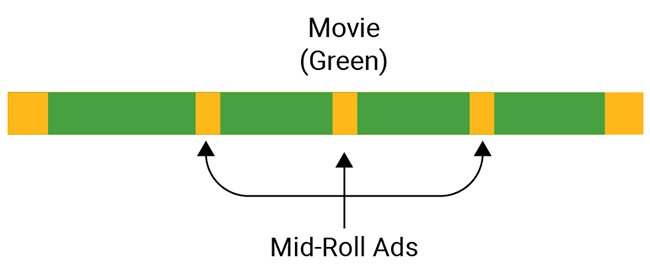
Mid-roll ads are video ads placed during longer recorded or live content. Eligibility, placement mode, and actual delivery are separate decisions. Count served breaks, not marked slots.

Mid-roll ads are a video advertising format placed during longer recorded or live content. Viewers have already started watching. A poor break interrupts that session. Platforms, publishers, and creators control eligibility, placement, length, and whether an available slot actually serves an ad.
Compare mid-rolls with bumper ads when you need a short non-skippable unit, and with livestream advertising when the file is live rather than uploaded.
YouTube eligibility is still eight minutes
YouTube’s Manage mid-roll ad breaks article, reviewed September 19, 2026, still says: on monetized videos that are 8 minutes or longer, you can turn on ads during the middle of the video. You can manage mid-rolls on a video regardless of the channel-level upload default. Eligible live streams have their own mid-roll settings.
That eight-minute rule is a creator eligibility rule for uploaded videos. It is not an advertiser promise that every eight-minute video will play a mid-roll, and it is not a TikTok rule.
Automatic versus manual slots
YouTube Studio currently offers three ways to place mid-roll ads on eligible uploads:
| Placement mode | What you tell YouTube | What YouTube still decides |
|---|---|---|
| Manual ad slots | Exact times you would allow an ad | Whether an ad serves, based on slot quality, demand, and viewer experience |
| Automated ad slots | Permission to find breakpoints | Where those breakpoints are |
| Manual and automatic | Your marks plus automatic extras | Which of those options to use |
YouTube says ad slots placed at natural breakpoints, such as a pause in audio or a visual transition, are more likely to serve ads because retention is usually higher there. Slots mid-sentence or mid-action are less likely to serve. Studio can mark unlikely slots in red so you can move them.
A mid-roll slot does not guarantee that a mid-roll ad will run. YouTube states that systems weigh slot quality, advertiser demand, and viewer experience. If automatic systems find no slots, YouTube suggests adding manual ones and leaving automatic on.
Live mid-rolls are a different control set. YouTube’s live monetization page allows automatic (recommended), scheduled (every 6, 12, 18, 24, or 30 minutes), or manual insertion. Not every viewer gets a mid-roll. Automatic mode can serve different viewers at different times.
Uploaded video versus live video
| File | Eligibility | Placement | After the session |
|---|---|---|---|
| Uploaded VOD | Monetized and at least 8 minutes | Manual, automatic, or both | The same marks stay on the file until you edit them |
| Live stream | Monetized live, if mid-rolls are enabled | Automatic, scheduled, or manual in the live room | Replay is a later file with its own reporting |
Do not copy a live cue sheet onto a VOD and assume the same ads served. Report live and replay separately, as the livestream article describes.
What TikTok currently documents
TikTok’s official help describes In-Feed auction ads (Spark and Non-Spark) and TopView as a video that shows when someone opens TikTok. Those are feed and open-screen placements. This review did not find current official TikTok documentation for a YouTube-style mid-roll inserted into another long video. Do not imply that TikTok has a comparable mid-roll format.
Google’s advertiser video format table still lists skippable in-stream, non-skippable in-stream, and bumper units that can play before, during, or after other videos on YouTube and eligible Google video partners. That is the buy-side mid-roll path on Google, not a TikTok product.
Revenue, retention, and metrics per break
More slots can raise earning opportunities and can also raise drop-off. YouTube’s own help uses meditation videos as an example of content that may be a poor fit for mid-rolls.
Measure each break opportunity with three numbers, not one:
- Marked slots on the timeline.
- Served ads actually shown, by break when the report allows it.
- Retention around the break, plus any post-exposure clicks or conversions you already track.
Front-load brand and offer in the first seconds of the creative. Control frequency across a long session so the same viewer is not hit at every remaining slot. Compare completion and response after exposure. Do not treat the count of yellow marks on a timeline as delivery.
Our view at Anderson Collaborative: A mid-roll slot is permission, not a guarantee of delivery. Plan creative and measurement around served impressions.
Paid media is the related service when mid-roll findings need coordinated campaign execution.
Frequently Asked Questions
What is a mid-roll ad?
A mid-roll ad is a video ad placed during longer recorded or live content, after the video has already started. It is not a pre-roll, bumper, or in-feed unit.
Does YouTube still require 8 minutes for mid-rolls?
Yes. YouTube Help current as of this review permits mid-rolls on monetized videos that are 8 minutes or longer. Eligible live streams have a separate mid-roll control path in Studio.
What is the difference between automatic and manual mid-roll slots?
Automatic slots let YouTube look for natural breakpoints. Manual slots are times you mark. You can combine both. A slot is permission to serve an ad, not a guarantee that an ad will play.
Does TikTok have a comparable mid-roll format?
TikTok’s current official help documents In-Feed ads, including Spark and Non-Spark, and TopView as an opening placement. It does not document a YouTube-style mid-roll inserted into someone else’s long video. Do not plan TikTok as if it did.
Sources
- YouTube Help, Manage mid-roll ad breaks in long videos, accessed September 19, 2026.
- YouTube Help, Monetize your live stream, accessed September 19, 2026.
- Google Ads Help, About video ad formats, accessed September 19, 2026.
- TikTok Ads, Auction In-Feed Ads, accessed September 19, 2026.
- TikTok Ads, About TopView, accessed September 19, 2026.
PUT THIS KNOWLEDGE TO WORK
NEED MORE HELP?
Talk with our team about applying Mid-Roll Ads to your marketing.
Get a free marketing audit call