

Broad Match: Eligibility, Controls, and Review
Broad match is Google Ads' default keyword match type. It can show ads on related searches, including some that do not contain the keyword's direct meaning. Keep expansion usable with conversion goals, Smart Bidding, negatives, and search-term review.
Broad match is the Google Ads keyword match type that can show ads on searches related to your keyword, including searches that do not contain the keyword’s direct meaning. It is the default. It is also the widest of the three match types. It is not a synonym list, and it is not exact match with extra spelling variants.
Google’s keyword matching article, accessed September 20, 2026, says broader match types capture the queries of narrower types plus more. A broad match keyword can therefore cover the same searches as the phrase and exact versions, plus additional related searches. To choose those matches, broad match may also use the user’s recent search activity, the content of landing pages and assets, and other keywords in the ad group.
That is eligibility. It is not a promise that every related query is a good customer. Paid search still needs a conversion goal, a bid strategy that can say no, and a human reading search terms.
Match types, without mixing the rules
| Match type | Syntax | What Google documents | Typical use |
|---|---|---|---|
| Broad | keyword | Related searches, including some that lack the keyword’s direct meaning, plus the extra signals above | Scale after tracking and Smart Bidding are ready |
| Phrase | ”keyword” | Searches that include the meaning of the keyword, even if that meaning is implied or more specific | Mid-range control |
| Exact | [keyword] | Searches with the same meaning or same intent | Tight core terms |
The search terms report has a Match type column that can label a hit as exact, phrase, or broad, and can mark a close variant. That column describes how the query related to the keyword, including when a broad match keyword served on a query that happens to be an exact match. It is a reporting label. It is not the definition of broad match eligibility. Close-variant language in Google’s exact-match help (misspellings, plurals, same intent) belongs to exact and phrase. Do not paste it into broad match.
Quality Score is based on historical impressions for exact searches of the keyword, regardless of the keyword’s match type. Changing match type does not reset the score. The visible 1-to-10 score is a diagnostic and is not an auction input; auction-time ad and landing-page quality instead contribute to Ad Rank. CTR and landing-page relevance still matter, but the diagnostic score is not the live-auction calculation.
Google’s broad match guide calls Smart Bidding critical with broad match: every query is different, so the bid should reflect auction-time signals. Broad match can still operate with manual bidding, but a fixed keyword bid does not make the same query-specific conversion or value adjustment.
A separate campaign setting can force all keywords to broad match. Google documents that this setting requires conversion-based Smart Bidding, and that starting in September 2026 campaigns using that campaign-level setting are upgraded to AI Max. That is a campaign toggle, not the definition of a single broad match keyword.
Worked query table
Hypothetical keyword: emergency plumber on broad match, with Maximize Conversions and a “booked job” primary conversion. Labeled sample, not an account result.
| Search term | Why it could serve | Verdict | Action |
|---|---|---|---|
| emergency plumber near me | Same meaning as the keyword | Eligible and useful | Keep. Confirm the landing page still offers emergency dispatch. |
| 24 hour plumber | Related service intent; may not use the word emergency | Useful discovery | Keep if booked-job rate holds. Add as its own keyword if you want cleaner reporting. |
| plumber salary | Related to plumbing, not a job | Irrelevant | Negative phrase "salary" and "wage" |
| plumbing school | Related career query | Irrelevant | Negative phrase "school" "training" "apprentice" |
| emergency plumber jobs | Related but hiring intent | Irrelevant | Negative "jobs" "hiring" "career" |
| emergency electrician | Related home emergency, wrong trade | Irrelevant | Negative "electrician" "hvac" unless you sell those trades |
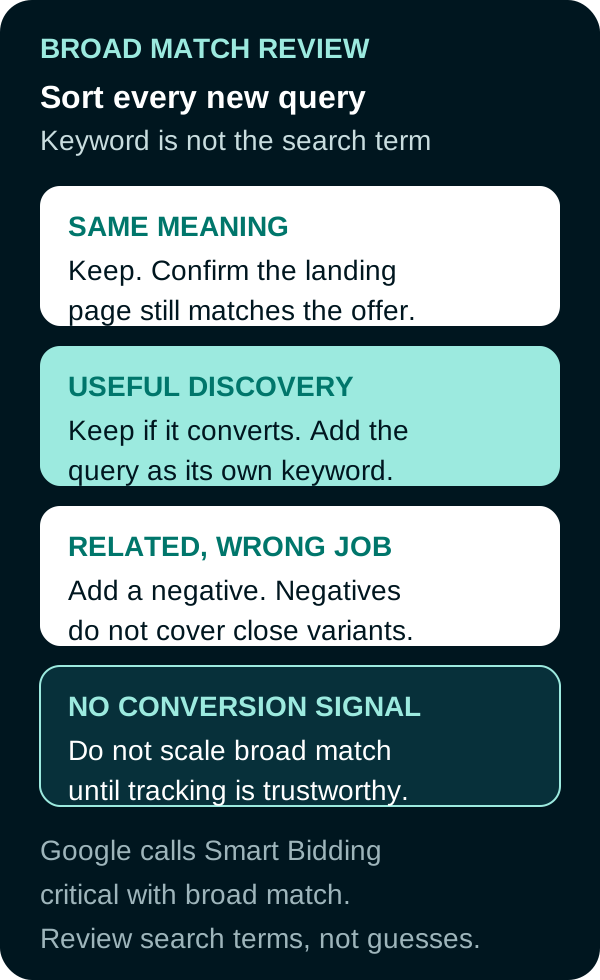
Sort new queries into keep, harvest, or negate. Do not scale coverage before the conversion action is the business event.
Controls that make expansion usable
- Conversion goals. Primary actions must be booked jobs, qualified leads, or revenue. If “click to call” is primary and dispatch never answers, broad match will buy more unanswered calls.
- Smart Bidding readiness. Use Target CPA, Target ROAS, Maximize conversions, or Maximize conversion value when the selected conversion actions and values are trustworthy. Smart Bidding changes the bid for each auction using contextual signals; it cannot repair a weak conversion definition.
- Negatives. Negative keywords do not match close variants.
flowersas negative broad will not blockflower. Add the variants you need. Negatives apply to the first 16 words of a query. From the search terms report, Google defaults new negatives to exact unless you change the syntax. - Search term review. Use the report to find irrelevant queries and new keyword ideas. Some low-volume queries are omitted or grouped for privacy, so the report is not a complete query log.
- Ad group hygiene. Google uses other keywords in the ad group as a meaning signal. Mixing “emergency plumber” with “plumbing school” in one ad group teaches the wrong intent.
- Landing pages and assets. Those are matching signals. A page about DIY drain tips can pull DIY queries. See keyword strategy for how themes should sit in separate groups.
Review weekly while the query mix is new, then whenever you change goals or landing pages. Adding a negative is the corrective action for a related-but-wrong-job query. Pausing broad match is the corrective action when tracking is broken.

Frequently Asked Questions
What is broad match in Google Ads?
Broad match is the default keyword match type. Ads may show on searches related to the keyword, including searches that do not contain the keyword’s direct meaning. Google may also use recent search activity, landing pages and assets, and other keywords in the ad group to choose matches.
Is broad match the same as exact match close variants?
No. Exact match is limited to searches with the same meaning or intent as the keyword. Phrase match requires the meaning of the keyword to be present. Broad match is wider: it can serve additional related searches beyond that meaning. Do not copy exact-match close-variant language onto broad match.
When is a campaign ready for broad match?
When conversion tracking is trustworthy, primary actions match the business outcome, a conversion-based Smart Bidding strategy is on, and someone will read the search terms report. Google calls Smart Bidding critical with broad match because each query needs its own auction-time bid.
How do you stop irrelevant broad match queries?
Add negative keywords from the search terms report. Negative match types do not cover close variants, so add plurals and synonyms you also want blocked. Defaults from the report are negative exact match unless you change the syntax. Review weekly until the new query mix is stable.
Sources
- Google Ads Help, About keyword matching options, accessed September 20, 2026.
- Google Ads Help, Your guide to broad match, accessed September 20, 2026.
- Google Ads Help, About the search terms report, accessed September 20, 2026.
- Google Ads Help, About negative keywords, accessed September 20, 2026.
- Google Ads Help, Finding success with Smart Bidding, accessed September 20, 2026.
- Google Ads Help, About the broad match keywords campaign setting, accessed September 20, 2026.
- Google Ads Help, About Quality Score for Search campaigns, accessed September 20, 2026.
PUT THIS KNOWLEDGE TO WORK
NEED MORE HELP?
Talk with our team about applying Broad Match to your marketing.
Get a free marketing audit call