

Google Ads Bid Adjustments: Eligibility and Examples
A bid adjustment is a percentage increase or decrease applied to eligible Google Ads bids. Under Manual CPC it changes the bid. Under Smart Bidding, most percentage modifiers are ignored.
A bid adjustment is a percentage increase or decrease that can change how often Google Ads shows in a context you name: device, location, schedule, audience, demographics, or call interactions. It is separate from Quality Score and Smart Bidding. In paid search and other eligible Google Ads campaigns, check both the campaign type and bid strategy before setting the percentage. Most modifiers do not apply under Smart Bidding.
Google’s current definition and the worked $1.00 / +20% example live in About bid adjustments.
Ad Rank, Quality Score, and bids
Each auction computes Ad Rank from bid, auction-time ad quality, Ad Rank thresholds, competition, the search context, and the expected impact of assets. Quality Score is a 1 to 10 diagnostic, not an auction input. Auction-time expected CTR, ad relevance, and landing page experience still matter; the stored Quality Score column is a separate report.
A bid adjustment changes the eligible bid (or, for Target CPA device modifiers, the CPA target). It does not rewrite Quality Score.
When the percentage actually applies
Google groups Smart Bidding as Target CPA, Target ROAS, Maximize conversions, and Maximize conversion value. Those strategies set bids at auction time. From June 2026, Google is also relabeling “Maximize conversions with a Target CPA” as Target CPA and “Maximize conversion value with a Target ROAS” as Target ROAS. The bidding behavior stays the same during that rename.
About bid adjustments states that a manual bid adjustment on those Smart Bidding strategies will not be supported, with the device exceptions below. Ad schedules still limit the days and hours ads can show. The percentage on Saturday, for example, is ignored. The hours still apply.
Enhanced CPC is not a current Search or Display option. Google discontinued it for those campaign types the week of March 31, 2025. Campaigns that were not moved now use Manual CPC.
Bid strategy eligibility
| Adjustment | Maximize clicks | Target impression share | Target CPA | Target ROAS | Maximize conversions | Maximize conversion value |
|---|---|---|---|---|---|---|
| Device | Yes | -100% only | Changes the CPA target, not the bid | -100% only | -100% only | -100% only |
| Location | Yes | Ignored | Ignored | Ignored | Ignored | Ignored |
| Ad scheduling % | Yes | Ignored | Ignored | Ignored | Ignored | Ignored |
| Audiences (incl. RLSA) | Yes | Ignored | Ignored | Ignored | Ignored | Ignored |
| Call interactions | Yes | Ignored | Ignored | Ignored | Ignored | Ignored |
| Demographics | Yes | Ignored | Ignored | Ignored | Ignored | Ignored |
Device -100% still opts a device out. Google’s Target CPA Help: a $10 Target CPA with +40% mobile becomes a $14 mobile CPA target. Non-device adjustments are ignored on Search and Display for that strategy.
Manual CPC uses the same percentage math as Maximize clicks where the campaign type supports the modifier.
Campaign type eligibility (manual strategies)
Google’s campaign-type table (manual bid strategies) is:
| Campaign type | Device | Location | Schedule | Targeting methods | RLSA | Call adjustments | Demographics |
|---|---|---|---|---|---|---|---|
| Search | Yes | Yes | Yes | Yes | Yes | Yes | Yes |
| Display | Yes | Yes | Yes | Yes | No | No | Yes |
| Shopping | Yes | Yes | Yes | No | Yes | No | No |
| Display video | Yes | Yes | Yes | No | Yes | No | No |
| YouTube | Yes | Yes | Yes | No | No | No | No |
| Demand Gen | No | No | No | No | No | No | No |
| Hotel | Yes | Yes | No | No | No | No | No |
| Travel | Yes | No | No | No | No | No | No |
| App, Smart, Performance Max | No | No | No | No | No | No | No |
Ranges: device -100% to +900% (campaign or ad group; ad group wins unless the campaign is -100%). Location and schedule -90% to +900%, campaign only. Combined modifiers cannot exceed +900% or fall below -90%. Two location modifiers on the same user use the most specific location only.
Google’s $1.00 examples, with rationale
Google’s mobile example: max CPC $1.00, mobile +20%, resulting mobile bid $1.20.
Google’s location-and-schedule example, labeled here as Google’s numbers:
- Starting bid: $1.00
- California +20% → $1.20
- Saturday decrease 50% (multiply by 0.50)
- California on Saturday: $1.00 × 1.20 × 0.50 = $0.60
- California Sunday through Friday: $1.20
- Other states on Saturday: $0.50
- Other states Sunday through Friday: $1.00
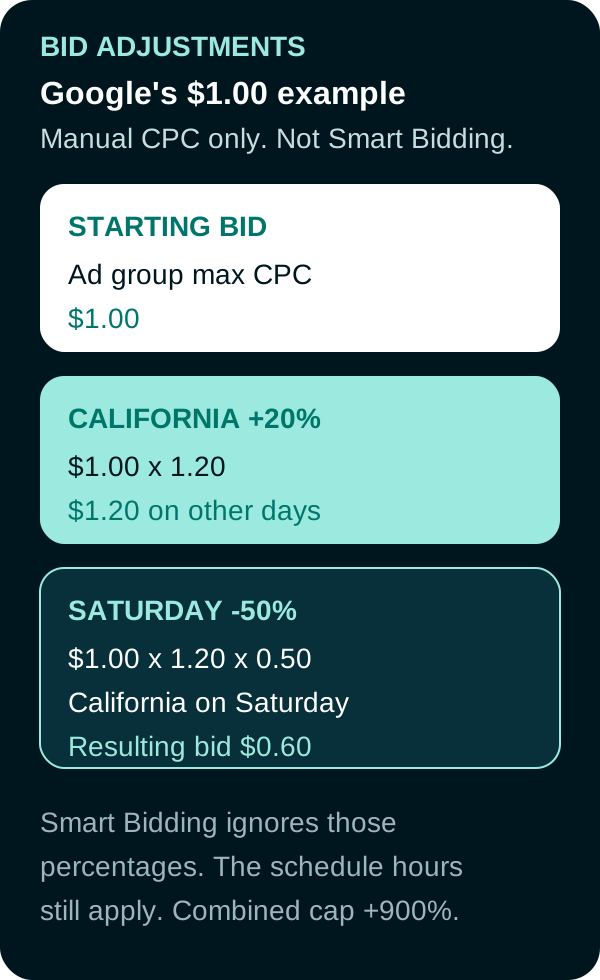
Those percentages apply only when the campaign type and strategy support them. Smart Bidding ignores the plus 20 percent and minus 50 percent, while the schedule's days and hours still control when the campaign can serve.
Rationale, owner, acceptance metric, expiry (use this for every live modifier):
| Field | Example for the California +20% |
|---|---|
| Reason | Store visits and calls concentrate in-state. Open the location report before you keep it. |
| Owner | Search lead who can change the modifier without a ticket |
| Acceptance metric | Conversion value and CPA for California vs other targeted locations, same conversion actions, same date range |
| Expiry | 30 days, or sooner if the landing page, hours, or conversion action changes |
A modifier without an expiry becomes account folklore. Recheck after the conversion path, offer, or device mix changes. Pair this with conversion tracking so the metric you accept is the action you actually record.
Negative keywords are not bid adjustments. They remove queries. Do not treat them as a substitute for a location or schedule modifier.

Bid adjustments need a documented reason and an expiration date. Set them only where the strategy will use them. Under Smart Bidding, spend that time on conversion value, targets, and exclusions instead of unused percentages.
Frequently Asked Questions
Can I apply multiple bid adjustments in a single campaign?
Yes, on eligible campaign types with a manual or Maximize clicks strategy. Different types usually multiply. Two location modifiers on the same place do not stack. The most specific location wins. Combined increases cannot exceed plus 900 percent, and combined decreases cannot go below minus 90 percent.
Does Enhanced CPC still work with bid adjustments?
Enhanced CPC is no longer available for Search and Display campaigns, effective the week of March 31, 2025. Google says campaigns that were not moved to another strategy now use Manual CPC. Use the current strategy’s eligibility table instead of an Enhanced CPC comparison.
Do bid adjustments raise ROI by themselves?
No. A plus 20 percent modifier raises the eligible bid. It does not guarantee more conversions, a lower CPA, or more profit. Under Smart Bidding, location and schedule percentages are not used. Read modifiers next to conversion volume, conversion value, and spend.
What can bid adjustments target?
On eligible campaigns you can adjust device, location, ad schedule, targeting methods, remarketing lists for Search, call interactions, and demographics. Performance Max, App, and Smart campaigns do not use these manual modifiers. Confirm the campaign type and bid strategy before you set one.
Sources
- Google Ads Help, About bid adjustments, accessed September 20, 2026.
- Google Ads Help, About Smart Bidding, accessed September 20, 2026.
- Google Ads Help, About Target CPA bidding, accessed September 20, 2026.
- Google Ads Help, Ad Rank: Definition, accessed September 20, 2026.
- Google Ads Help, About Quality Score for Search campaigns, accessed September 20, 2026.
- Google Ads Help, About Enhanced CPC (ECPC), accessed September 20, 2026.
- Google Ads Help, About automated bidding, accessed September 20, 2026.
PUT THIS KNOWLEDGE TO WORK
NEED MORE HELP?
Talk with our team about applying Bid Adjustments to your marketing.
Get a free marketing audit call