

Conversion Lift: Formulas and Test Design
Conversion lift estimates extra conversions by comparing a treatment group with a control. See formulas for CR lift, incremental conversions, iCPA, and iROAS.
Conversion lift estimates how many extra conversions advertising caused by comparing a treatment group that could see the ads with a control group that could not. The difference is incremental only when assignment is valid, the groups stay comparable, and the control remains unexposed.
It is not a last-click total and not a creative-winner table. Google Ads documents Conversion Lift as a controlled experiment. The product is not available in every account; Google says to contact a Google account representative. Review lift inside the wider reporting and analysis plan, and pair it with marketing attribution and incrementality.
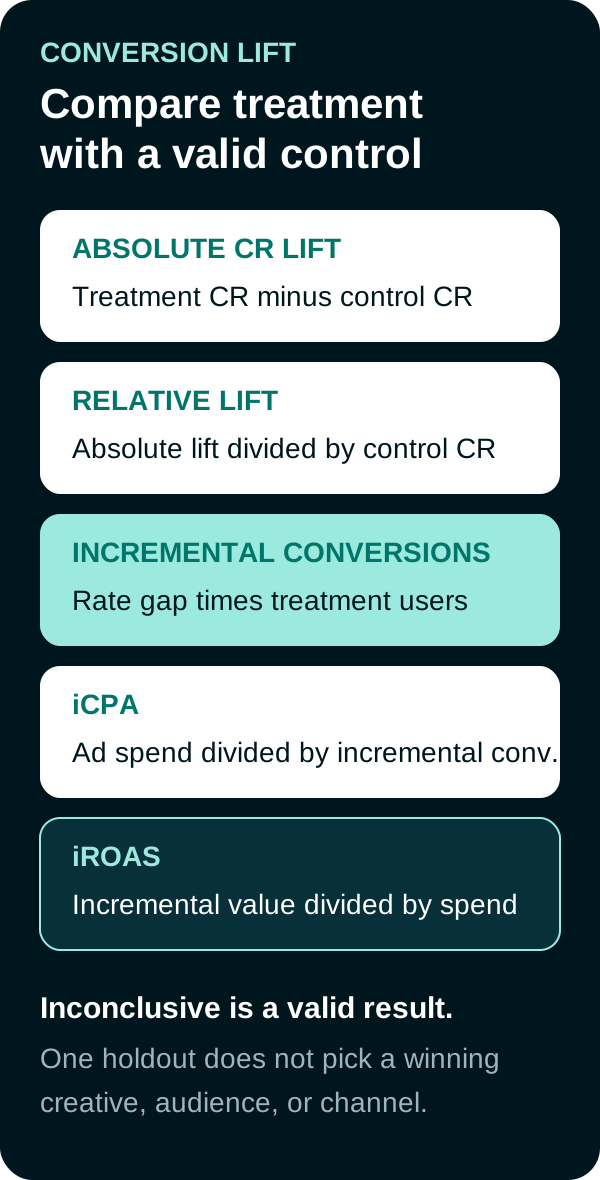
Planning diagram of the formulas. Not a Google Ads reporting screenshot.
User holdout, geo experiment, and observational estimate
These designs answer related questions with different weaknesses. Do not treat them as interchangeable.
| Design | How groups are formed | Best fit | Main limit |
|---|---|---|---|
| User holdout | Eligible people are randomized to treatment or control | Platforms with reliable identity and delivery suppression | Identity gaps and cross-device leakage |
| Geo experiment | Comparable regions show or withhold the ads | Broad media, offline conversions, or limited user matching | Travel between regions contaminates groups |
| Observational estimate | Exposed people are compared with similar unexposed people after the fact | Directional read when randomization is unavailable | Not a lift experiment. Selection bias remains |
Google Ads Conversion Lift based on users randomly assigns eligible people to a treatment group that can be served ads or a holdout that cannot. Conversion Lift based on geography splits Google Marketing Areas and uses a contamination model because someone can see an ad in a treatment region and convert in a control region. That contamination reduces the estimated difference.
An observational matched comparison is not Conversion Lift. Label it as an observational estimate.
Formulas
Use conversion rates when group sizes differ. Google’s user-based help defines incremental conversions as treatment conversions minus control conversions, which is the equal-size or already-scaled case.
- Absolute conversion-rate lift = treatment conversion rate - control conversion rate
- Relative lift = absolute conversion-rate lift / control conversion rate. Google’s user-based relative lift is also incremental conversions / control conversions, which matches the rate formula when the groups are comparable.
- Incremental conversions = (treatment CR - control CR) x treatment users. Or, when groups are equal or scaled: treatment conversions - control conversions.
- Incremental conversion value = treatment conversion value - control conversion value (on the same scaled basis)
- iCPA = total ad spend / incremental conversions
- iROAS = incremental conversion value / total ad spend
Attributed ROAS is conversion value assigned by tracking rules, divided by spend. iROAS uses only the extra value versus control. Google’s user-based Conversion Lift metrics make that split explicit.
If incremental conversions are zero, near zero, or the interval includes no lift, do not divide spend by a tiny number and publish an iCPA. Report the study as inconclusive.
Worked hypothetical example
Hypothetical user-level holdout. Illustrative numbers, not a benchmark or a Google UI export.
| Group | Eligible users | Conversions | Conversion rate | Conversion value | Ad spend |
|---|---|---|---|---|---|
| Treatment | 50,000 | 1,200 | 2.40% | $48,000 | $10,000 |
| Control | 50,000 | 1,000 | 2.00% | $40,000 | $0 |
- Absolute CR lift = 2.40% - 2.00% = 0.40 percentage points
- Relative lift = 0.40 / 2.00 = 20%
- Incremental conversions = 1,200 - 1,000 = 200
- Incremental value = $48,000 - $40,000 = $8,000
- iCPA = $10,000 / 200 = $50
- iROAS = $8,000 / $10,000 = 0.80
Those 200 extra conversions are the lift estimate for this study window, not proof that a particular ad, audience slice, or publisher caused them.
What a single treatment-control comparison cannot pick
A campaign-level holdout estimates the incremental effect of the treatment as run: the mix of creative, audience, bids, frequency, and inventory that treatment actually received.
It does not identify the best:
- Creative, unless creatives were separately randomized and powered
- Audience, unless audiences were separately randomized and powered
- Touchpoint, unless each touch was a designed factor
- Channel, unless channels were separately randomized and powered
Breaking the lift report down by age, gender, or device after the fact is segmentation of one experiment, not a set of new experiments. Google’s user-based studies can segment by aggregated attributes. That still does not make each segment a winner test.
Random assignment, eligibility, contamination, and uncertainty
Before reading any lift number, check the design.
- Eligibility. Only people or regions that could have been treated belong in the test. Google’s geo method requires compatible conversion actions and, for that methodology, campaigns that target a single country.
- Random assignment. The control must be chosen by the design, not by people who happened not to see ads.
- Contamination. Shared households, shared codes, frequency capping that still leaks, and travel between geos all move exposure into the control and shrink estimated lift. Google describes this for geo Conversion Lift.
- Minimum detectable effect. Google’s geo setup uses feasibility status and a minimum detectable iROAS: the effect size the test needs a high chance to detect. A “Low” feasibility study is a good reason not to run it as designed.
- Confidence or credible intervals. Google reports an estimated range for the lift result. If the range includes no lift, the result is inconclusive. Inconclusive is a decision input: do not scale spend as if lift were proven, and do not declare the channel worthless.
- Study window versus attributed conversions. Conversion Lift counts conversions in treatment versus control over the study. It does not use the campaign’s usual click-through window as the definition of incrementality. Google also notes delayed incremental conversions for some Demand Gen user studies; those are modeled estimates after the official end date.
Lift is not guaranteed. Google’s geo article says so directly. Use a test-and-learn loop instead of a one-shot verdict.

Practical check
Write the spend or strategy change for positive lift, no lift, and an inconclusive interval before the study starts. Do not claim incrementality from exposed conversions without a valid control.
FAQs
What is conversion lift?
Conversion lift estimates extra conversions caused by ads by comparing a treatment group that can see the ads with a control group that cannot. The gap is incremental only when assignment is valid and the control stays unexposed.
How does conversion lift differ from attribution?
Attribution assigns credit inside observed paths using a rule or model. Conversion lift ignores those rules and compares all conversions in treatment versus control over the study window.
How do you calculate conversion lift?
Absolute conversion-rate lift is treatment CR minus control CR. Relative lift is that gap divided by control CR. Incremental conversions are the rate gap times treatment users, or treatment conversions minus scaled control conversions when groups are comparable.
When should you run a conversion lift study?
Run a lift study when the decision needs extra conversions versus a control, the audience is large enough for the minimum detectable effect, and you can protect the holdout. An inconclusive interval is a valid result.
Sources
- Google Ads Help, About Conversion Lift, accessed September 19, 2026.
- Google Ads Help, Set up Conversion Lift based on geography, accessed September 19, 2026.
- Google Ads Help, Understand your Conversion Lift based on users measurement data, accessed September 19, 2026.
PUT THIS KNOWLEDGE TO WORK
NEED MORE HELP?
Talk with our team about applying Conversion Lift to your marketing.
Get a free marketing audit call