

Algorithmic Attribution: How Data-Driven Credit Works
Algorithmic attribution uses a statistical or machine-learning model to split conversion credit across recorded touchpoints. Define the eligible paths and windows before using those shares for a budget decision.
Algorithmic attribution assigns fractional conversion credit using a model trained on recorded paths, including converting and non-converting journeys. Google’s product name is usually data-driven attribution. The output is a set of shares across eligible touchpoints for the conversions the system recorded. It is useful for reporting and optimization inside that measured path; lift is measured with a separate control design.
Keep the three layers used on ad attribution modeling and marketing attribution: observed journeys, assigned credit, and incrementality. Reporting and analysis is where you decide which layer the budget question actually needs. For the causal layer, use conversion lift or another valid incrementality design.
What the model actually does
Google Ads’ data-driven attribution article describes the mechanics for website, store-visit, and Google Analytics conversions from Search (including Shopping), YouTube, Display, and Demand Gen. The model compares paths that convert with paths that do not, then gives more credit to interactions associated with a higher conversion probability. Each advertiser’s model is specific to that account. Google notes that last click and data-driven results can look the same when path data is thin.
GA4 attribution uses converting and non-converting path data, a counterfactual comparison inside the algorithm, and features such as time from the key event, device, number of interactions, order of exposure, and creative type. Conversions can be reattributed for up to seven days. Direct usually receives no credit unless the path is only direct. These mechanics allocate recorded credit; Google Ads Conversion Lift instead compares treatment and control groups to estimate incremental conversions.
| Stage | What to specify | Why it changes the weights |
|---|---|---|
| Inputs | Conversion actions, values, identity keys, consented events | Duplicate, missing, or misnamed events distort the learned shares |
| Lookback / conversion window | How far before the conversion an interaction may receive credit | Google Ads Attribution reports offer 30, 60, or 90 day lookbacks, separate from the conversion window that decides whether the conversion is recorded at all (attribution reports, conversion windows) |
| Path eligibility | Clicks, engaged views, which channels, cross-device rules | Unrecorded email or sales calls cannot receive credit |
| Training | Converting versus non-converting paths; volume | Google Ads recommends 200 conversions and 2,000 ad interactions in 30 days for more precise DDA; the model still runs below that |
| Outputs | Fractional credit by campaign, keyword, or channel | Shares sum to attributed conversions, not to incremental conversions |
| Validation | Stability over time, comparison with a rule, holdout when the question is lift | Shows whether weights are stable and whether a budget change produces extra outcomes |
Rule-based models remain useful as alternatives and checks. Linear, first click, time-decay, and position-based are valid warehouse rules. They are not current GA4 Attribution-report options after November 2023. Last click is still available in GA4 as paid-and-organic last click and Google paid channels last click.

Model-readiness checklist
Complete these checks before using the model for a material budget decision.
- One conversion definition. Lead, qualified lead, and purchase are different events. Mixing them trains a blend you cannot interpret.
- Identity that matches the question. Click-based paths will under-credit view-through channels. Cross-device gaps look like “email closed it.”
- Windows written down. Conversion window (is the sale counted?) versus lookback (which earlier ads may share credit?).
- Eligible path types listed. Excluding Display view-through interactions will also exclude their credit from the model.
- Volume in the ballpark of Google’s 200 / 2,000 in 30 days recommendation, or an explicit decision to accept noisier weights.
- A rule-based companion report (usually last click) so a swing in DDA can be explained.
- A holdout plan for any budget shift large enough that being wrong is expensive.
Worked path: credit shares versus lift
Hypothetical recorded path for one $200 purchase. The data-driven percents are illustrative labels, not a Google Ads export.
- Paid Search click, day 0
- Display engaged view, day 4
- Email click, day 9
- Direct session, day 10, purchase
| Model | Where credit goes | Question it answers |
|---|---|---|
| Last click (paid and organic) | Email 100% | Who was the last recorded click? |
| Linear (warehouse) | Search, Display, Email about 33% each | Who appeared on the stored path? |
| Algorithmic / DDA (illustrative) | Search 40%, Display 15%, Email 45% | How did this model split the $200? |
| Direct | None, unless the path is only direct | Not an eligible closer in GA4’s usual rule |
Now a separate hypothetical holdout for the Search campaign that produced step 1. Equal groups, one study window:
| Group | Eligible people | Conversions |
|---|---|---|
| Treatment (could see Search ads) | 10,000 | 120 |
| Control (could not) | 10,000 | 100 |
Incremental conversions = 120 - 100 = 20. Relative lift = 20 / 100 = 20%.
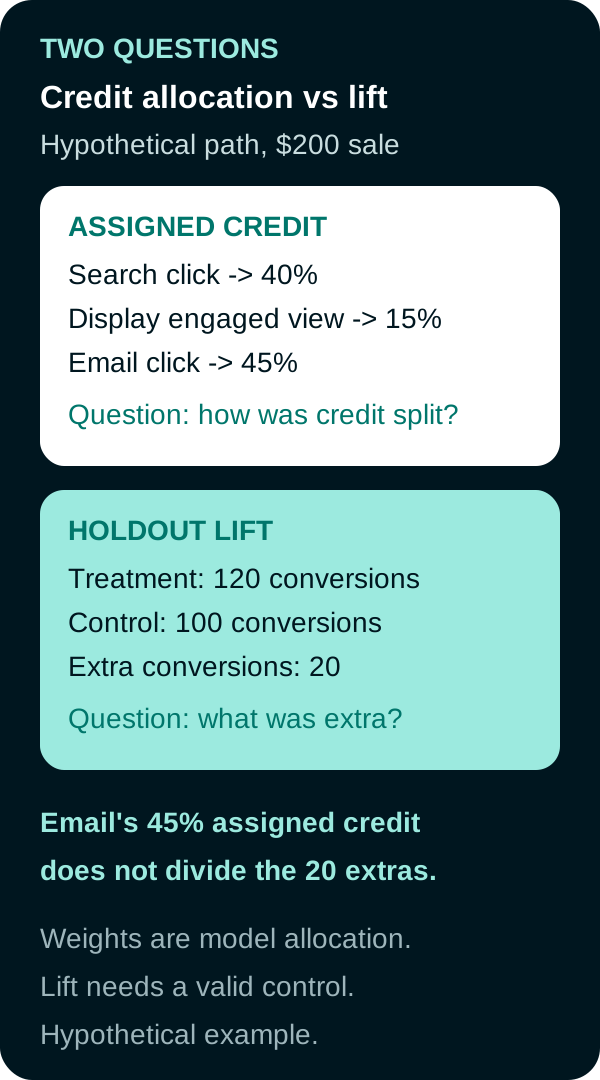
Illustrative numbers. Email's 45% credit share is not 45% of the 20 extra conversions.
Email’s 45% represents $90 of assigned value on this recorded path. It does not divide the 20 incremental conversions from the separate Search holdout. The holdout estimates extra conversions from the Search treatment as run; the model splits one stored conversion among eligible interactions. Both are useful for their respective questions.
Frequently Asked Questions
What is algorithmic attribution?
Algorithmic attribution, often called data-driven attribution in Google products, assigns fractional conversion credit using converting and non-converting path data. It reports how the model allocated the event. It does not prove the touchpoint caused the conversion.
How is it different from rule-based attribution?
Rule-based models apply a fixed split such as last click, first click, or linear. Algorithmic models allocate credit from patterns in observed paths. Google Analytics 4 currently offers data-driven attribution plus two last-click models. First click, linear, time-decay, and position-based were removed from GA4 Attribution reports in November 2023.
How is attribution different from incrementality?
Attribution allocates recorded conversions among eligible touchpoints inside a lookback window. Incrementality estimates extra conversions versus a control that could not see the ads. A high credit share can sit next to zero lift, and the reverse can also be true.
When is an algorithmic model ready to use?
The conversion definition, identity rules, lookback window, and eligible path types must be documented. Google Ads recommends at least 200 conversions and 2,000 ad interactions in 30 days for more stable data-driven results, while still allowing the model at lower volume. Validate with a holdout when the decision is extra conversions.
Sources
PUT THIS KNOWLEDGE TO WORK
NEED MORE HELP?
Talk with our team about applying Algorithmic Attribution to your marketing.
Get a free marketing audit call