

Churn Rate: Formula, Denominator, and Revenue Variants
Churn rate is the share of customers or recurring revenue lost during a named period, divided by the starting balance for that period. Logo churn, gross revenue churn, and net revenue churn answer different questions.
What is churn rate?
Churn rate is the percentage of customers or recurring revenue lost during a named period, divided by the balance at the start of that period. A monthly customer-churn rate and a monthly net-revenue-churn rate can move in opposite directions. Always label the object (customers or revenue), the period, and the denominator.
Use churn in the next reporting and analysis review only after you write down which loss type the decision needs.
Lower churn does not by itself prove product-market fit, better onboarding, or healthier unit economics. Payment failures, contraction, mix shifts, and seasonal cohorts can move the same percentage.
Customer churn formula and example
Stripe describes customer churn as canceled subscriptions in a period divided by subscriptions at the beginning of the period, then multiplied by 100. Keep that starting balance. Do not silently switch to an average of start and end counts unless you label the change.
Customer churn rate = (customers lost during the period / customers at period start) × 100
Worked example for one calendar month:
| Input | Value |
|---|---|
| Customers at month start | 200 |
| Customers lost during the month | 8 |
| Customer churn | 8 / 200 × 100 = 4% |
Those 8 losses should exclude customers acquired and lost in the same month unless your definition says otherwise. If you include intra-period new logos in the denominator or numerator, say so.
Logo churn is the same idea at the account level: how many paying customers ended. It does not measure how much revenue those accounts represented.
Logo, revenue, and net revenue churn
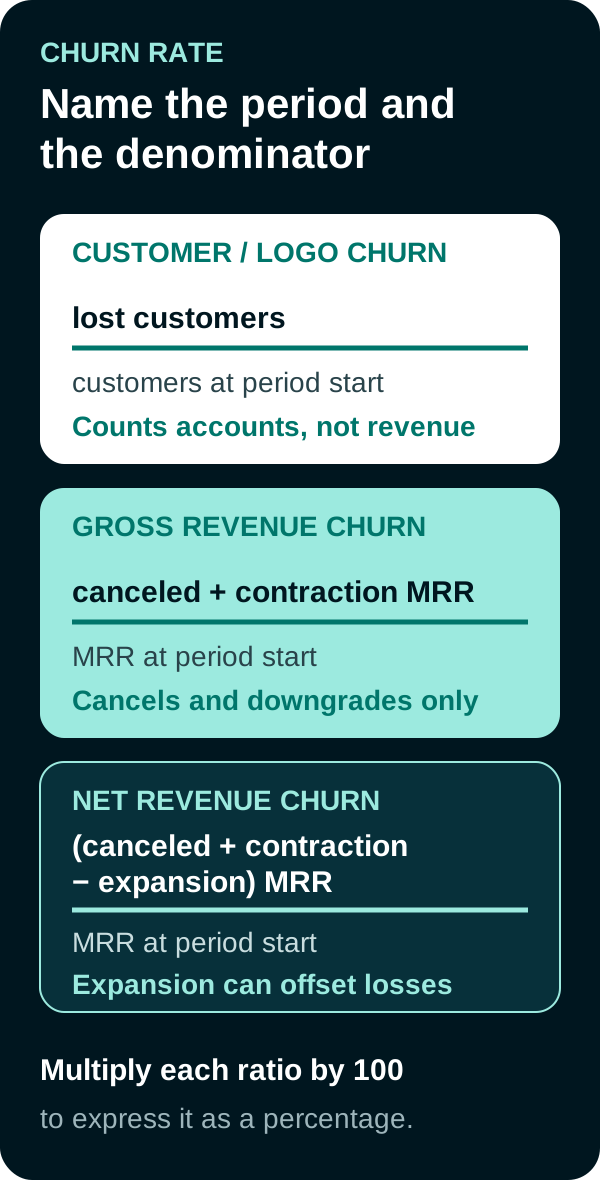
Stripe separates customer behavior from revenue impact.
- Gross revenue churn counts recurring revenue lost from cancellations and downgrades. Stripe’s teaching formula is churned MRR divided by MRR at the end of the previous month (the start of the current period), times 100.
- Net revenue churn subtracts expansion MRR, such as upgrades and added seats, before dividing by the same starting MRR. Expansion can make net revenue churn lower than gross, or negative.
- Contraction is revenue lost from customers who remain. It raises gross revenue churn without raising logo churn.
- Voluntary churn is a customer choosing to cancel.
- Involuntary churn is a cancellation from failed payment, expired cards, or similar billing failure.
Stripe’s published revenue example: $100,000 starting MRR, $5,000 lost to cancellations and downgrades, and $2,000 expansion.
- Gross revenue churn = $5,000 / $100,000 × 100 = 5%
- Net revenue churn = ($5,000 - $2,000) / $100,000 × 100 = 3%
If expansion had been $7,000, net revenue churn would be −2%. Negative net revenue churn means remaining customers added more revenue than the business lost. It does not mean nobody left.
Why the distinctions change the next action
| Type | What changed | Typical investigation |
|---|---|---|
| Voluntary churn | The customer chose to leave | Product value, service, price, or fit |
| Involuntary churn | Service ended without an active cancellation | Payment failures and account issues |
| Revenue contraction | An account remains but spends less | Downgrades, seat loss, or reduced usage |
| Logo churn with low revenue churn | Small accounts left | Whether the lost logos were ever target customers |
| Revenue churn with low logo churn | Contraction among retained accounts, a small number of high-value accounts leaving, or both | Which accounts left, and whether retained accounts contracted |
Use behavioral analytics to see which actions precede each of those outcomes. A win-back campaign does not fix an expired card, and a dunning flow does not fix a product that customers no longer need.
How to use churn without false conclusions
- Write the decision before choosing a metric: save logos, protect MRR, or reduce failed payments.
- Keep one period length in a comparison. A 4% monthly rate is not interchangeable with a 4% annual rate.
- Do not treat a single industry median as a goal. Products, contract length, and customer mix differ.
- Relate churn to lifetime value with the same cohort and customer definition, and state the churn period and the elapsed LTV horizon.

What does current evidence show?
Recurly reported a 4% median churn rate across industries in its 2024 subscription study. That figure is a dated median from Recurly’s dataset, not a universal target and not proof of product-market fit.
Source: Recurly State of Subscriptions, 2024.
Stripe’s current teaching pages for customer churn and revenue churn are the primary formula references used above.
What practical check should teams use?
Our view: Churn analysis should separate voluntary cancellations from payment failures, and logo loss from revenue contraction. Those rows may share a dashboard, but they need different owners and different next actions.
- Write down the decision churn rate should inform before choosing a metric.
- Separate voluntary cancellations from payment failures before planning an intervention.
- Report customer churn and net revenue churn side by side when accounts can downgrade or expand.
Frequently Asked Questions
What is churn rate?
Churn rate is the percentage of customers or recurring revenue lost during a named period, divided by the starting customer count or starting recurring revenue for that period.
How do you calculate churn rate?
For customer churn, divide customers lost during the period by customers at the start, then multiply by 100. For gross revenue churn, divide cancellations and downgrades by starting recurring revenue. For net revenue churn, subtract expansion revenue first.
What is a good churn rate?
There is no universal good churn rate. Compare your own trend over matching periods, and treat any external median as a dated dataset rather than a target for every product.
How does churn relate to customer lifetime value?
Higher churn shortens the observed relationship and usually lowers lifetime value when both use the same cohort and customer definition. State the churn period and the elapsed LTV horizon. Retention work can support LTV only after you know whether the losses are voluntary, involuntary, or contraction.
Sources
PUT THIS KNOWLEDGE TO WORK
NEED MORE HELP?
Talk with our team about applying Churn Rate to your marketing.
Get a free marketing audit call