

Google Brand Lift: Surveys, Search, and Conversion
Google Brand Lift compares survey responses from people exposed to eligible YouTube ads with responses from a withheld group. Read lift together with reach and cost.

Google Brand Lift is a survey experiment. Google shows Brand Lift questions on YouTube, then compares responses from people who saw eligible ads with responses from people who were eligible but withheld. The gap estimates change in recall, awareness, association, consideration, favorability, or purchase intent. Search Lift and Conversion Lift answer different questions.
Pair Brand Lift with conversion lift when the decision is extra conversions, and with incrementality when you need the wider test-design context. Gross rating point (GRP) is a planning unit for delivery, not a substitute for a holdout. Reporting and analysis is where the study should change a budget or creative choice.
Study map: Brand Lift, Search Lift, Conversion Lift
Google’s lift-studies overview splits the products this way. None of them is available in every account. Google says to contact a Google account representative.
| Product | What is compared | Typical decision it can support | What it cannot stand in for |
|---|---|---|---|
| Brand Lift | Survey answers: exposed versus withheld | Whether video or eligible Demand Gen on YouTube moved a brand question | Sales, site conversions, or Gmail and Discover Demand Gen |
| Search Lift | Organic searches for selected terms on Google Search and YouTube | Whether ads raised search for those terms | Survey perception or conversions |
| Conversion Lift | Conversions in treatment versus a user or geography holdout | Extra purchases, leads, visits, or value versus control | A brand-survey score |
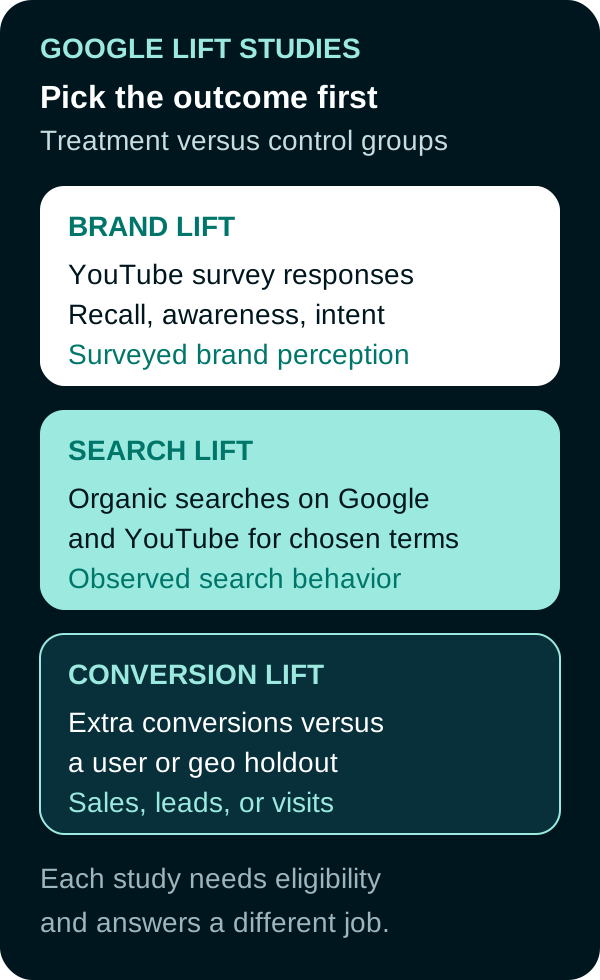
Pick the outcome first: surveys for Brand Lift, searches for Search Lift, and incremental actions for Conversion Lift.
For Demand Gen, Google’s Brand Lift setup says to prioritize video ads on YouTube. Measurement does not capture other Demand Gen channels such as Gmail or Discover.
Absolute lift, relative lift, and cost per lifted user
Google’s lift metrics definitions, accessed September 20, 2026:
- Absolute Brand Lift = exposed positive-response rate minus baseline positive-response rate (percentage points). Google’s example: 20% baseline to 40% exposed is 20 percentage points.
- Relative Brand Lift = absolute lift / baseline rate. The same 20% to 40% example is 100% relative lift.
- Headroom Brand Lift = absolute lift / (1 minus baseline rate). The same example is 0.20 / 0.80 = 25%.
- Lifted users = the survey gap extended to campaign reach. Google notes the metric does not necessarily measure unique users, and re-engaging lifted users is not supported.
- Cost per lifted user = campaign cost / lifted users.
Google recommends reading cost per lifted user alongside absolute lift because reach and media cost change the business meaning. In Google’s published comparison, two campaigns spend $100. Campaign 1 shows 10% absolute lift and a $0.15 cost per lifted user. Campaign 2 shows 5% absolute lift and a $0.10 cost per lifted user, so Campaign 2 reaches more estimated lifted users per dollar in that example.
Survey answers are a sample. Google’s metrics article describes an 80% two-sided confidence interval and says this corresponds to a 90% chance that lift is above the lower bound. Read the point estimate with both bounds. “No lift detected” means enough responses were collected without a statistically significant positive difference; “not enough data” means the response threshold was not met for the selected range.
Eligibility, responses, and change control
Write the business decision first: keep the creative, change the audience, or move budget. Then match the survey metric to that decision. Keep brand and competitor labels unambiguous. Google lets you select up to three survey metrics. Viewers receive at most one survey a day and three in a week, and one response per product or brand in 14 days. If you measure several metrics, a viewer sees one of those questions at random.
Budget and study strength (from Google’s setup article):
| Setting | What Google documents |
|---|---|
| Spend window | Minimum budget across 10 days at the product or brand level |
| Country buckets | Example: 1 question in Country B (including the United States) needs $10,000 USD; 3 questions need $20,000 to $60,000 depending on country group |
| Standard Lift | Completes in about 3 to 14 days at the standard minimum |
| Enhanced Lift | About 9 to 14 days, 3 times the standard budget, aimed at more survey responses |
| Response volume | Detectable lift often needs thousands of responses per metric; smaller absolute lifts need more |
Enhanced Lift collects more survey responses, improving the chance of detecting a smaller difference. The measured response gap can still be positive, inconclusive, or zero.
Avoid major creative, targeting, or budget cuts while the study is collecting. Google recommends re-measurement after a major creative or media change, not as constant checking. Studies that retarget people who already saw the creative can fail to build a control group.
What a result can support
| Result | Decision it can support | Decision it should not carry alone |
|---|---|---|
| Significant lift on the chosen survey metric | Keep or scale the YouTube treatment as run | That sales moved |
| No lift detected with enough responses | Change creative, audience, or stop that argument | That the ads had no business effect of any kind |
| Not enough data | Fix spend, reach, language match, or study setup | A claim that the metric is zero |

Frequently Asked Questions
What is Google Brand Lift?
Google Brand Lift is a survey-based measurement product. It compares YouTube survey answers from people exposed to eligible ads with answers from a withheld group, then estimates change in recall, awareness, association, consideration, favorability, or purchase intent.
How is Brand Lift different from Search Lift and Conversion Lift?
Brand Lift measures perception with surveys. Search Lift measures organic searches for selected terms on Google Search and YouTube. Conversion Lift estimates extra conversions versus a user or geography holdout. They are separate Google lift products, not three views of one report.
What do absolute lift, relative lift, and cost per lifted user mean?
Absolute Brand Lift is exposed positive-response rate minus baseline rate, in percentage points. Relative Brand Lift divides that gap by the baseline rate. Cost per lifted user is campaign cost divided by estimated lifted users. Google treats cost per lifted user as the more complete success metric because it includes reach and cost.
What can a Brand Lift result support?
A completed study with enough responses can support creative, audience, or budget arguments about the survey metric you chose. It cannot replace Conversion Lift for sales, and it cannot measure Demand Gen inventory outside YouTube. Inconclusive and no-lift results are valid outcomes.
Sources
- Google Ads Help, About lift studies, accessed September 20, 2026.
- Google Ads Help, About Brand Lift, accessed September 20, 2026.
- Google Ads Help, Set up Brand Lift, accessed September 20, 2026.
- Google Ads Help, Understand Lift measurement statuses and metrics, accessed September 20, 2026.
- Google Ads Help, About Search Lift, accessed September 20, 2026.
- Google Ads Help, About Conversion Lift, accessed September 20, 2026.
PUT THIS KNOWLEDGE TO WORK
NEED MORE HELP?
Talk with our team about applying Google Brand Lift to your marketing.
Get a free marketing audit call