

Marketing Attribution: Journeys, Assigned Credit, and Incrementality
Marketing attribution assigns credit for a conversion to recorded touchpoints using a rule or algorithm. Assigned credit is not the same as an observed journey, and neither one is a causal incrementality result.
What is marketing attribution?
Marketing attribution assigns conversion credit to recorded ads, clicks, and other touchpoints using a rule or algorithm. It answers how a report allocated an outcome. It does not show what actually caused the outcome, and it cannot see touchpoints the system never stored.
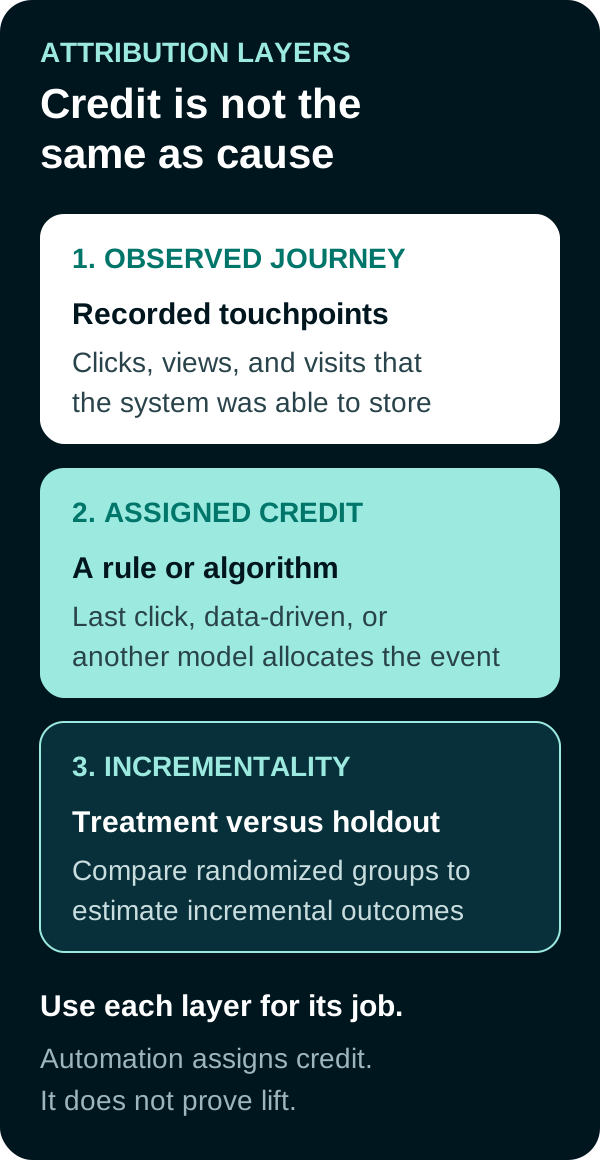
Keep three layers separate:
- Observed journeys: the clicks, views, and visits that were recorded.
- Assigned credit: the model that allocates the conversion among those records.
- Incrementality: an estimate of what would have happened without the tactic, usually from a holdout, geo test, or similar design.
Why assigned credit is still useful
In a path that includes search, email, and paid social, attribution can show which recorded step received credit under the selected model. That helps teams:
- Reconcile platform reports that each claim last-click credit for the same sale.
- See whether credit is concentrating in branded search, email, or another closing step.
- Document one model for routine reporting.
It does not replace a test when the question is “what extra conversions did this campaign create?” Align the reporting model with attribution windows and lookback windows on each platform.
Attribution models currently available in Google Analytics 4
Google’s Attribution reports in GA4 currently include three models:
| GA4 model | Credit logic | Direct traffic |
|---|---|---|
| Data-driven | Distributes credit using converting and non-converting path data | Direct is excluded unless the path is only direct |
| Paid and organic last click | 100% to the last non-direct click or eligible YouTube engaged view | Direct is skipped unless the path is only direct |
| Google paid channels last click | 100% to the last eligible Google paid interaction, including an eligible YouTube engaged view; otherwise falls back to paid and organic last click | Same direct rule |
Google removed first click, linear, time-decay, and position-based models from Analytics in November 2023. Do not configure GA4 as if those models are still in the product.
Google describes data-driven attribution as using account data, including converting and non-converting paths, to estimate how touchpoints change conversion probability. That is still an assignment model. It is not a substitute for a designed incrementality test, even though Google documents a counterfactual method inside the algorithm.
Rule-based models you can still teach or implement outside GA4
These models remain valid as concepts, and some ad platforms or warehouses still implement them. They are not current GA4 Attribution-report options.
| Model | Credit logic | Typical use | Limit |
|---|---|---|---|
| First-touch | All credit to the first recorded interaction | Demand-gen sourcing questions | Ignores later steps |
| Last-touch | All credit to the final recorded click | Short, simple paths | Over-credits the closer |
| Linear | Equal credit across recorded touchpoints | Full-path visibility | Treats minor touches equally |
| Time-decay | More weight to recent recorded steps | Long consideration | Needs complete journey data |
| Position-based (U-shaped) | Most credit to first and last recorded steps | Balanced reporting | Still a rule, not a cause |
First-click attribution remains a useful sourcing view when you implement it outside GA4, not as a current Analytics model.
Example of assigned credit, not proven cause
A retail path is: paid search click, then email click, then a retargeting click that precedes the purchase. Under paid and organic last click, the retargeting click receives 100% of the conversion. Under a linear model implemented in your own warehouse, each of the three recorded clicks would receive one third. Neither result proves the customer would have skipped the purchase without that channel. A holdout or geo test is the incrementality layer.
Limits of journey tracking
- Missing identifiers, cross-device gaps, and walled gardens leave incomplete journeys.
- Choosing a model changes the report. It does not make the underlying observations complete.
- Automation and CRM connectors apply their own rules. They do not guarantee accurate causal credit.

Practices that keep attribution honest
- Document one reporting model and the window it uses.
- Compare that view with incrementality or blended results when the decision is budget.
- Separate new-customer and existing-customer paths when the business cares about acquisition versus retention.
- Centralize results in reporting and analysis so paid, owned, and earned channels share one documented rule.
Popular marketing attribution tools
Tools record events and assign credit under their settings. They do not make that credit causal.
- Google Analytics: Current Attribution reports offer data-driven, paid and organic last click, and Google paid channels last click. Google Analytics attribution
- Amazon Attribution: Provides reporting for Amazon and selected off-Amazon media.
- Salesforce Marketing Cloud: Manages and tracks customer interactions across channels.
- HubSpot: Combines CRM and marketing automation with its own attribution reports.
- Adobe Analytics: Offers attribution features for analyzing recorded cross-channel paths.
What does current evidence show about marketing attribution?
Google’s current product documentation is the primary evidence for Analytics models: three available models, and the November 2023 removal of first click, linear, time-decay, and position-based. Source: Get started with attribution.
What has AC learned from marketing attribution?
Our view: Attribution is a decision model built from incomplete observations. We use one documented model for routine reporting, compare it with experiments or blended results, and avoid presenting platform credit as proven causality.
Frequently Asked Questions
What is marketing attribution?
Marketing attribution is the practice of assigning credit to recorded touchpoints on the path to a conversion. It reports how a chosen model allocated the event. It does not by itself prove which touchpoints caused the outcome.
What is an example of attribution in marketing?
A shopper might click a Google search ad, return through email, and convert after a retargeted social ad. An attribution model decides how much credit each recorded step receives when reporting the sale.
What is the difference between single-touch and multi-touch attribution?
Single-touch models credit one recorded touchpoint, usually the first or last interaction. Multi-touch models spread credit across several recorded steps. In Google Analytics 4, first click, linear, time-decay, and position-based models were removed in November 2023.
How does marketing attribution help with ROI?
Attribution is a reporting model for allocated conversions and value. Use it to see where credit landed, then confirm budget changes with incrementality tests or other causal designs when the decision needs cause, not only assigned credit.
Video by Flux Academy, published April 8, 2019. This is a third-party explainer, not official product documentation or proof of campaign outcomes.
Sources
PUT THIS KNOWLEDGE TO WORK
NEED MORE HELP?
Talk with our team about applying Marketing Attribution to your marketing.
Get a free marketing audit call