

Location-Based Marketing: Signals and Activation
Location-based marketing uses a person or device location signal to shape targeting, messaging, or measurement. Proximity is not intent. Choose the least precise signal that still solves the job.

Location-based marketing is a method that uses a person or device location signal to shape targeting, messaging, or measurement. Methods include regional targeting, geofencing, beacons, and local search. A valid use needs clear relevance, appropriate consent, and enough accuracy for the decision being made. This page is the broader signal and activation guide. The hyperlocal advertising page is the small-trade-area operations application of the same map. Geofencing covers fence design in more detail.
This page is educational measurement and media guidance. It is not legal advice. Consent, retention, and location rules vary by country, state, and sector.
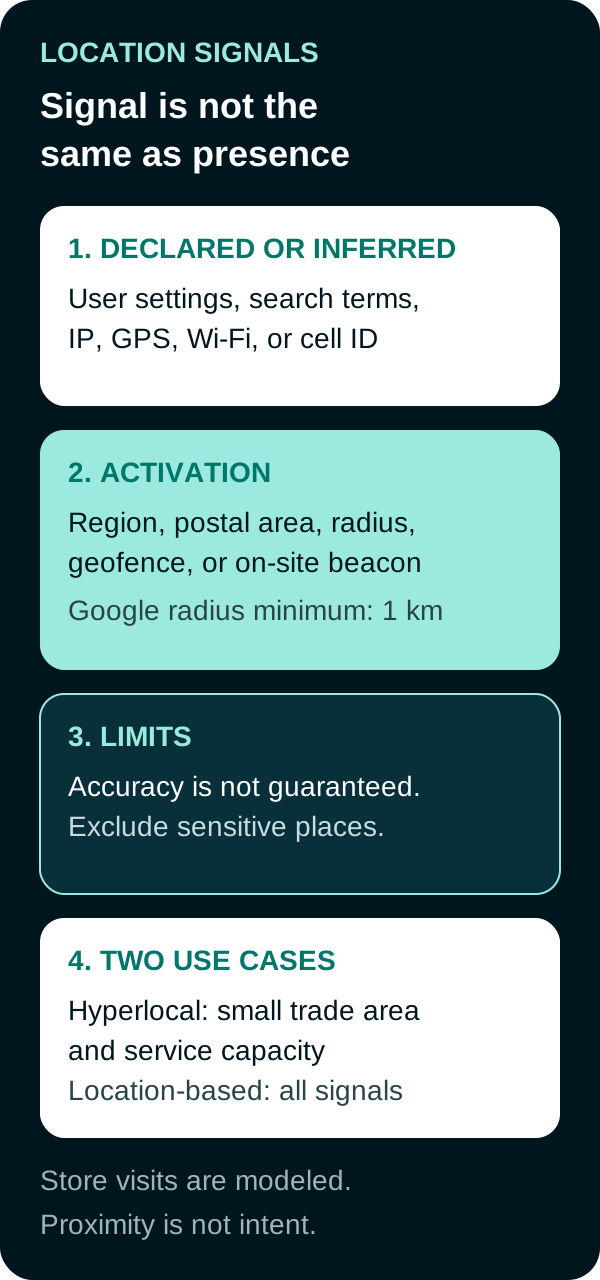
Declared versus inferred location
Google’s geographic location help splits two ideas:
- Physical location: where someone is likely to be, or regularly is. Signals can include IP address, GPS, Wi-Fi, Bluetooth, and cell-tower ID, depending on device settings. GPS accuracy varies with signal. Wi-Fi accuracy is similar to a typical router range. Cell ID depends on tower density.
- Location of interest: places the person has shown interest in, even while sitting somewhere else. Signals can include search terms, past searches, past physical locations, Maps queries, a custom search location, and (on Display) page or site context. A page that mentions a city is not always interest in that city.
Advanced options in Google Ads are Presence or Interest (default) and Presence. Exclusions default to people likely located in the excluded area. Google repeats that 100% accuracy is not guaranteed. Nearby related areas can also receive ads when the named target is too small or low-population.
Meta’s location targeting help says people who live in, recently spent time in, or often go to selected countries, regions, cities, or postal codes can qualify, and that complete accuracy cannot be guaranteed. Some impressions, messages, or leads can come from outside the selection.
Regional targeting, geofences, and beacons
| Method | Typical signal | Precision limit |
|---|---|---|
| Regional targeting | Country, region, city, postal area | Coarse. Good for market control, weak for a single store |
| Radius | Distance from an address or pin | Google Ads minimum 1 km. Includes barriers inside the circle |
| Geofence | A virtual boundary around a place, often in a DSP or app SDK | Still estimated. Fence size and dwell rules change who qualifies |
| Beacon | On-site Bluetooth hardware | Requires the person to be near the device and to have granted permission |
Use the least precise signal that solves the need. A statewide service area does not need a 200-meter fence. A mall kiosk might. Beacons do not replace consent; they add a hardware requirement.
Sensitive-place rules still apply. Google housing, employment, and credit ads in the US and Canada cannot use ZIP targeting. Meta Special Ad Category campaigns require a large minimum radius and do not support ZIP targeting or location exclusions. Google store-visit conversions are ineligible for sensitive location types such as religion, sexual interests, children, and certain health issues.
Consent and store-visit validation
Explain what location you collect and why, in language a customer can actually read. Do not treat a platform toggle as a privacy policy.
Google store visit conversions need a signed-in Google account with Location History opted in. Google then uses anonymous, aggregated statistics and extrapolates to a broader population. Reporting can lag about five days, values can change as the model updates, and visits are attributed to the ad-interaction date, not the visit date. Compare those modeled visits with your own appointment, POS, or door-count records before you change budget.
IAB’s State of Data 2024 found 71% of surveyed brands, agencies, and publishers were growing or planning to grow first-party datasets. Use that only as dated industry-data context, not as a location-product result.
Our view at Anderson Collaborative: Proximity is not intent. Combine location with a reason the customer might act now, such as availability, service eligibility, or event context.
Paid search is the related service when location-based findings need campaign execution.
Frequently Asked Questions
What is location-based marketing?
Location-based marketing uses a person or device location signal to shape targeting, messaging, or measurement. Methods include regional targeting, geofencing, beacons, and local search. A valid use needs relevance, appropriate consent, and enough accuracy for the decision.
What is the difference between declared and inferred location?
Declared location is what a person states or types, such as an address or a search for a city. Device permission allows access to a location signal; it does not make that signal declared. Inferred location is what a platform estimates from IP, GPS, Wi-Fi, Bluetooth, cell ID, past visits, or page context. Google says accuracy is not guaranteed.
How do geofences and beacons differ from regional targeting?
Regional targeting uses countries, cities, postal areas, or a radius. A geofence is a tighter virtual boundary around a place. A beacon is on-site hardware that needs the person to be near it and to have granted permission. Google Ads radius targeting starts at 1 km.
Can store-visit reports prove someone walked in because of an ad?
No. Google store visits are modeled from signed-in users who opted into Location History, then extrapolated. They are delayed, privacy-thresholded, and ineligible for sensitive location types. Compare them with your own visit or POS records.
Sources
- Google Ads Help, About targeting geographic locations, accessed September 19, 2026.
- Google Ads Help, About advanced location options, accessed September 19, 2026.
- Google Ads Help, About store visit conversions, accessed September 19, 2026.
- Meta Business Help, About location targeting in Meta Ads Manager, accessed September 19, 2026.
- IAB, State of Data 2024, dated March 14, 2024, accessed September 19, 2026.
PUT THIS KNOWLEDGE TO WORK
NEED MORE HELP?
Talk with our team about applying Location-Based Marketing to your marketing.
Get a free marketing audit call