

Geofencing: Fence Design, Consent, and Measurement
Geofencing draws a virtual boundary and fires an event when a device is estimated to enter, leave, or stay. It is not the same as Google Ads city or radius targeting, and it is not a precision or privacy guarantee.

Geofencing is a virtual boundary plus a time rule. When a device is estimated to enter, leave, or remain, the system may fire an ad, a message, an audience update, a suppression, or a security log. The boundary is not a person’s exact feet-on-the-ground location.
Use it with geo-targeting in PPC and location-based marketing. Paid execution sits in paid media.
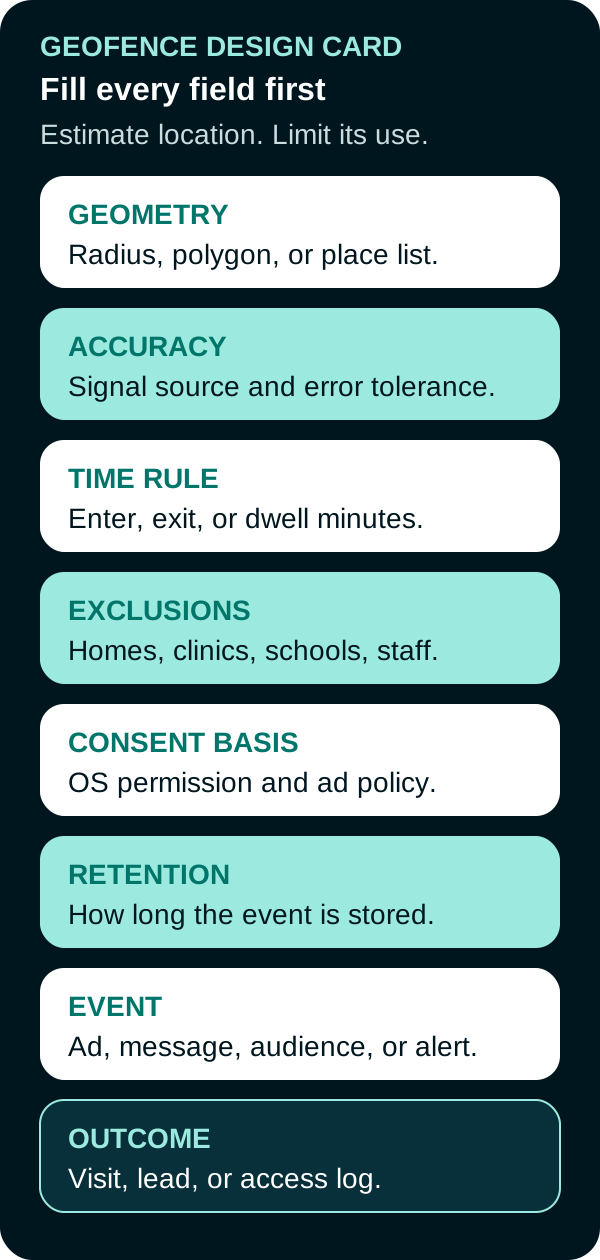
Design card for the boundary, signal, time rule, privacy controls, event, and outcome.
Fence construction
| Use | Geometry | Time rule | Typical event | Main risk |
|---|---|---|---|---|
| Local offer | Radius around a store | Enter or short dwell | Ad or push | Includes roads and homes you did not mean to include |
| Venue conquest | Polygon around a competitor lot | Dwell long enough to imply a visit | Audience membership | False visits from adjacent traffic |
| Event window | Polygon for dates and hours only | Enter during show hours | Suppression after the event | Overnight residents still in the shape |
| Site security | Campus or yard polygon | Enter or exit | Access log or alert | A marketing SDK is not an access-control system |
Radius is simple and sloppy. A polygon can follow a lot line and still fail when GPS bounces. Address or household audiences are a different product, with their own provider policy.
Google Ads location targeting can use a radius, with a minimum of 1 km and other privacy thresholds (minimum area and user counts). Google says 100% accuracy is not guaranteed. That radius setting controls who may see search or display ads. It does not, by itself, log dwell inside a store.
Personalized advertising also restricts ZIP-code location targeting for Housing, Employment, and Consumer Finance ads in the United States and Canada. Put clinics, schools, places of worship, and similar sensitive places on the exclusion list for marketing fences.
Design card
Fill this before buying a list or drawing a shape.
| Field | Write down |
|---|---|
| Geometry | Radius, polygon, or named place list, plus map source |
| Accuracy assumption | GPS, Wi-Fi, cell, IP, or mixed. State the error you will tolerate |
| Time rule | Enter, exit, or dwell of N minutes |
| Exclusions | Staff, trade-area homes, clinics, schools, houses of worship, and other sensitive sites |
| Consent basis | OS location permission, platform policy, and any notice you actually show |
| Retention | How long the event and derived audience exist |
| Event | Ad, message, audience add, suppression, or security log |
| Outcome | Store visit, qualified lead, or access record, with a control if you claim lift |
Do not call the audience precise, anonymous, or secure. A fence can leak: shared devices, delayed pings, and people who drive through without stopping. Attribution that uses the same location signal as targeting can overstate confidence. Use a valid holdout when the decision depends on causal lift; an unfenced baseline is directional only.
Security geofences belong in physical-security and access-control design. Marketing SDKs, ad IDs, and dwell audiences are not door locks.

Practical check
Start from the event that matters, then choose the least invasive location signal that can fire it. Exclude sensitive places. Set retention. Do not treat a pretty radius on a map as proof of presence.
FAQs
What is geofencing?
Geofencing defines a virtual boundary and triggers an action when a device is estimated to enter, exit, or remain inside it. Marketing uses include ads and audience building. Security uses include site-access logs. Both depend on location accuracy, consent, and retention rules.
How is geofencing different from geo-targeting in PPC?
PPC geo-targeting sets where ads may serve based on presence or interest in countries, cities, postal areas, or a radius. A geofence adds a geometry plus a time rule (enter, exit, or dwell) that can fire an event. Google Ads radius targeting is not a dwell-triggered fence.
Is a geofence precise or anonymous?
No. Location is inferred from GPS, Wi-Fi, Bluetooth, cell, IP, or app signals, each with error. Google Ads radius targeting, for example, requires at least 1 km and is a best-effort setting, not a guarantee. Do not assume a location-derived audience is anonymous or that a marketing fence is a security control.
What belongs on a geofence design card?
Geometry, accuracy assumption, time rule, exclusions (including sensitive places), consent basis, retention period, trigger event, and business outcome. Complete each field before launch.
PUT THIS KNOWLEDGE TO WORK
NEED MORE HELP?
Talk with our team about applying Geo-Fencing to your marketing.
Get a free marketing audit call