

Frequency in Advertising: Formula and Examples
Frequency in advertising is how often the same person or household is shown an ad during a defined period. The useful report is average frequency next to unique reach. Neither number is a universal target.
Frequency in advertising is how often the same person or household is shown an ad during a defined period. It only makes sense next to reach, the count of unique people or households shown the ad at least once. Enough repetition can aid recall. Too much can produce ad fatigue. Platform frequency capping and, where Meta documents it, a Facebook Ads frequency cap are delivery controls, not proof of the right number. In paid social and video, inspect both.
Television planners still multiply reach percentage by average frequency to get gross rating points. Equal GRPs can describe very different audience experiences.
Reach versus average frequency
| Measure | What it answers | What it can hide |
|---|---|---|
| Reach | How many unique people or households were shown the ad | How often each of them saw it |
| Impressions | How many times the ad was served or viewed, depending on the column | How many unique people those servings were |
| Average frequency | Impressions divided by reach for the same window | People far above or below the average |
| Frequency cap | The delivery limit requested on eligible inventory | People who never hit the cap, and inventory the cap does not cover |
Google’s Unique Reach definition measures people shown an ad across devices, formats, and networks, including modeled co-viewing on connected TV. Measuring reach and frequency adds average impression frequency per user and frequency distribution columns (1+, 2+, 3+, and higher). Use distribution when you have it. An average of 3 is not “everyone saw it three times.”
Worked example
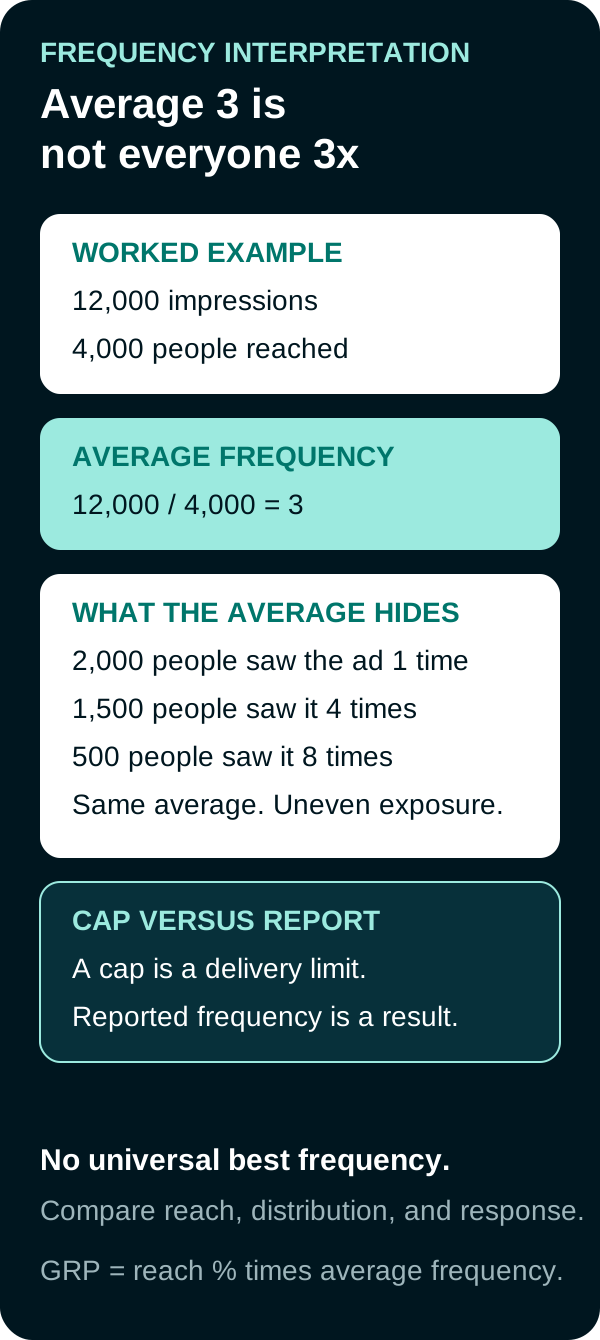
A flight serves 12,000 impressions to 4,000 people.
Average frequency = 12,000 ÷ 4,000 = 3.
That same average can describe uneven delivery, for example:
- 2,000 people saw the ad 1 time (2,000 impressions)
- 1,500 people saw it 4 times (6,000 impressions)
- 500 people saw it 8 times (4,000 impressions)
The report still says 3. The 500-person tail had a different experience from the 2,000 who barely saw it. Duplicated exposure across campaigns, devices, and channels makes the true person-level total higher than any one platform average.
Caps are not the same as reported frequency
A frequency cap is a rule that tries to limit how often the same person sees ads in a period. Reported frequency is what the platform recorded after delivery.
Google’s frequency capping article splits the control:
- Display: Caps can be set per day, week, or month at campaign, ad group, or ad. Third-party cookies are used by default. First-party cookies approximate when they are not available. For Display, only viewable impressions count toward caps. Other frequency reporting can look higher because it also counts unviewable impressions.
- Video: Caps are campaign-level, for impressions and/or views, per day, week, month, or a combination. They apply to signed-in users, or to devices if the user is signed out. In-feed, in-stream, and bumper ads in that campaign all count. When the same video runs in other Video campaigns, only in-stream and bumper impressions or views from those campaigns count toward the original campaign’s cap.
Meta documents a frequency cap for eligible Awareness campaigns that use Maximize reach of ads. That control is not universal. Setup, limits, and average-versus-cap confusion are covered on the Facebook Ads frequency cap page.
Programmatic DSPs can apply their own caps on the inventory they see. They cannot see every other campaign you are running.
Why there is no universal optimal frequency
Useful repetition depends on the goal, the audience size, the flight length, how distinct the creative is, and what overexposure costs. A product launch in two weeks is not an evergreen prospecting campaign. A tiny retargeting list is not a national reach buy. Social scroll inventory is not a 30-second television pod.
Read together:
- Unique reach growth versus spend
- Frequency distribution, not only the average
- Response, negative feedback, and conversion quality
- Creative age and overlap with other campaigns
Raise repetition only when the message needs it and the audience can support it. Tighten delivery when spend grows faster than reach, or when the same people are hit while new reach stalls. A rule such as “two every seven days” is a test setting, not a law.
Channel tools, with their real scope
- Google Ads. Frequency capping for Display and Video as documented above. Start at Google Ads.
- Meta Ads Manager. Direct caps only where Meta exposes them. Otherwise manage audience windows, exclusions, budget, and creative. See Facebook Ads.
- Programmatic platforms. A DSP such as The Trade Desk can cap on the impressions it buys. Cross-platform overlap still has to be reconciled in your own plan.
Frequency in business reporting
In CRM or retail reporting, frequency can mean how often a customer buys, visits, or logs in. That is a useful loyalty measure. It is not interchangeable with advertising frequency. Keep the two labels separate in the same dashboard.

Frequently Asked Questions
What is an example of frequency in marketing?
If a campaign serves 12,000 impressions to 4,000 people, average frequency is 3. That average can hide 2,000 people who saw the ad once and 500 who saw it eight times.
What is the difference between reach and frequency?
Reach is how many unique people or households were shown the ad at least once. Frequency is how often those reached people were shown it. Average frequency is impressions divided by reach for the same period and identity rules.
Is a frequency cap the same as reported frequency?
No. A cap is a delivery limit you request where the platform offers one. Reported frequency is a result. Caps and reports can use different identity rules, and Google notes that Display reporting can count impressions that did not count toward a viewable-impression cap.
What is a good advertising frequency?
There is no universal best number. Choose a test from campaign purpose, audience size, flight length, creative supply, and the cost of overexposure, then read reach, distribution, cost, and response together.
What is frequency in business?
Outside media reports, frequency can mean how often a customer buys, visits, or logs in. That is a loyalty or usage measure, not the same object as advertising frequency.
Video: What is Reach and Frequency? Marketing and Advertising Reach and Frequency Explained by Surfside PPC on YouTube.
PUT THIS KNOWLEDGE TO WORK
NEED MORE HELP?
Talk with our team about applying Frequency in Marketing to your marketing.
Get a free marketing audit call