

Behavioral Targeting: Signals, Consent, and Expiry
Behavioral targeting uses observed actions to select ads. Document the source, allowed use, recency, and expiry, then measure qualified outcomes.
Behavioral targeting selects ads using observed actions, such as site visits, app events, searches, or purchases, rather than the page topic alone. The signal is only useful when you can name where it came from, whether it may be used for ads, how recent it is, and when it expires.
Bring behavioral targeting into paid media planning before changing budget, creative, or measurement. It overlaps with audience targeting and with lookalike audiences. It is not the same as retargeting. Retargeting is the subset that advertises back to people already on your list. Behavioral targeting can also mean in-market or activity-based platform segments that never visited you.
IAB’s 2024 Outlook Survey (fielded October 20 to November 9, 2023, n=203) found that 70% of surveyed buyers planned more focus on first-party data acquisition or partnerships in 2024, and 45% planned more focus on behavioral ads. Those are dated planning-intent shares, not click or conversion lifts.
Behavioral versus contextual versus demographic
| Approach | What it uses | Best for |
|---|---|---|
| Behavioral | Past clicks, views, purchases, searches, or list activity | Intent-based campaigns and retargeting |
| Contextual | Current page topic or content theme | Privacy-friendly, content-aligned placements |
| Demographic | Age, gender, location, job title | Broad awareness and top-of-funnel reach |
For page-based placement, see contextual advertising. Demographic controls are traits. Behavioral controls are events. Mixing them without saying so is how a “high-intent” list fills with the wrong people.
Signal matrix
Fill this matrix for every behavior you activate. Behavioral signals are strongest when they describe recent intent and weakest when they become permanent labels.
| Field | What to record | Example |
|---|---|---|
| Source | Site tag, app SDK, CRM upload, or platform activity | Google tag on /pricing |
| Purpose | Prospecting signal, retargeting list, or exclusion | Cart abandoners, last 7 days |
| Allowed use | Whether the identifier may be used for ads | Documented permission and platform eligibility |
| Sensitivity | Health, finance, housing, employment, or other restricted topics | Use policy-compliant alternatives when sensitive targeting is restricted |
| Recency | How new the event must be | 7 days for carts, 30 days for research |
| Expiry | When the person leaves the audience | Membership duration, not “forever” |
| Audience action | Include, exclude, or observation-only | Exclude purchasers from prospecting |
| Measurement | Primary result and comparison | Qualified purchases versus a holdout |
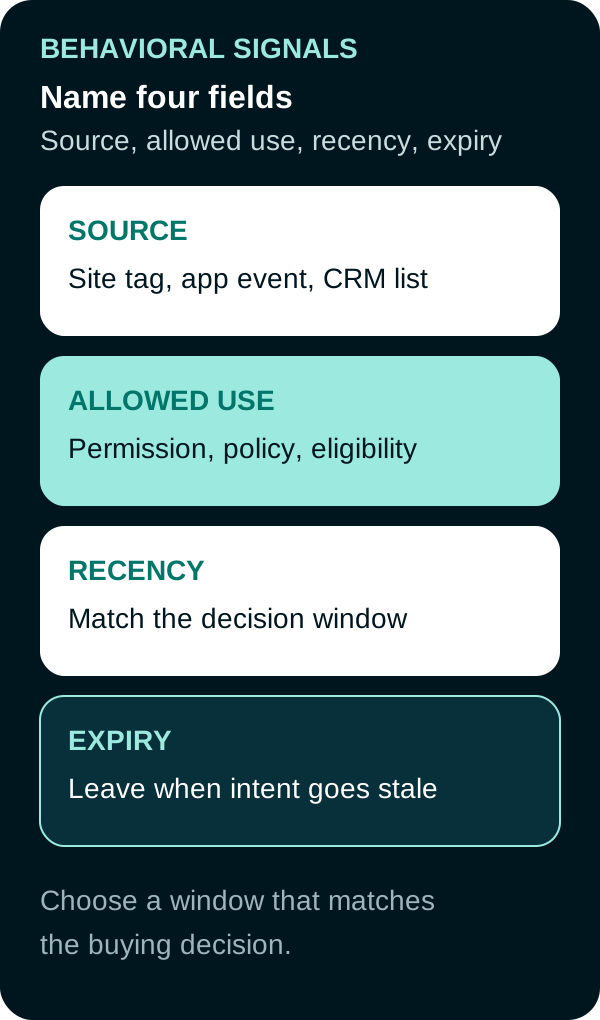
Document the source, allowed use, recency, and expiry for each behavioral signal. A platform maximum can be much longer than the useful intent window.
Google your data segments default to 30 days and allow up to 540 days on Search and Display. Customer Match lists also have a 540-day membership maximum in About Customer Match. Meta website custom audiences commonly look back up to 180 days, or up to two years for purchase events, per website custom audience rules. Google’s personalized advertising policy blocks advertiser-curated audiences for many sensitive interest categories. Verify the current platform control and the requirements that apply to the campaign.
Retailer example
A clothing retailer can retarget people who viewed winter jackets and did not buy, then show a jacket-season message and exclude purchasers from that acquisition offer. Use a short window while the product is relevant, and route buyers to an appropriate follow-up. Evaluate qualified purchases, conversion value, cost, and frequency alongside click-through rate.
Cap repetition with frequency capping so the same action does not follow someone past the useful window.

Named platforms
| Platform | Behavioral role | Official starting point |
|---|---|---|
| Google Ads | Your data segments, Customer Match, in-market and custom segments | About your data segments |
| Meta Ads | Website, app, and customer-list custom audiences | About custom audiences |
| Criteo | Commerce media and retargeting across its network | Criteo |
| AdRoll | Cross-channel retargeting and prospecting | AdRoll |
In compatible Google Display, qualifying Video, and Demand Gen campaigns, optimized targeting can expand beyond a selected list. Use exclusions where the campaign needs a hard boundary. Keep platform-inferred interest categories separate from first-party behavior in the brief.
How to run the signal
- Write the decision the behavior should change.
- Fill the matrix. Set expiry before you scale spend.
- Separate retargeting lists from prospecting signals.
- Exclude converters, staff, and sensitive-category constructions the policy forbids.
- Use a randomized experiment or geo holdout when scale allows. A matched cohort can provide directional evidence, but check balance and selection differences before interpreting it; a simple before-and-after also reflects seasonality, prospecting volume, and creative changes.
Refresh the segment logic when an old action no longer indicates current intent. An expired signal should leave the audience.
Frequently Asked Questions
What is behavioral targeting in digital marketing?
Behavioral targeting uses actions or patterns, such as a product view, search, or purchase, to include or exclude people in an audience. Document each signal’s source, allowed advertising use, recency window, and expiry.
What is an example of a behavioral targeting strategy?
A clothing retailer can build a list of people who viewed winter jackets and did not buy, then show a jacket-season message for a short window and exclude purchasers. That is retargeting, which is one behavioral method, not the whole category.
What is the difference between behavioral targeting and contextual targeting?
Behavioral targeting uses past actions or activity-based platform signals. Contextual targeting uses the page, app, or video being viewed now. An uploaded customer list is behavioral only when its selection rule comes from a relevant action.
Does behavioral targeting improve CTR and conversions?
It can raise relevance when the signal is recent, eligible for advertising use, and tied to the offer. Compare it with a suitable control and judge qualified purchases or leads alongside click-through and conversion rates.
Sources
- Google Ads Help, About your data segments, accessed September 20, 2026.
- Google Ads Help, How your data segments work, accessed September 20, 2026.
- Google Ads Help, About Customer Match, accessed September 20, 2026.
- Google Advertising Policies, Restricted targeting in Personalized advertising, accessed September 20, 2026.
- Meta Business Help, About custom audiences, accessed September 20, 2026.
- Meta Business Help, Options to create a website custom audience, accessed September 20, 2026.
- Criteo, accessed September 20, 2026.
- AdRoll, accessed September 20, 2026.
- IAB, 2024 Outlook Survey PDF, fielded October 20 to November 9, 2023, accessed September 20, 2026.
PUT THIS KNOWLEDGE TO WORK
NEED MORE HELP?
Talk with our team about applying Behavioral Targeting to your marketing.
Get a free marketing audit call