

Landing Page Experience: From Promise to Tracking
Landing page experience is how relevant and useful the destination is after an ad click. Review the promise, the page, mobile use, tracking, and the business outcome together.

Landing page experience is the quality and relevance of the page a person reaches after clicking an ad. A strong page matches the promise, loads quickly, works on a phone, and makes the next action obvious. In Google Ads Search campaigns, that experience is also one diagnostic component of Quality Score.
Google’s Quality Score article is explicit: the 1 to 10 score is not a KPI and is not an input in the ad auction. Ad Rank is calculated at auction time from bid, auction-time ad and landing-page quality, thresholds, competition, search context, and expected asset impact. Repair the destination because people need it, then read cost per click and conversion tracking against the business result.
Preflight: follow the click, not the score
Work the path in this order. A later fix cannot rescue an earlier break.
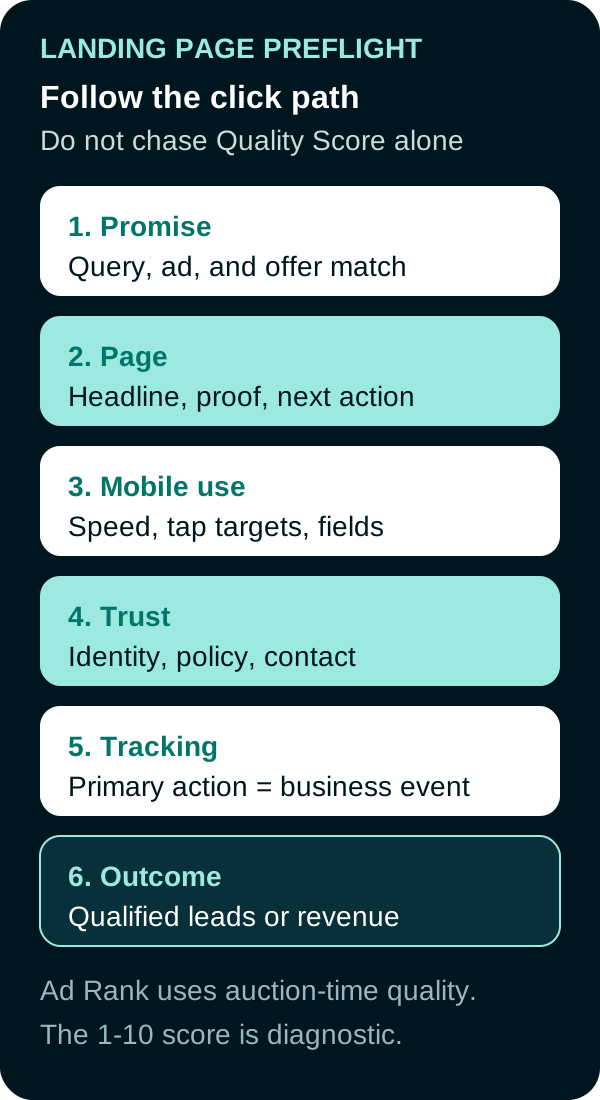
Quality Score summarizes a 90-day comparison. Ad Rank uses auction-time quality. Measure both, and judge the page on qualified outcomes.
| Step | Question | Pass when | Fail when |
|---|---|---|---|
| Intent | Does the query want this offer now? | The ad and page answer the same job | The query is research, career, DIY, or a different product |
| Promise | Does the first screen keep the ad’s offer and CTA? | Headline, price or terms, and next step match the ad | The offer is missing, expired, or moved below the fold |
| Hierarchy | Can someone find proof and the action without hunting? | One primary action, supporting proof nearby | Competing CTAs, hidden price, or unrelated modules first |
| Mobile | Can a thumb complete the action? | Fields, tap targets, and keyboard type are usable | Tiny fields, overlays, or a desktop-only form |
| Speed | Does the page become usable quickly on a phone? | Field LCP, INP, and CLS in the good band | Lab-only screenshots with no field data |
| Friction | Does every field change how the lead is handled? | Name, contact, and the one qualifier sales uses | Extra fields that stall the form |
| Trust | Can a stranger identify the business? | Name, location or service area, policy, and contact | Stock claims with no identity |
| Tracking | Does the counted conversion equal the business event? | Primary action is the sale or qualified lead | Thank-you views, button clicks, or duplicate tags |
Google’s Quality Score improvement article says to give people what they searched for, keep messaging consistent from ad to page, make the site mobile-friendly, and improve loading speed. It also says conversion rate is a useful proxy for the marketer and does not change the landing-page status in Quality Score. Treat those as two clocks.
Google’s landing-page glossary notes that the landing page and display URL must share the same domain under the destination-mismatch policy. Do not send Search clicks through an unrelated domain.
Dedicated page, category page, or product page
Pick the destination from the query and the offer, not from a preference for “more landing pages.”
| Destination | Use when | Tradeoff |
|---|---|---|
| Dedicated landing page | The ad names a specific offer, audience, financing term, or constraint a catalog page would bury | More URLs to keep truthful when the offer changes |
| Category page | The query is a family of items and the person still needs to compare | Weaker match if the ad promised one SKU or a named promo |
| Product page | The query already names that item and the live price or inventory matches the ad | Dead-end if the SKU is out of stock or the promo is sitewide |
| Homepage | Almost never for paid search | People must re-navigate the promise they already clicked |
Decision rule: If the ad’s unique claim is not visible above the fold on the existing URL, build or choose a dedicated page. If the claim is the product itself, use the product URL. If the claim is a set (“work boots,” “family dentists”), use the category URL and put the promised filter or offer at the top.
You do not need the search term repeated word for word. Google’s example is direct: a search for a long local hotel query does not require that exact headline. Deliver the hotel the person asked for.
Speed, forms, and valid conversion measurement
Use Core Web Vitals as the field usability check, not as a claimed Google Ads auction lever. Google Search Central’s current good thresholds, judged at the 75th percentile of real visits and split by mobile and desktop, are:
- Largest Contentful Paint (LCP): 2.5 seconds or faster
- Interaction to Next Paint (INP): 200 milliseconds or faster
- Cumulative Layout Shift (CLS): 0.1 or lower
A page can pass those and still lose the visitor if the offer is wrong. A page can miss them and still convert if demand is strong. Repair speed because people abandon slow pages. Do not treat a Lighthouse screenshot as proof that Ad Rank moved.
On forms, keep every field tied to routing or qualification. If sales never uses “company size,” delete it. If calls are the outcome, put a click-to-call control on mobile and count calls that meet a minimum duration, not every tap.
Conversion measurement only helps if the primary action is the business event. Smart Bidding follows primary actions included in the campaign’s goals. A secondary “form start” is observation unless you place it in a custom goal. Count One conversion for a unique lead unless the business truly earns value from every repeat. Import offline qualified leads or revenue when the sale happens after the click. Consent requirements still apply where the law or Google’s EU user consent policy requires them.
Hypothetical review (labeled sample, not a client result): An HVAC ad promises an $89 tune-up. The click lands on a services hub. Ten of its 14 form fields are unused by dispatch. The primary conversion is “Get estimate” button clicks. Repair order: route the ad to a tune-up page that restates $89, cut the form to name, phone, ZIP, and preferred window, and fire the conversion on a unique confirmation state after a successful submit. Then watch booked jobs, not the Quality Score digit.
Work like this belongs in conversion rate optimization once the destination choice is settled. Message match is still the first repair when the ad and the page disagree.

Frequently Asked Questions
What is landing page experience in Google Ads?
Landing page experience is how relevant and useful the destination is for people who click the ad. In Search campaigns it is one of three Quality Score components, rated Above average, Average, or Below average against other advertisers for the same exact search over the last 90 days.
Does a better landing page automatically raise Ad Rank?
No. The 1 to 10 Quality Score is a diagnostic, not an auction input. Ad Rank can include auction-time landing-page quality among other factors. Fixing one element does not guarantee a higher position, a lower CPC, or a higher conversion rate.
When should a campaign use a dedicated landing page?
Use a dedicated page when the ad names a specific offer, audience, or constraint that a category or product page would bury. Use a category page for discovery across a set. Use a product page when the query already names that item and the offer on the page matches the ad.
What should a landing-page review measure?
Measure qualified conversions and revenue, not button clicks alone. Confirm the primary conversion action matches the business outcome, the tag fires once per completed action, and mobile Core Web Vitals are in the good range at the 75th percentile. Quality Score status does not replace those checks.
Sources
- Google Ads Help, About Quality Score for Search campaigns, accessed September 20, 2026.
- Google Ads Help, 5 ways to use Quality Score to improve your performance, accessed September 20, 2026.
- Google Ads Help, Landing page glossary, accessed September 20, 2026.
- Google Ads Help, About Ad Rank, accessed September 20, 2026.
- Google Ads Help, About conversion measurement, accessed September 20, 2026.
- Google Search Central, Understanding Core Web Vitals and Google search results, accessed September 20, 2026.
- web.dev, Web Vitals, accessed September 20, 2026.
PUT THIS KNOWLEDGE TO WORK
NEED MORE HELP?
Talk with our team about applying Landing Page Experience to your marketing.
Get a free marketing audit call