

Data Clean Room: Joins, Thresholds, and Activation Limits
A data clean room is a controlled environment where approved parties run permitted joins and queries without exporting raw user-level files. Privacy depends on the thresholds, contracts, and output rules you actually run.
A data clean room is a restricted environment where approved parties run permitted joins and queries, then receive outputs that have passed the environment’s privacy checks. Brands, publishers, and platforms use it to answer overlap, reach, measurement, or activation questions without exposing one another’s raw customer files. Its thresholds, contracts, access rules, and permitted outputs determine the protection it provides.
Use it next to first-party data strategy and cookie tracking policy, and instrument the events you will join with event tracking. Reporting and analysis is where a clean-room table should change a media or measurement decision.
Roles, joins, and queries
| Role | Typical custody | What they may do |
|---|---|---|
| Advertiser / brand | First-party CRM, site, or app events | Propose the question, supply keys, read permitted outputs |
| Publisher or retailer | Exposure or transaction logs | Permit a join for measurement or overlap |
| Platform operator | The clean-room software and logs | Enforce query rules, thresholds, and audit trails |
| Analyst | No raw-row access | Write approved SQL or templates |
| Legal / privacy | Contracts and DPIAs | Permit purpose, retention, and activation |
A join is allowed only for a written purpose: overlap, reach, measurement, or activation. Keys are usually hashed emails, device IDs, or platform IDs. If the keys do not overlap, the query returns empty, not “anonymous insight.”
Ads Data Hub (closed beta; access through a Google account team) lets advertisers upload first-party data to BigQuery and join it with Google event-level ad data. Underlying rows cannot be inspected. Results are aggregated. Privacy checks include static query checks, data-access budgets, aggregation thresholds, and noise injection. Google documents approximate row thresholds of 50 unique users under difference checks, 20 under noise injection, and 10 for queries of only clicks and conversions. Rows below the threshold are dropped. A filtered-row summary can roll dropped rows into one line, and that summary itself can be dropped if it has fewer than about 50 users or two rows.
Amazon Marketing Cloud is Amazon’s clean room, built on AWS Clean Rooms. AMC accepts pseudonymized inputs, keeps advertiser-uploaded signals inside the advertiser’s instance, and returns outputs Amazon describes as aggregated. The product page also says reporting uses built-in aggregation thresholds. Custom audiences can be activated to sponsored ads, video, and display when the rules allow. Event-level signals may be queried; raw advertiser files are not exported back out.
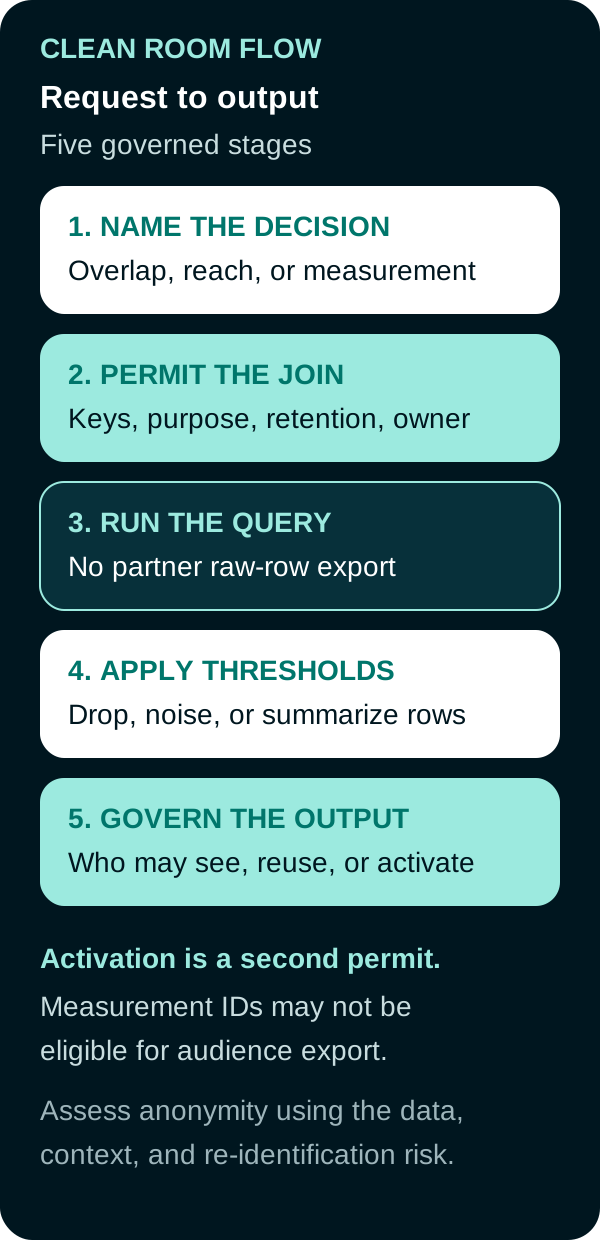
Permitted question, join, query, threshold, governed output. Activation is a second permit.
Privacy terms, with scope
The ICO’s anonymisation introduction (UK GDPR guidance, flagged as under review after the Data (Use and Access) Act) draws a hard line:
- Anonymous information does not relate to an identifiable person, including when combined with other sources. Data protection law does not apply to that information.
- Pseudonymisation replaces or separates direct identifiers. The result is still personal data if people can be re-identified with additional information.
- Applying anonymisation techniques is processing. The procedure must have a lawful basis even when the intended output is anonymous.
- Aggregation and noise can reduce risk. They do not, by themselves, meet the legal threshold.
GDPR Recital 26 uses the same identifiable-person test, including means reasonably likely to be used. US state privacy laws use their own definitions. Do not label a clean-room CSV “anonymous” because the product UI said aggregated.
Amazon’s product copy says outputs are “aggregated, anonymous.” Treat that as Amazon’s product language. Apply the ICO test before you treat the file as outside data-protection law.
Use-case matrix
| Use | Typical join | Useful output | Limit |
|---|---|---|---|
| Overlap | Brand customers x publisher or platform IDs | Overlap rate, not named people | Small cells get dropped |
| Reach / frequency | Ad exposure x universe rules | Deduplicated reach across partners | Definitions of reach differ by platform |
| Measurement | Exposures x conversions or sales | Aggregated conversion tables | Attribution inside the room is still assignment, not lift, unless you designed a holdout |
| Activation | Qualifying events x allowed audience export | A list the buying platform will accept | ADH: some publisher user IDs are measurement only, not activation. AMC: activation is into Amazon ads products, under AMC rules |
Request-to-output controls
- Name the business decision and the minimum table that would change it.
- List permitted datasets, keys, purpose, retention, and a named owner.
- Run the query. Do not ask for a row dump.
- Read privacy-check logs: dropped rows, noise, access-budget hits.
- Store the governed output with the query text and date. Treat screenshots as working notes rather than the system of record.
- If you want an audience, submit a separate activation request. Measurement eligibility is not export eligibility.
A CDP remains the right tool for one brand’s profile unification. The clean room is the right tool when two parties cannot share raw PII and still need an overlap or measurement table.

Frequently Asked Questions
What is a data clean room?
A data clean room is a restricted environment where two or more parties analyze overlapping or joined datasets under query and output rules. Participants do not download each other’s raw user-level files. Aggregation, noise, and access limits are product controls. They are not a legal finding that the output is anonymous.
How is a clean room different from a CDP?
A customer data platform typically unifies first-party profiles controlled by one organization for analysis and activation. A clean room supports permitted analysis across parties that cannot expose their underlying rows to one another. Both still need purpose, access, retention, and consent rules.
Does aggregation make clean-room output anonymous?
Not automatically. UK GDPR guidance treats information as anonymous only when people are not identifiable, including by combining sources. Pseudonymised data remains personal data. Small counts, rare attributes, and repeat queries can still identify someone. Follow the product’s thresholds and your counsel’s standard.
What can advertisers actually take out of a clean room?
Usually aggregated tables that pass privacy checks, and sometimes audience lists the platform allows you to activate. Google Ads Data Hub notes that some publisher IDs are available for measurement only, not activation. Amazon Marketing Cloud allows custom audiences into Amazon ads when the product rules permit it. Each export needs an owner and a purpose.
Sources
PUT THIS KNOWLEDGE TO WORK
NEED MORE HELP?
Talk with our team about applying Data Clean Room to your marketing.
Get a free marketing audit call