

First-Party Data: Inventory, Consent, and Activation
First-party data is information an organization collects directly through its own customer relationships and properties. Direct collection does not make the data complete, accurate, or lawful to use. Each field still needs a purpose, a permission basis, an owner, and an exit.

First-party data is information an organization collects through its own relationships and properties: purchases, accounts, form fills, service tickets, loyalty activity, and on-site events you actually operate. It is valuable because you can often name the source and the purpose. It is not automatically better, complete, or legal to activate.
Use it next to cookie tracking when the question is the browser, and next to data clean rooms when the question is collaboration without exporting raw identities. Reporting and analysis should show which fields actually fed the metric.
Direct collection is not a quality stamp
| Type | Example | Typical gap |
|---|---|---|
| Transaction | Orders, refunds, store visits | Weak intent context; identity may be household-level |
| Declared | Preferences, survey answers, account profile | Goes stale when people do not update it |
| Observed on your property | Site or app events, logged-in usage | Depends on tagging, consent, and login rate |
| Support | Tickets, chat transcripts | High sensitivity; easy to over-retain |
Third-party data is collected by someone else. Second-party data is another organization’s first-party set, shared by agreement. Clean rooms sit in between. None of those labels replace a purpose.
Chrome has not turned off third-party cookies for everyone. On 22 April 2025 Chrome said it would keep the existing third-party cookie choice in Privacy and Security settings and would not roll out a new standalone prompt. First-party programs still matter because users, other browsers, and regulation already limit cross-site identifiers.
Collection-to-activation workflow
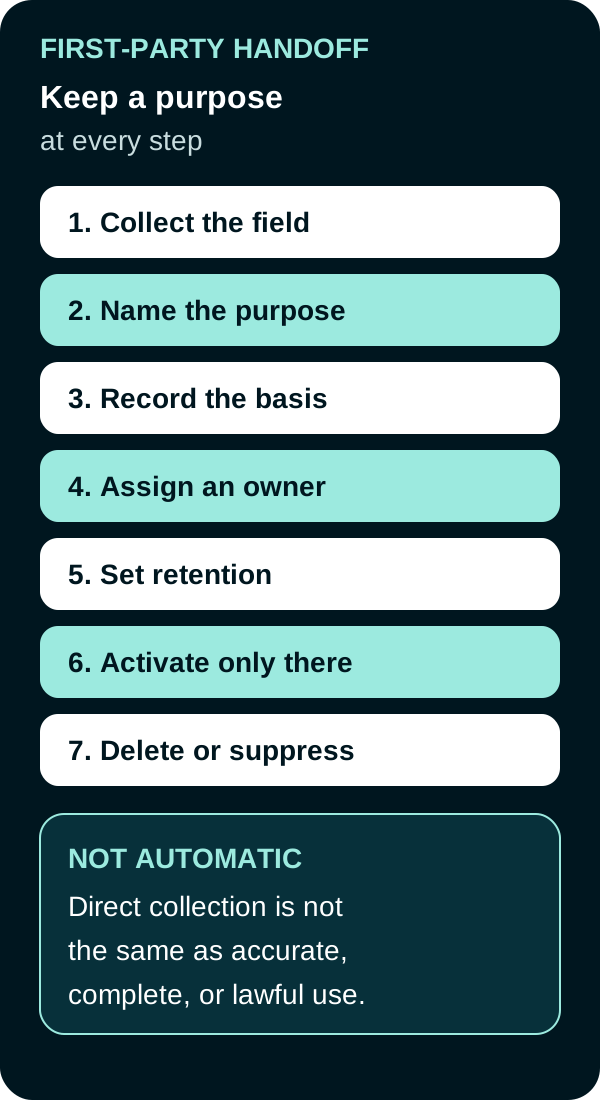
If a handoff has no owner, stop the activation. Adding more fields will not fix it.
- Collect only fields that serve a stated purpose.
- Name the purpose in the notice and in the inventory, using the same words.
- Record the basis. GDPR defines consent as a freely given, specific, informed, unambiguous indication (Art. 4(11)). Other bases exist. Do not label every first-party record as “consented.”
- Assign an owner who can approve a change or a deletion.
- Set retention and the clock that starts it.
- Activate only in destinations the purpose covers, such as email, analytics, or ads matching.
- Delete or suppress when the purpose ends, the person asks, or the law requires it. GDPR Art. 17 and California’s right to delete both have exceptions. Build the path anyway.
Inventory table
Hypothetical retailer. Replace the rows with yours.
| Field | Source | Purpose | Basis | Owner | Retention | Destination | Suppression / deletion |
|---|---|---|---|---|---|---|---|
| Checkout | Order mail and optional marketing | Contract for receipts; documented marketing permission or basis where required | CRM | Policy tied to purpose and applicable requirements | ESP, Customer Match | Suppress marketing promptly; delete when eligible | |
| Order SKU | POS | Fulfillment and service | Contract | Commerce | Tax and recordkeeping policy for the jurisdiction | Warehouse, support | Remove from activation; delete when eligible |
| Loyalty ID | App login | Rewards | Contract plus program terms | Loyalty | Documented membership and closure schedule | App, ESP | Close access, suppress marketing, then purge on schedule |
| Page events | First-party tag | On-site analytics | Configured consent choice or other documented basis, by jurisdiction | Analytics | Configured analytics retention policy | GA4 | Honor storage choices and propagate eligible deletion requests |
Google Customer Match lets advertisers use uploaded customer information to match Google users, with a maximum membership duration of 540 days. Campaigns using Smart Bidding and optimized targeting can auto-include Customer Match lists; Google currently documents that auto-inclusion for YouTube, with in-feed and Search listed as coming. Opt out exists. Manual bidding does not use lists that way. Starting March 2024, Customer Match lists are not available for activation on Google Partner Inventory or third-party exchange websites in the EEA, UK, and Switzerland for web and app; Google owned-and-operated properties remain in scope. Upload partners working with EEA user data must pass required consent signals. None of that makes the underlying CRM compliant. It only describes Google’s matching product.
Limits to keep in the plan
- First-party data is not inherently accurate. People share devices and mistype emails.
- A larger file is not a better file. Unused fields increase deletion cost.
- Server-side tagging is not a legal basis.
- A matched ads audience is not incrementality.

Frequently Asked Questions
What is first-party data?
First-party data is information an organization gathers through its own sites, apps, stores, sales, and service relationships. Examples include purchases, account activity, and form responses. Direct collection does not, by itself, mean the record is accurate, complete, or compliant.
How is first-party data different from cookies?
Cookies are one collection mechanism. First-party cookies belong to the site in the address bar. Third-party cookies belong to other domains. First-party data also includes offline records and logged-in account data that never lived in a browser cookie.
Can first-party data be used in ads without extra rules?
No. Activation products such as Google Customer Match still require permitted customer information, matching rules, and, for many EEA uploads, consent signals. Customer Match membership is capped at 540 days. Document the lawful or permission basis before you upload.
What belongs in a first-party data inventory?
For each field: source, purpose, permission or lawful basis, owner, retention, destination systems, and how suppression or deletion is honored. If a field has no purpose, do not keep it.
Sources
- Google Ads Help, About Customer Match, accessed September 20, 2026.
- Privacy Sandbox, Next steps for Privacy Sandbox and tracking protections in Chrome, April 22, 2025, accessed September 20, 2026.
- EUR-Lex, Regulation (EU) 2016/679, Articles 4 and 17, accessed September 20, 2026.
- State of California Department of Justice, California Consumer Privacy Act, accessed September 20, 2026.
PUT THIS KNOWLEDGE TO WORK
NEED MORE HELP?
Talk with our team about applying First-Party Data to your marketing.
Get a free marketing audit call