

How to Improve Click-Through Rate in Google Ads
Clickthrough rate in Google Ads is clicks divided by impressions. Improve Search CTR by fixing query eligibility and message match first. A higher rate is useful only when the extra clicks remain qualified.

Clickthrough rate (CTR) in Google Ads is clicks divided by impressions. Google’s definition uses 5 clicks and 100 impressions as 5%. Improving Search CTR starts with the queries that earned the impression, then the ad group, the responsive search ad, assets, and where the ad sat on the page. Do not rewrite headlines until the search-terms report says the problem is the message.
CTR connects to Quality Score as a diagnostic, to CPC as a cost, and to the broader CTR definition when you compare channels. Paid search is the campaign home for this work.
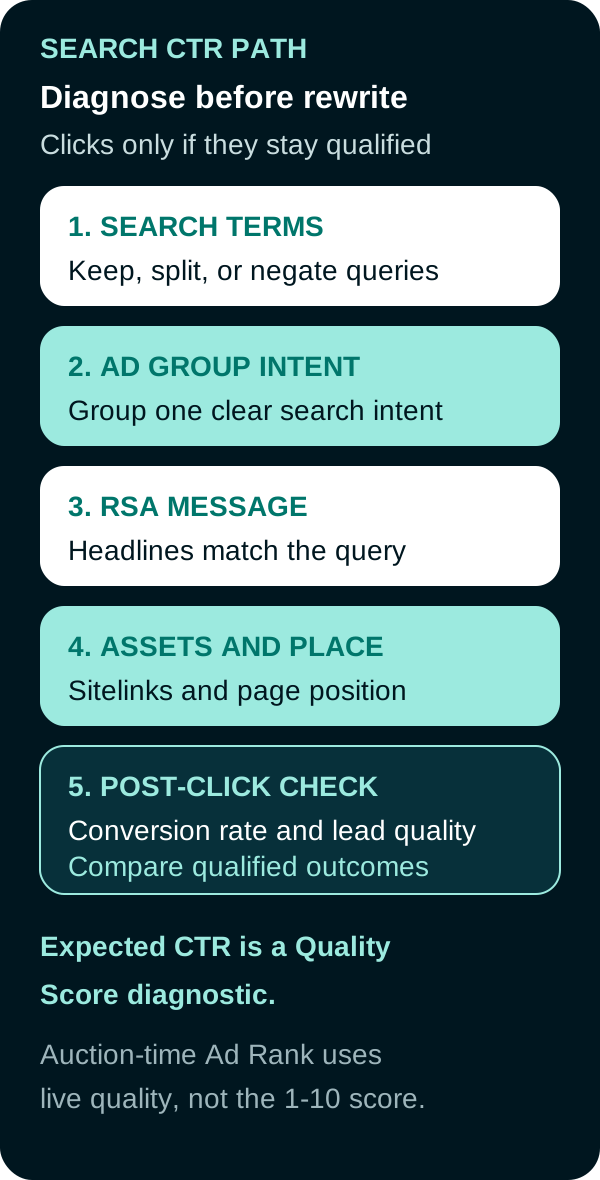
Diagnostic order. A CTR gain that fails the conversion-quality guardrail is not an improvement.
Diagnostic order
1. Search-term eligibility
The search terms report lists queries that triggered ads, with a match-type column that can differ from the keyword’s match type. Low-volume queries may be omitted for privacy and grouped in Search terms insights. Use the report to sort queries into keep, split, or negate.
2. Ad-group intent
One ad group should cover one job: emergency repair, replacement quote, or branded navigation. Mixed intent makes every headline a compromise and makes CTR unreadable.
3. RSA message match
Responsive search ads take at least 3 headlines and 2 descriptions, up to 15 headlines (30 characters) and 4 descriptions (90 characters). Google assembles combinations and can bold matching query text. Pin a line only when it must appear, such as required compliance copy. Pinning one line to a slot blocks other lines from that slot and reduces combination flexibility. Google’s Help also notes enhanced flexibility: unused headlines may serve as link-like assets.
The RSA asset report provides full asset statistics for dates from 5 June 2025; the former Performance label is deprecated. Read asset-level CTR, CPC, CPA, and ROAS as directional because several assets serve together. Use the combinations report and ad-group or campaign outcomes before replacing one headline.
4. Assets and position context
Sitelinks and other assets add extra clickable paths when Ad Rank and predicted performance allow them. Clicks on sitelinks still count in CTR. Compare CTR with Impr. (Top) % and Impr. (Abs. Top) % so you do not treat a drop from first position to below the results as a copy failure. Ad Rank is calculated at auction time from bid, live quality, thresholds, competition, search context, and expected asset impact.
5. Post-click quality
Landing-page promise must match the ad. Then watch conversion rate and qualified-lead rate. CTR is the doorway. Google Ads assets should answer a pre-click question, not farm extra clicks.
Expected CTR versus the 1-10 Quality Score
Quality Score is a keyword-level diagnostic from 1 to 10. Its three components are expected CTR, ad relevance, and landing page experience, each Above average, Average, or Below average versus other advertisers for exact searches of that keyword over about 90 days. Google states that Quality Score is not an input in the ad auction. Auction-time Ad Rank uses live quality, which can include expected CTR, plus the other Ad Rank factors. Do not chase an account-average Quality Score as if it were a bid lever.
Google’s CTR article says observed CTR contributes to expected CTR. That is a relationship between a diagnostic and live behavior, not a promise that raising CTR lowers CPC.
Before-and-after ad and search-term triage
Hypothetical HVAC Search ad group. Illustrative, not an account export.
Before (one generic group, weak match):
- Keyword dump:
hvac,ac repair,furnace,hvac jobs - Headlines: “Quality Service Since 1998” / “Call Our Team Today” / “Local HVAC Company”
- Result pattern: impressions on job-seeker and DIY queries, modest CTR, weak booked-job rate
After (repair intent isolated):
- Ad group: emergency and same-day repair only
- RSA headlines: “Same-Day AC Repair in {City}” / “Licensed Techs, Upfront Price” / “24/7 Service Call”
- Description: hours, service area, what to expect on site
- Sitelinks: Financing (only if it exists), Maintenance plans, Reviews
- Negatives:
job,salary,diy,parts only, competitor names you will not service
| Search term | Action | Why |
|---|---|---|
| ac repair near me | Keep in repair group | High intent, matches the offer |
| emergency furnace no heat | Split to a heat-emergency group if volume exists | Different urgency and copy |
| hvac technician salary | Negate | Job seeker |
| how to recharge home ac | Negate or move to content, not the lead form | DIY |
| competitor brand + coupon | Negate or a dedicated conquest group with honest copy | Different message and close rate |
Conversion-quality guardrail. Ship the copy change only if, over a comparable window with enough volume:
- Repair-intent share of clicks rises or holds
- CTR may rise
- Form or call conversion rate does not collapse
- Qualified-lead or booked-job rate does not fall enough to raise cost per qualified outcome
If CTR goes from 4% to 7% because you added “free” to every headline and half the leads are out of area, revert. Google’s RSA Help cites average click and conversion lifts when Ad Strength moves from Poor to Excellent. Treat that as Google’s published average across advertisers, not a forecast for this account, and not a waiver of the guardrail.

Frequently Asked Questions
What is clickthrough rate in Google Ads?
Clickthrough rate is clicks divided by impressions. Google’s Help example is 5 clicks from 100 impressions, or 5%. Each ad, listing, and keyword has its own CTR. A ‘good’ rate depends on the network and the query mix.
Does a higher CTR lower CPA or raise profit?
Not by itself. Extra clicks can be cheaper or more expensive, and they can be worse leads. Judge CTR next to conversion rate, qualified-lead rate, and cost per qualified outcome. Stop a CTR test when junk query volume rises.
How do responsive search ads affect CTR?
A responsive search ad can include up to 15 headlines (30 characters) and 4 descriptions (90 characters). Google tests combinations. Pin only the lines that must always appear. Assets such as sitelinks can add extra clickable paths. Unused headlines may also fill sitelink-like space.
Is expected CTR the same as Quality Score?
Expected CTR is one of three Quality Score components, rated Above average, Average, or Below average versus other advertisers for exact searches of the keyword over about 90 days. Quality Score is a diagnostic, not an auction input. Auction-time Ad Rank uses live quality, which can include expected CTR, plus bid, assets, and context.
Sources
- Google Ads Help, Clickthrough rate (CTR): Definition
- Google Ads Help, About the search terms report
- Google Ads Help, About responsive search ads
- Google Ads Help, Ad-level asset report for responsive search ads
- Google Ads Help, About Quality Score for Search campaigns
- Google Ads Help, About Ad Rank
- Google Ads Help, About sitelink assets
PUT THIS KNOWLEDGE TO WORK
NEED MORE HELP?
Talk with our team about applying Click-Through Rate (CTR) in Google Ads to your marketing.
Get a free marketing audit call