

Audience Segmentation: From Analysis to Activation
Audience segmentation splits a market into groups that deserve different treatment. A useful segment has a definition, exclusions, an owner, and a destination that can actually receive the message.
Audience segmentation is the process of dividing a broad audience into groups that share traits you can act on. Those traits may be demographic, behavioral, psychographic, or geographic. The point is not more labels. The point is a different message, bid, offer, or exclusion.
Segmentation pairs with audience targeting and lookalike audiences. Review the set inside the paid media plan, next to first-party data you actually have permission to use.
Start with the decision, then the variables
Write the business decision first: who should see this offer, who must not, and what success looks like. Then pick variables that can change that decision.
| Type | Based on | Example use |
|---|---|---|
| Demographic | Age, gender, income, education, company size | Life-stage messaging you can defend |
| Psychographic | Values, interests, lifestyle | Creative tone and positioning |
| Behavioral | Purchases, site actions, lifecycle stage | Retargeting and lifecycle email |
| Geographic | Location and region | Local offers and geo rules |
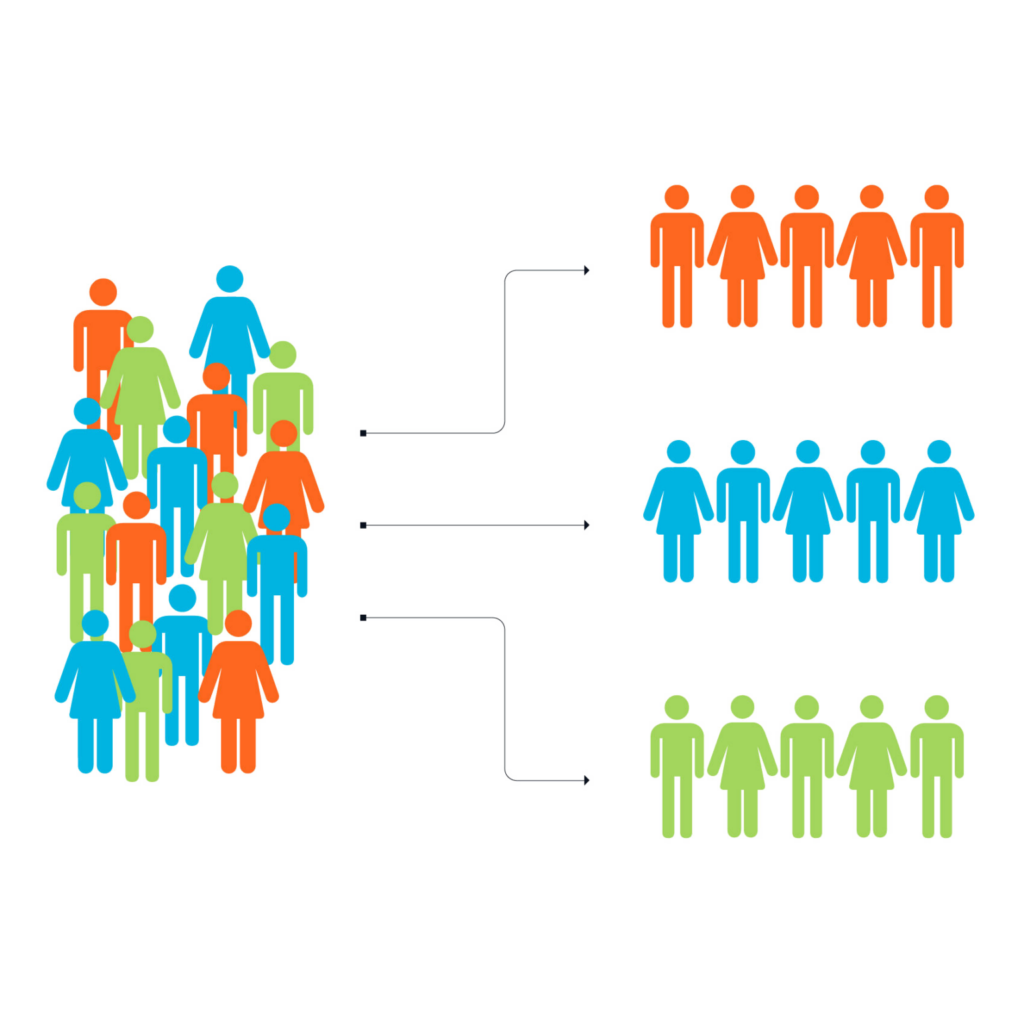
Those types are for analysis. They do not automatically become ads. Google Ads audience segments include affinity, in-market, detailed demographics, custom segments, and your-data lists. Performance Max can treat selected audiences as signals and still serve outside them. A worksheet persona is not a Delivery setting.
Analysis segments versus activatable audiences
| Object | Where it lives | What it can do |
|---|---|---|
| Analysis segment | A report, notebook, or CRM view | Explain who bought, who bounced, who churned |
| Activatable audience | An ad, email, or personalization tool | Target, observe, or exclude people the tool can match |
GA4 audiences are rules based on dimensions, metrics, and events. They can be used in Analytics and, when the property is linked and personalized advertising is enabled, shared to Google Ads. New audiences generally start accumulating from creation forward. Google Ads remarketing lists can prepopulate with up to 30 days of data when it is available. Membership is reevaluated as new data arrives. Standard properties can store up to 100 audiences.
A Meta customer-list custom audience matches hashed identifiers you already collected to Meta profiles. Match rate depends on the identifiers you upload. It is not a copy of your full CRM.
If the destination cannot receive the group, you still have an analysis segment. You do not have an audience.
Eligibility, exclusions, and privacy
Eligibility. Name who belongs: purchasers in the last 90 days, qualified leads, or visitors of a URL. For Google Customer Match, upload only first-party information collected directly from customers, disclose sharing in your privacy policy, and obtain consent where law or Google’s policies require it. Lists have a maximum 540-day membership duration. Policy-compliant accounts can use Observation and Exclusions; Targeting and manual bid adjustments also require 90 days of Google Ads history and more than $50,000 in lifetime spend.
Minimum useful size. A group that cannot deliver is not a media audience. Platforms publish their own floors. Below that, keep the group for analysis or merge it.
Exclusions. Suppress current customers from a prospecting offer, recent purchasers from a discount, employees, competitors, and anyone who opted out. GA4 can exclude users temporarily or permanently when they meet an exclude condition. Google Customer Match and Meta lists are commonly used as exclusions even when targeting features are limited.
Sensitive categories. Do not build or describe lists that imply health, financial distress, or other sensitive status the platform forbids. Google’s Customer Match policy bars ads that imply knowledge of personally identifiable or sensitive facts about the people on the list.
Salesforce’s 2022 State of Marketing (8th edition) reported that 72% of high-performing marketers could analyze marketing performance in real time, compared with 61% of underperforming marketers. That is a dated survey about reporting speed. It does not evaluate a particular segmentation scheme.
Segment brief
Fill one brief per group you intend to keep.
| Field | Write |
|---|---|
| Definition | Who is in, in one sentence |
| Source | CRM, site events, Customer Match, or a survey |
| Eligibility | Recency, match rules, consent |
| Exclusions | Who must never get this message |
| Message | The one change in offer or creative |
| Destination | Email, Search, paid social, or onsite |
| Owner | The person who refreshes and pauses it |
| Success metric | Qualified leads, revenue, or unsubscribe rate |
Activation, measurement, and refresh
- Activate only the destinations named in the brief.
- Measure the decision you wrote down, not “engagement” in the abstract.
- Refresh on a calendar. Stale emails shrink match rate. GA4 and ads lists both age out.
- Merge two briefs that now send the same message.
Google Analytics, HubSpot, and Mailchimp can hold analysis or activation lists. They are not interchangeable. Link each tool to the destination it actually feeds.
Frequently Asked Questions
What is audience segmentation?
It is the work of grouping people by shared traits so a message, bid, offer, or experience can differ. If every group gets the same plan, the labels are not a strategy.
What are the main types of audience segmentation?
Common analysis types are demographic, psychographic, behavioral, and geographic. Activation then depends on what a platform can legally and technically reach.
How is an analysis segment different from an activatable audience?
An analysis segment lives in a report or worksheet. An activatable audience is a list or rule a channel can target or exclude, such as a GA4 audience shared to Google Ads or a Meta customer list.
How many segments should a team keep?
Keep a group only when it changes creative, bid, offer, or suppression. Merge groups that receive the same treatment. Size must be large enough for the destination to deliver.
Sources
- Google Ads Help, About audience segments, accessed September 20, 2026.
- Google Analytics Help, Create, edit, and archive audiences, accessed September 20, 2026.
- Google Ads Policies, Customer Match policy, accessed September 20, 2026.
- Meta Business Help, About customer list custom audiences, accessed September 20, 2026.
- Salesforce, State of Marketing, 8th edition, 2022, accessed September 20, 2026.
PUT THIS KNOWLEDGE TO WORK
NEED MORE HELP?
Talk with our team about applying Audience Segmentation to your marketing.
Get a free marketing audit call