

Social Proof in Marketing: Types, Proof, and Disclosure
Social proof is evidence from other people that a claim is believable. It works when the proof matches the claim, can be verified, and discloses any material connection.

Social proof is the use of other people’s actions and opinions to help a buyer decide under uncertainty. In marketing, that evidence can be a review, a testimonial, a rating, a usage signal, a credential, or a case study. Review and reputation management turns verified customer feedback into proof that can sit next to a claim.
Buyers often discount a brand’s unsupported sentence. Outside evidence is useful only when a reader can tell who said it, what they bought, and whether they were paid.
Types of social proof
Choose the proof type for the decision in front of the buyer, not by how easy it is to paste into a page.
| Type | What it looks like | Where it helps |
|---|---|---|
| Expert proof | A named credential, certification, or specialist endorsement | Technical or high-consideration purchases |
| Celebrity or creator proof | A known person using or recommending the product | Awareness, if the disclosure is clear |
| User proof | Reviews, ratings, testimonials, and cases from customers | Product, pricing, and checkout objections |
| Crowd proof | Subscriber counts, bestseller marks, or public usage | Low-stakes, early-stage choices |
| Friend proof | A visible like, share, or purchase from someone the buyer knows | Social and referral paths |
A relevant micro-influencer review can be more specific than a famous name. Organic comments with a real engagement rate can also supply language, if you have permission to quote it.
Match the claim to the proof
Write the claim first. Then pick proof that can actually support it.
| Claim on the page | Proof that can support it | Put it here |
|---|---|---|
| ”Customers finish onboarding in a week” | A dated case or a named result you can show | Next to the onboarding offer |
| ”Easy to set up” | A review that describes setup, not a star average alone | Next to the setup steps |
| ”Top rated in its category” | A rating with the count, date, and source | Next to the rating widget |
| ”Used by 2,000 teams” | An auditable usage or customer count | Next to the adoption line |
| ”Recommended by clinicians” | A credential or an expert who used the product, with any tie disclosed | Next to the clinical claim |
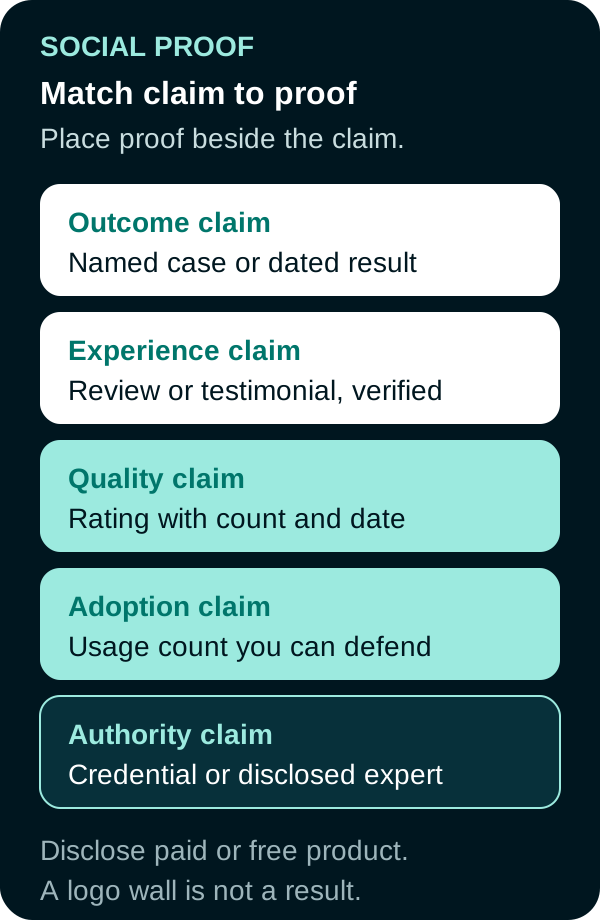
If the asset cannot support the sentence beside it, do not publish the sentence or the asset.
A logo wall does not prove an outcome. A five-star badge without a count, date, and source does not establish current quality.
Verify, place, and disclose
Verify. Confirm the person or organization exists, had the experience described, and gave permission. Keep the date. If the product changed, retire the quote or say what version they used. For U.S. marketing, the FTC Consumer Reviews and Testimonials Rule, effective October 21, 2024, prohibits fake or false reviews and testimonials, buying a required sentiment, undisclosed insider reviews, deceptive suppression of negative reviews, fake social-media influence marks, and company-controlled sites that pretend to be independent.
Place. Put the proof beside the doubt it answers: price, setup, risk, or fit. A specific named review beats a generic compliment at the top of the page.
Disclose. For U.S. marketing, 16 CFR 255.5 calls for a clear, conspicuous disclosure when a payment, free or discounted product, employment, family, or other unexpected connection could affect how a reader weighs the endorsement. The Consumer Reviews Rule does not replace that disclosure duty for influencers. Incentives are allowed when reviewers may post any honest sentiment. If those incentivized reviews raise the displayed average rating, even a disclosure on each review can still leave the average misleading.
Selection bias is ordinary. People who bother to review are not a random sample. You cannot fix that with a badge. You can avoid making it worse: do not invite only five-star customers, do not hide negatives, and do not treat a handful of quotes as “everyone.”
Frequently Asked Questions
Is a testimonial the same as social proof?
A testimonial is one form. Social proof also includes reviews, ratings, usage counts, credentials, case studies, and visible shares, each with a different job.
Can a sponsored endorsement still count as proof?
Yes, if the experience is real and the material connection is clear. For U.S. marketing, the FTC Endorsement Guides require a conspicuous disclosure when payment, free product, or another unexpected tie could affect credibility.
Where should social proof appear?
Place it beside the claim it supports: a result next to the offer, a review next to the objection, a credential next to a technical claim. A logo wall at the top of the page is not proof of an outcome.
Can a small brand use social proof without many reviews?
Yes. Use a few dated, named accounts, a short case, or a credential you can show. Do not invent volume, suppress negatives, or present staff posts as independent reviews.
Sources
- Federal Trade Commission, The Consumer Reviews and Testimonials Rule: Questions and Answers, accessed September 20, 2026.
- eCFR, 16 CFR Part 465, Rule on the Use of Consumer Reviews and Testimonials, accessed September 20, 2026.
- eCFR, 16 CFR 255.5, Disclosure of material connections, accessed September 20, 2026.
PUT THIS KNOWLEDGE TO WORK
NEED MORE HELP?
Talk with our team about applying Social Proof to your marketing.
Get a free marketing audit call