

Keywords in Digital Marketing: Types and Examples
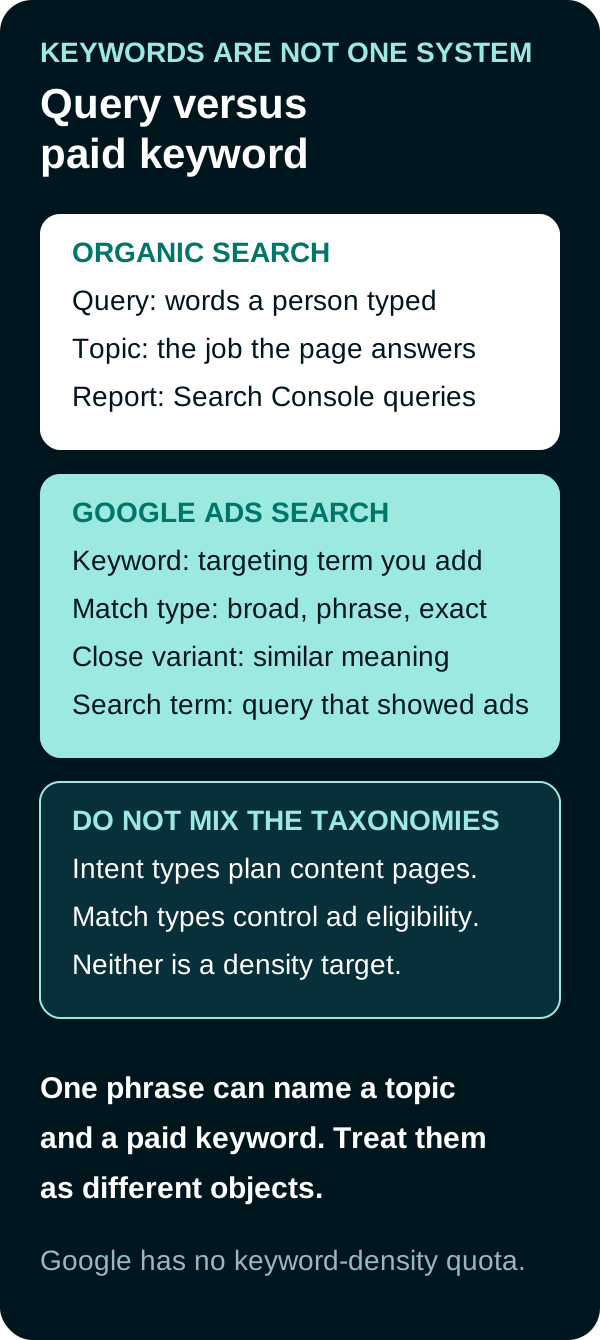
In digital marketing, a keyword is a word or phrase used to represent what someone is looking for. Organic search and Google Ads both use that idea, but they are not the same system.

In digital marketing, a keyword is a word or phrase used to represent what someone is looking for. Organic search and paid search both use that idea. They do not share one taxonomy.
- In organic search, the useful objects are the query a person typed, the topic a page can answer, and the queries Google Search Console reports.
- In Google Ads, a keyword is a targeting term you add to an ad group. Match types and close variants decide which search terms can trigger ads. The search terms report shows the queries that actually showed ads.
Keyword research for content still connects to the keyword planner guide and to link building. Paid execution belongs with paid search.
Organic search: queries, topics, and page intent
Google Search Console’s Performance report groups search traffic by the queries people used, the pages that appeared, country, device, and date. A query in that report is evidence of demand. It is not a ranking lever you paste into a page a set number of times.
Google’s SEO Starter Guide is explicit about what not to chase:
- Google Search does not use the keywords meta tag.
- Excessively repeating the same words is tiring for users, and keyword stuffing is against Google’s spam policies.
- Content length alone does not determine ranking. There is no magical word-count target.
Intent labels remain useful for planning which page should exist. They describe the searcher’s task. They are not Google Ads match types.
| Keyword type | Search intent | Example | Best page type |
|---|---|---|---|
| Informational | Learn or solve a problem | how to calculate engagement rate | Guide or definition |
| Commercial | Compare possible solutions | best backlink analysis tools | Comparison page |
| Transactional | Complete an action | hire a paid search agency | Service or product page |
| Navigational | Reach a known site or brand | Google Search Console login | Brand or destination page |
| Local | Find a nearby provider | marketing agency in Miami | Location page |
| Branded | Research a named company or product | Anderson Collaborative services | Brand, service, or review page |
A page can rank for many queries. Its primary queries should still lead to one compatible answer. Group related queries that deserve the same page. Split queries that need a different answer. When you decide which URL should own a query, backlink analysis is how you inspect the links already supporting that page, rather than treating every keyword as a reason to publish a new URL.
Google Ads: keywords, match types, close variants, and search terms
Google’s keyword matching options define a keyword as words used to match ads with the terms people are searching for. That is targeting, not on-page SEO.
Google’s search terms report separates the objects:
- A search term is what a person entered.
- A keyword is what the advertiser added.
- The report’s match type column describes how that search term related to the keyword. A broad match keyword can still show as an exact match in the report when the query and keyword are identical.
| Match type | Syntax | What Google says ads may show on |
|---|---|---|
| Broad match | keyword (default) | Searches related to the keyword, including some that do not contain its direct meaning |
| Phrase match | ”keyword” | Searches that include the meaning of the keyword, including implied or more specific forms |
| Exact match | [keyword] | Searches with the same meaning or same intent as the keyword |
Broader match types capture the queries of narrower types, plus more. Broad match may also use recent search activity, landing page and asset content, and other keywords in the ad group. Google says Smart Bidding is critical with broad match because each query is different.
Close variants apply to all match types. There is no opt-out. Close variants can include misspellings, singular and plural forms, stems, abbreviations, reordered words, added or removed function words, implied words, paraphrases, and searches with the same intent. Language availability for some variant types is listed in Google’s close-variant article.
Negative keywords exclude searches. Their match behavior is not the same as positive match types. Confirm current negative-match rules in Google Ads Help before copying a list from an old playbook.
For deeper paid-search targeting notes, see exact match keywords and broad match.
How to use both systems without mixing them
- Build content around one primary task per page, using natural language and related entities. Measure qualified outcomes, not phrase repetition.
- Build Google Ads keyword lists around the queries you are willing to pay for, then read the search terms report and add negatives for work you do not sell.
- Do not treat an SEO intent table as a match-type guide, and do not treat match types as an on-page heading outline.

Frequently Asked Questions
What is a keyword in digital marketing?
A keyword is a word or phrase used to represent a searcher’s task. In organic search it describes queries and page topics. In Google Ads it is a targeting term you add, which can match search terms through match types and close variants.
Are SEO keywords the same as Google Ads keywords?
No. Organic work starts from the queries people type and the topic a page can answer. Google Ads keywords are advertiser-chosen targeting terms. Match types, close variants, and the search terms report belong to paid search, not to SEO ranking rules.
What are Google Ads keyword match types?
Google Ads has three match types: broad, phrase, and exact. Broader types can match more queries. All match types can match close variants, and there is no opt-out. Actual queries appear in the search terms report.
Does Google require a keyword density or word count?
No. Google Search does not use a keyword-density target or a special word-count quota. Repeating a phrase to manipulate rankings is keyword stuffing, which is against Google’s spam policies.
Sources
PUT THIS KNOWLEDGE TO WORK
NEED MORE HELP?
Talk with our team about applying Keyword in Digital Marketing to your marketing.
Get a free marketing audit call