
Zero-Click Search: Causes and How to Measure
A zero-click search is a query that ends without a click to a result, or without a click to the open web, depending on the study's definition. Featured snippets, knowledge panels, local facts, and AI answers can all finish the task on the results page. Measure those surfaces without assuming your traffic rose or fell.

A zero-click search is a query whose session does not produce a click, or does not produce a click to the open web, depending on how the researcher counted. For most of search’s history the SERP was a menu. Answer boxes, local facts, and AI Overviews can finish the task on the page. Answer engine optimization is about remaining visible in that environment. It is not a guarantee of more visits.
Definitions differ. SparkToro’s 2024 study counted searches that ended without clicking any presented result (including ending the session or running a new query). It also reported clicks to Google properties, ads, and the open web as separate buckets. Read the denominator before you reuse a headline number.
What commonly causes a zero-click outcome
These features can each end the task. They do not all appear on every query, device, or date.
| Surface | Typical job | Click required? |
|---|---|---|
| Featured snippet | Definition, steps, short list | Optional |
| AI Overview or AI Mode | Broader or multi-part questions | Optional; supporting links may still be there |
| Knowledge panel | Named entity facts | Often no |
| Direct answer | Unit conversion, a simple fact | No |
| Local pack | Hours, phone, directions | Often no for those facts |
| Standard text result | Everything that still needs the page | Yes, if the user continues |
Google documents AI Overviews and AI Mode in AI features and your website. Overviews often do not trigger. Preview controls such as nosnippet and max-snippet also apply to those AI features as direct-input limits (robots meta tags).
Dated third-party measurements (geography and denominator)
Reuse these only with their labels. They are not Google Search Console data and not Anderson Collaborative account data.
| Study | Geography and window | Definition / denominator | Headline figure |
|---|---|---|---|
| SparkToro / Datos, July 2, 2024 | US and EU Google searches; Datos clickstream; mobile Android plus desktop; limited iPhone coverage; US/EU mobile share weighted from Sistrix 2023 | Open-web clicks per 1,000 searches (non-Google-owned, non-ad). Separate zero-click share of searches | 360 open-web clicks per 1,000 US searches; 374 per 1,000 EU searches. Zero-click: 58.5 percent US, 59.7 percent EU |
| SparkToro / Similarweb, June 8, 2026 | US Google searches, January through April 2026; Similarweb desktop and mobile web (not the Google mobile app); 2/3 mobile, 1/3 desktop weighting | Searches that ended without a click | 68.01 percent zero-click. The 2026 write-up restates 2024 US zero-click as 60.45 percent using this later framing; the 2024 post printed 58.5 percent. Different panels, so do not treat the series as one panel |
The 2024 URL slug swaps US and EU. The article body assigns 360 to the US and 374 to the EU. Use the body.
SparkToro’s 2026 post also attributes part of the rise to AI Overviews and notes AI Mode at 0.34 percent of searches in that window. Those are the author’s readings of the panel, not Google-published rates. Google Search does not treat GSC positions as traffic forecasts.
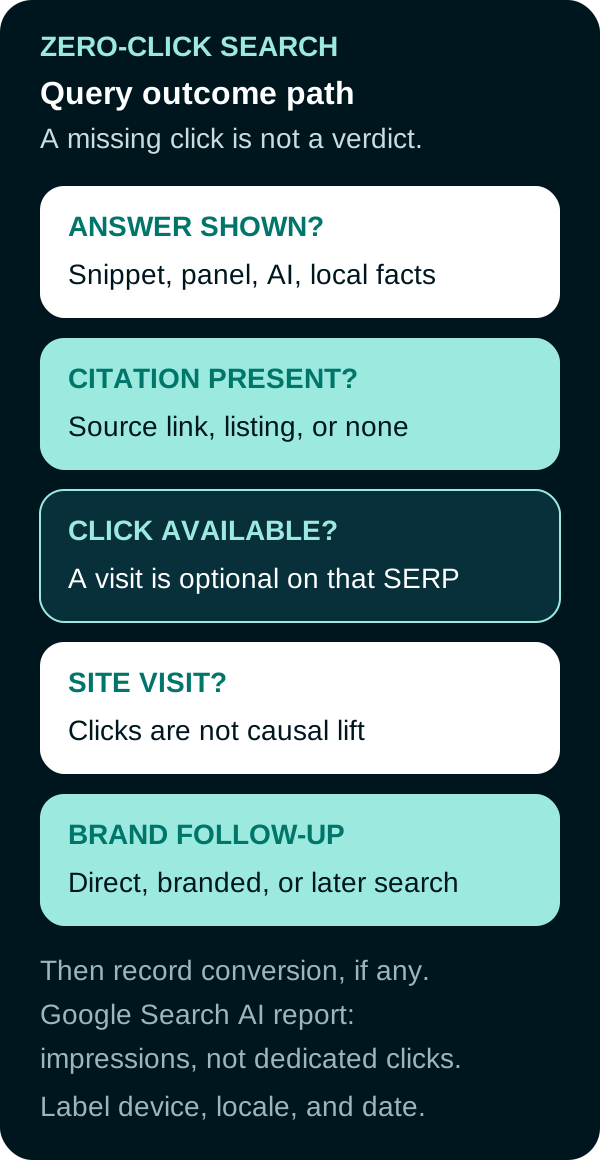
Query-outcome matrix
Separate the story into observable outcomes instead of reducing it to “we lost traffic” or “we gained brand lift.” Score each important query on the live SERP (device, locale, date) and in analytics.
| Outcome to record | Where you see it | What it does not mean |
|---|---|---|
| Answer shown | Snippet, panel, AI feature, local facts | That your page was the source |
| Citation or listing present | Supporting link, Business Profile, text result | That the user noticed it |
| Click available | A URL the user could open | That they will open it |
| Site visit | Search Console clicks, analytics sessions | Causal lift from the feature |
| Branded follow-up | Later branded query, direct, email | That the SERP caused the brand search |
| Conversion | Your goal completions | That Search caused the conversion (that is incrementality, not attribution) |
Answer Engine Optimization work can still aim to be a cited source. Google Search Console’s generative AI performance report currently reports impressions for AI Overviews and AI Mode by page, country, date, and device. It does not publish dedicated clicks or conversions. Availability varies during rollout and with impression volume, so verify the report on the property before building measurement around it.
Google Search ignores llms.txt for Search and generative Search features. That scope is Google Search only.
Frequently Asked Questions
What share of searches are zero-click?
It depends on the study, country, device mix, and definition. SparkToro and Similarweb reported 68.01 percent of US Google searches in January through April 2026 ended without a click. That panel is not every country or the Google mobile app.
Is zero-click search bad for SEO?
Not automatically. Some queries should end on the SERP. Others should still earn a visit. Separate impressions, citations, clicks, branded demand, and conversions. Do not treat a click drop as proof the page got weaker.
Which queries are most likely to be zero-click?
Simple facts, definitions, conversions, hours, and directions often need no site visit. Commercial and branded tasks still often need a click. Confirm on the live SERP for that device and locale.
Does a zero-click result still involve ranking?
Featured snippets are pulled from a page Google is already willing to show. AI features can cite supporting links without using a classic rank slot the same way. Eligibility still starts with being indexed and snippet-eligible.
Sources
- SparkToro, 2024 zero-click search study, published July 2, 2024, accessed September 20, 2026.
- SparkToro, In 2026, less than one third of Google searches still send a click, published June 8, 2026, accessed September 20, 2026.
- Google Search Central, AI features and your website, updated December 10, 2025, accessed September 20, 2026.
- Google Search Central, Featured snippets and your website, updated December 10, 2025, accessed September 20, 2026.
- Google Search Central, Optimizing your website for generative AI features on Google Search, updated July 10, 2026, accessed September 20, 2026.
- Search Console Help, Generative AI performance report (Search), accessed September 20, 2026.
- Google Search Central, Robots meta tag specifications, updated March 24, 2026, accessed September 20, 2026.
PUT THIS KNOWLEDGE TO WORK
NEED MORE HELP?
Talk with our team about applying Zero-Click Search to your marketing.
Get a free marketing audit call