

Hyperlocal Advertising: Trade Areas and Service Radii
Hyperlocal advertising is paid or owned marketing aimed at a small, named area such as a neighborhood, trade zone, or service radius. The useful work is matching that map to what the location can actually fulfill.

Hyperlocal advertising is a paid or owned marketing approach focused on a small, clearly defined area such as a neighborhood, trade zone, or service radius. Location-dependent businesses use it to match a message with nearby demand. Accurate boundaries, local proof, and operational readiness matter more than how small the map looks.
This page is the small-trade-area operations guide. The companion location-based marketing page covers declared versus inferred signals, geofences, beacons, consent, and store-visit validation. Geo-targeting in PPC covers presence versus interest settings on paid search.
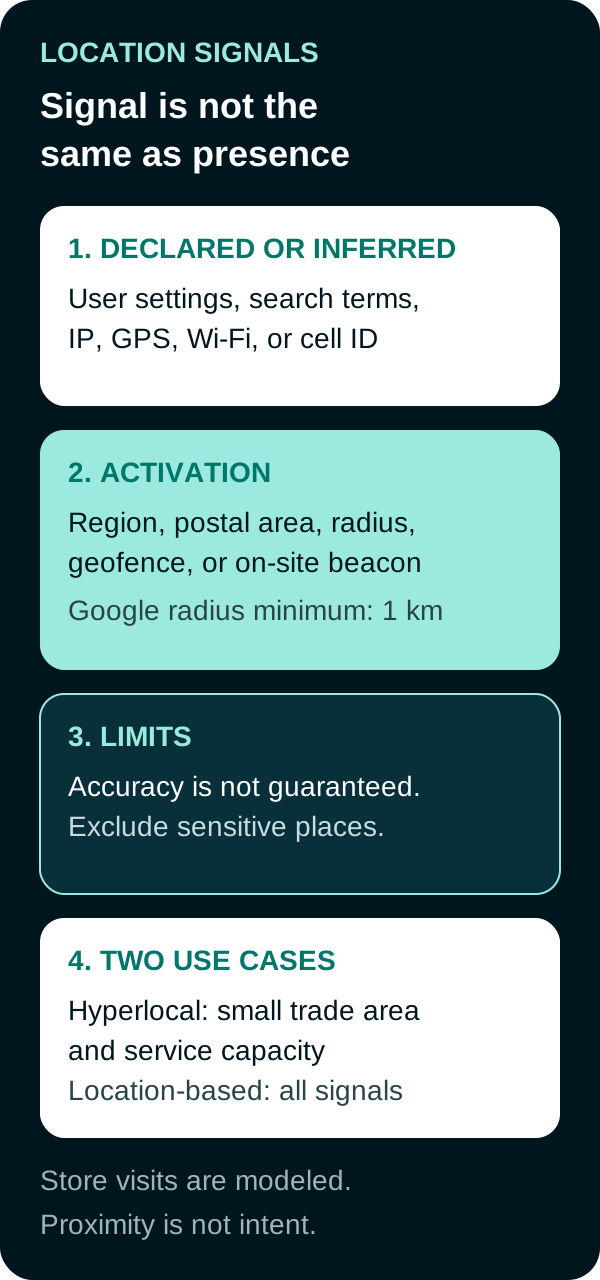
Draw the area from operations, not from a pin
Start with what the location can do on a Tuesday afternoon.
| Shape | Best operational use | Main limit |
|---|---|---|
| Postal area | Planning and reporting against a known ZCTA or postcode | The postcode can cross a river, a highway, or another store’s catchment |
| Radius | A simple service or delivery ring around a point | Includes barriers the driver cannot cross. Google Ads requires at least 1 km |
| Custom boundary | A true service footprint | More upkeep when hours, trucks, or territories change |
Also name:
- Trade area: where customers actually come from, which may not match the city limit.
- Service radius: how far you will travel or deliver, including traffic and staffing.
- Store catchment: the area a single store can fulfill without stealing another store’s inventory.
- Exclusions: places you will not serve, plus platform-sensitive locations you must not target.
Google’s location targeting help says location targeting is a best effort from user settings, devices, and behavior. 100% accuracy is not guaranteed. Small radii or very small locations can show ads only intermittently or not at all because they may miss targeting criteria. Ads will not show against a radius under 1 km.
Presence, hours, and inventory
For a local service, Presence (people in or regularly in the area) is usually the safer advanced option than Presence or Interest. Google recommends Presence when you only want people in the location, or when you are in a sensitive vertical with targeting limits. Default Search and Demand Gen targeting still includes people who showed interest in the place while sitting somewhere else. See Google’s advanced location options.
Match the campaign clock to opening hours and staffing. An ad that sends a same-day booking after the last truck has left creates complaints, not catchment.
Hypothetical local-service example
Hypothetical only. Not an Anderson Collaborative client result.
A two-truck HVAC shop will take same-day calls inside an 8-mile drive of its warehouse, 7:00 a.m. to 6:00 p.m. on weekdays. The team:
- Targets a radius around the warehouse, then switches the campaign to Presence so people searching the city name from another state do not eat the budget.
- Excludes a neighboring town the shop will not drive to, and does not use hospital or other sensitive-location targeting.
- Pauses the campaign outside working hours.
- Compares booked jobs inside the 8-mile ring with Google Ads matched-location rows, knowing those rows can mix presence and interest.
If matched locations show a zip the shop cannot serve, the next change is an exclusion or a tighter Presence setting, not a new slogan.
Sensitive locations and reporting limits
Verify current controls in the platform you are buying.
- Google Ads, housing, employment, and credit: ZIP code location targeting cannot be used for those ads in the United States and Canada. See restricted targeting.
- Google store visits: locations related to religion, sexual interests, children, and certain health issues are sensitive and ineligible for store visit conversions. See About store visit conversions.
- Meta Special Ad Categories (housing, employment, financial products and services): ZIP targeting and location exclusions are unavailable. Selected locations must cover at least a 15-mile (25 km) radius in the US and Canada, or 15 km in Europe. That floor is often too large for a true hyperlocal catchment. See Meta’s Special Ad Category documentation.
Google’s geographic performance report has two views. Targeted locations are the areas you chose. Matched locations are where ads appeared, which can be physical location or location of interest. Distance reports can show a distance greater than your radius because they may measure from a location of interest to the store in the ad.
IAB’s State of Data 2024 survey of more than 500 advertising and data experts found 71% of brands, agencies, and publishers were currently growing or planning to grow first-party datasets, nearly twice the 41% rate from two years earlier. That is dated industry-data context. It is not a hyperlocal performance benchmark.
Our view at Anderson Collaborative: A small map does not guarantee relevance. Pair geography with opening hours, staffing, inventory, and the action a nearby customer can actually take.
Paid media is the related service when hyperlocal findings need campaign execution.

Frequently Asked Questions
What is hyperlocal advertising?
Hyperlocal advertising is paid or owned marketing focused on a small, clearly defined area such as a neighborhood, trade zone, or service radius. It is the small-trade-area application of location-based marketing, not a different physics of location data.
How should a team draw a hyperlocal area?
Draw the area from service capacity: where you can arrive, deliver, or take a store visit. Use postal areas, a radius, or a custom boundary, then exclude places you cannot serve. Google Ads radius targeting requires at least 1 km.
What location restrictions matter for small areas?
Google Ads does not guarantee location accuracy. Housing, employment, and credit ads in the US and Canada cannot use ZIP targeting. Meta Special Ad Category campaigns require a large minimum radius and do not support ZIP or location exclusions. Store-visit reporting excludes sensitive location types.
How do you know if a hyperlocal campaign stayed in area?
Read matched-location reports, not only the targeting list. Google’s matched locations can be physical presence or location of interest, and distance reports can exceed the radius you set.
Sources
- Google Ads Help, Target ads to geographic locations, accessed September 19, 2026.
- Google Ads Help, About advanced location options, accessed September 19, 2026.
- Google Ads Help, About measuring geographic performance, accessed September 19, 2026.
- Google Ads Help, About store visit conversions, accessed September 19, 2026.
- Google Ads Policies, Restricted targeting in Personalized advertising, accessed September 19, 2026.
- Meta, Special Ad Categories, accessed September 19, 2026.
- IAB, State of Data 2024, dated March 14, 2024, accessed September 19, 2026.
PUT THIS KNOWLEDGE TO WORK
NEED MORE HELP?
Talk with our team about applying Hyperlocal Advertising to your marketing.
Get a free marketing audit call