

Linear TV Advertising: Ratings, GRPs, and Channel Choice
Linear TV advertising is commercial inventory inside scheduled broadcast, cable, or satellite programming. Plan it with ratings, reach, frequency, and GRPs, then compare its scheduling and geography with CTV.

Linear TV advertising is commercial inventory delivered inside scheduled television programming on broadcast, cable, or satellite channels. Viewers watch the program as it airs. The buy is priced and planned against a defined universe: a DMA, a cable zone, a national network, or a demographic such as adults 25-54.
It belongs in a media plan when a live event, local news franchise, or broad geographic reach is the job. Evaluate delivery and business outcomes separately. Pair it with connected TV when household targeting or on-demand inventory is the missing piece, and with gross rating points when you need the weight math. Paid media is the execution layer once the channel choice is written down.
How linear inventory is bought and scheduled
Television Bureau of Advertising’s Research 101 (April 2026) is the buying vocabulary used below. Dayparts vary by market. TVB lists common Eastern Time segments such as early morning (5:00-9:00), daytime (9:00-15:00), early news (17:00-19:00), prime (20:00-23:00 Monday-Saturday), and late news (23:00-23:30).
| Buy | What you are purchasing | Geographic control | Typical use |
|---|---|---|---|
| Network | Time on a national feed carried by owned stations and affiliates | National, with limited local cut-ins | Live events, national brand reach |
| Spot TV | Time bought from individual stations | One DMA, or several markets as a national spot list | Local retail, franchise, political |
| Cable / MVPD zone | Insertions on wired cable channels in a defined zone | Finer than a full DMA when the system allows it | Regional offers, dealer groups |
| Syndication | Nationally distributed programs cleared station by station | Depends on the clearance list | Selected program environments |
Broadcast stations are owned-and-operated, affiliates, independents, or public. Affiliates give the network specified hours and program the rest locally. Cable and satellite subscription systems (MVPDs) can carry network or spot advertising. In its traditional distribution definitions, TVB distinguishes local insertion on hard-wired cable from satellite delivery, so confirm the provider and insertion method instead of treating every MVPD buy as one pool.
Spots are sold in standard lengths, most often 15 or 30 seconds, inside commercial pods. Make-good weight is the usual remedy when a spot is preempted or under-delivers the agreed rating, not a sales guarantee.
Linear TV versus CTV and streaming
IAB UK’s CTV definitions keep the terms from collapsing into one another.
| Term | What it is | How ads are scheduled |
|---|---|---|
| Linear TV | Program watched as aired on its original broadcast, cable, or satellite channel | Clock time, daypart, program, and pod |
| Connected TV (CTV) | Internet-connected television environment (smart TV, streaming device, or console) | Audience, household, deal, or platform inventory |
| Over-the-top (OTT) | TV or video delivered over the internet, on any device | Same delivery method, not limited to the living-room screen |
A streaming app on a smart TV is CTV. The same app on a phone is OTT, not linear. Addressable linear overlays on some MVPD systems are still sold against a linear program, with extra household rules. Do not add a linear GRP total to a CTV impression total and call it one reach number. People overlap.
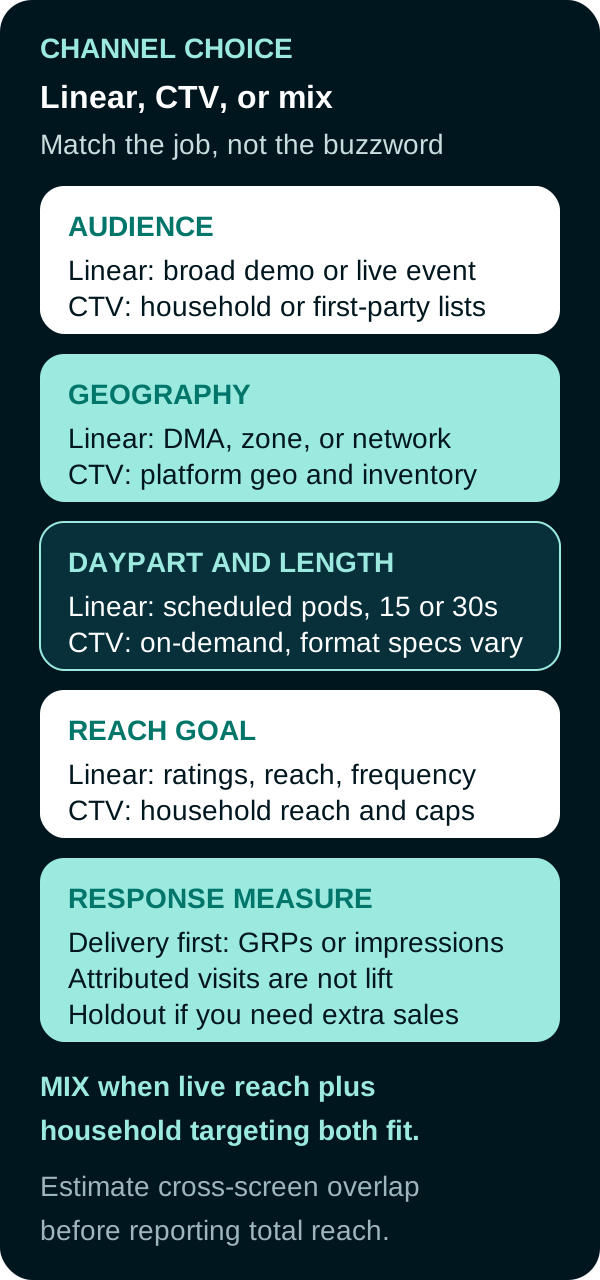
Channel choice worksheet. Ratings and GRPs describe schedule weight; a response study answers a different question.
Ratings, reach, frequency, and GRPs
Nielsen (November 2025) defines a rating as the percentage of the TV-owning population, or a stated demographic universe, that watched a program or commercial during a stated window. Windows include live, live plus same day, live plus 3, live plus 7, and live plus 35. Household ratings and persons ratings are not interchangeable. Nielsen’s audience glossary defines GRPs as the sum of rating points in a broadcast schedule, equivalently reach times frequency, with one rating point equal to 1% of the coverage-base audience.
TVB’s formulas:
Rating points = (audience / universe estimate) x 100
Share (%) = (rating points / HUT or PUT percentage) x 100
GRPs = sum of rating points = reach (%) x average frequency
Gross impressions = (GRPs / 100) x universe
CPP = schedule cost / GRPs
Share is a percent of people using television at that moment. Rating is a percent of the whole universe, including people who were not watching. TVB’s HUT example: the same 20 household share is a 4 rating at a 20 HUT (early morning news) and a 10 rating at a 50 HUT (early evening news). Daypart changes the denominator of opportunity.
Nielsen’s audience-measurement overview notes that US national commercial currency has long used average commercial minute ratings, commonly C3 (live plus three days of playback) and sometimes C7, often against adults 18-49 or another stated demo. Frequency across platforms is hard to control even when the plan is expressed in GRPs.
Worked planning example
Hypothetical one-week spot plan in a single DMA. Illustrative numbers, not a station rate card.
| Input | Value |
|---|---|
| Universe (adults 25-54) | 800,000 |
| Early-news spots | 8 spots at a 5 rating |
| Prime spots | 5 spots at an 8 rating |
| Schedule cost | $160,000 |
- Early news GRPs = 5 x 8 = 40
- Prime GRPs = 8 x 5 = 40
- Total GRPs = 80
- Gross impressions = 0.80 x 800,000 = 640,000
- If delivered unduplicated reach is 40%, average frequency = 80 / 40 = 2.0
- CPP = 160,000 / 80 = $2,000 per GRP
A second plan could also deliver 80 GRPs with 20% reach and frequency 4. Same weight, heavier repetition on a smaller group. Ask for the reach and frequency pair, the universe, the window (C3 versus live), and whether the figure is planned or delivered.
What linear delivery can and cannot measure
Linear reporting answers whether the schedule ran in the right programs, dayparts, and geography, at the agreed ratings. It does not, by itself, tell you whether the spots caused store visits or leads. Matched site visits or promo codes inside a window are attributed response. Extra conversions versus a holdout are incrementality. Keep those three layers separate, the same way the CTV page does.
Creative identifiers (ISCI or Ad-ID) should be consistent across the linear buy and any overlapping CTV or digital video, or you cannot reconcile which cut aired.
Channel-choice worksheet
Score each row, then pick linear, CTV, or a mixed plan. A mixed plan still needs one overlap rule.
| Decision | Linear is a fit when | CTV is a fit when | Mixed plan when |
|---|---|---|---|
| Audience | You need a live-event or broad demo, not a customer list | You have household or first-party audiences the platforms can use | The demo and the list both matter |
| Geography | The trading area is a DMA, a set of stations, or a cable zone | You need zip, radius, or platform geo that linear cannot isolate | Core DMAs on linear, out-of-home-market on CTV |
| Daypart | News, sports, or a specific clock time is the environment | On-demand viewing is acceptable if frequency is capped | Live sports on linear, catch-up on CTV |
| Creative length | You have a 15s or 30s cut that works in a pod | You can meet each publisher’s duration and spec | Same master with length variants |
| Reach goal | Shared reach in a defined universe is the KPI | Household reach and frequency caps are the KPI | You will report unduplicated cross-screen reach |
| Response measurement | Delivery in GRPs, plus a branded search or store-visit read | Platform household matching is available | One incrementality design across both, not two last-touch reports |
Frequently Asked Questions
What is linear TV advertising?
Linear TV advertising is commercial inventory delivered inside scheduled television programming on broadcast, cable, or satellite channels. Viewers watch the program as it airs on that channel, not by picking an on-demand title.
How is linear TV different from CTV and streaming?
Linear TV is a scheduled channel. Connected TV is an internet-connected television screen. Streaming or OTT is internet delivery, which can happen on a TV, phone, or computer. A streaming app on a smart TV is CTV. A 30-second spot in live local news is linear.
How do you calculate GRPs for a linear schedule?
A rating is the percentage of a defined universe watching during the measured window. GRPs are the sum of those ratings across spots, or reach percentage multiplied by average frequency. Equal GRPs can describe very different reach and repetition.
When should a plan use linear TV, CTV, or both?
Use linear when shared live reach, a DMA or zone, and a daypart matter more than household targeting. Use CTV when you need household reach, frequency caps, or first-party audiences on a TV screen. Mix them when both jobs exist, then measure overlap instead of adding the two GRP totals.
Sources
PUT THIS KNOWLEDGE TO WORK
NEED MORE HELP?
Talk with our team about applying Linear TV Advertising to your marketing.
Get a free marketing audit call