

Connected TV (CTV): Transforming Advertising Strategies
Connected TV advertising delivers video ads on internet-connected television screens, including smart TVs and TVs connected through streaming devices or game consoles.
What is connected TV (CTV) advertising?
Connected TV advertising delivers video ads on television screens connected to the internet. The connection may be built into a smart TV or provided through a streaming device or game console.
CTV describes the viewing environment, not one buying platform. Anderson Collaborative can evaluate multiple buying approaches based on geography, audience scale, inventory quality, creative specifications, reach and frequency controls, fees, and measurement needs. Learn more about our CTV marketing agency services.
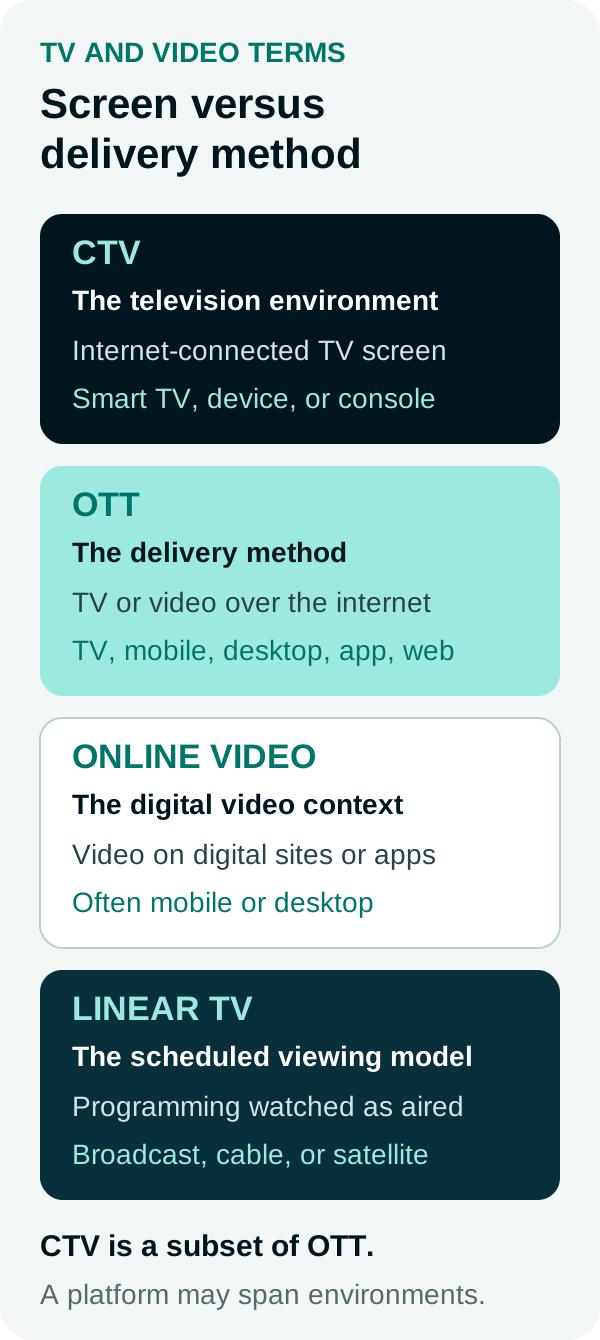
CTV versus OTT, online video, and linear TV
IAB UK’s CTV definitions distinguish the terms clearly: OTT includes television and video content delivered over the internet on televisions, phones, computers, consoles, apps, and the web. CTV is the large television-screen subset of OTT.
| Term | What it describes | Common screen or delivery context |
|---|---|---|
| Connected TV (CTV) | Internet-connected television environment | Smart TV, streaming device, or connected game console |
| Over-the-top (OTT) | TV or video delivered over the internet, bypassing cable, broadcast, or satellite distribution | TV, mobile, desktop, console, app, or web |
| Online video | Video viewed on digital sites or apps | Often desktop or mobile, though definitions vary |
| Linear TV | Scheduled programming watched when broadcast on its original channel | Broadcast, cable, or satellite television |
CTV can complement linear TV advertising rather than replace it. The right mix depends on the audience, geography, viewing behavior, creative, inventory, and ability to measure overlap.

How CTV advertising works
A CTV campaign connects five planning decisions:
- Goal: Define whether the campaign is meant to build qualified reach, introduce an offer, support a launch, or contribute to a broader acquisition plan.
- Audience and geography: Identify the households or market areas the campaign can reach using eligible first-party, contextual, interest, demographic, or in-market signals where available.
- Buying approach and inventory: Compare eligible platforms, publisher access, supply paths, fees, content context, fraud controls, and reporting. No platform provides every audience, publisher, or measurement method.
- Creative: Build video for a large screen with a clear message, visible branding, readable text, a practical next step, and versions that meet the inventory specifications.
- Delivery and measurement: Set budget, flight, pacing, reach and frequency controls, reporting definitions, conversion windows, and any lift design before launch.
Premium publisher deals, private marketplaces, direct buys, and platform-managed inventory can trade reach, cost, transparency, and control differently. “Premium” should describe verified inventory or deal terms, not serve as a substitute for a supply-path review.
What should a CTV campaign measure?
Separate delivery, attributed response, and incrementality.
| Measurement layer | Useful signals | Main limitation |
|---|---|---|
| Delivery | Impressions, reach, frequency, completion, geography, inventory | Does not show business impact by itself |
| Attributed response | Matched site visits, searches, leads, sales, or other defined actions within a window | Credit rules do not prove the ad caused the action |
| Incrementality | Test versus control or another valid lift design | Requires enough scale and a defensible design |
A shared television screen creates an identity gap. Platforms may connect a household ad exposure with later activity through IP, device, identity, or modeled methods. The method, lookback window, match rules, exclusions, and deduplication should be visible in the report.
Read how CTV attribution connects a TV ad to a sale for the mechanics and limitations. IAB’s Standardized Measurement Guide for CTV also explains why fragmented signals and inconsistent standards complicate cross-platform measurement.
CTV planning checklist
- Define the audience and geography before requesting inventory.
- Confirm where ads can run and how the buying platform verifies supply.
- Map each creative version to the required length, aspect ratio, file, audio, and caption specifications.
- Plan household reach and frequency across CTV and any overlapping video channels.
- Separate prospecting from eligible retargeting or first-party audience activation.
- Document budget pacing, inventory exclusions, creative rotation, and decision rules.
- Label observed, attributed, and modeled outcomes separately.
- Choose an incrementality method when the business question is causal lift.
Frequency capping can help manage repetition, but availability and identity resolution vary by buying approach. Bumper ads are a separate short-video format and should not be treated as a substitute for a television commercial without checking the placement and message.
Current market context
IAB’s 2025 Digital Video Ad Spend report said total US digital video ad spend grew 18% year over year in 2024 to $64 billion. The report estimated 2024 CTV ad spend at $23.6 billion, up 16% year over year. These are industry estimates, not Anderson Collaborative results or a forecast for an individual campaign.
FAQs
What is connected TV advertising?
Connected TV advertising delivers video ads on internet-connected television screens, including smart TVs and televisions connected through streaming devices or game consoles.
What is the difference between CTV and OTT?
OTT describes television or video content delivered over the internet across devices. CTV is the large television-screen environment within OTT.
How is CTV advertising measured?
CTV reports commonly include impressions, household reach, frequency, video completion, and attributed site or conversion activity. Attribution should be separated from causal lift, which requires an incrementality method.
When should a brand use CTV?
CTV fits campaigns that need television-scale storytelling with audience, geography, inventory, frequency, and measurement controls. It works best when the creative, reachable audience, budget, flight, and measurement plan support the goal.
Sources
- IAB UK, CTV: Key definitions for the industry, published August 26, 2022, accessed September 19, 2026.
- IAB, Standardized Measurement Guide for CTV, accessed September 19, 2026.
- IAB, 2025 Digital Video Ad Spend & Strategy Full Report, published July 15, 2025, accessed September 19, 2026.
PUT THIS KNOWLEDGE TO WORK
NEED MORE HELP?
Talk with our team about applying Connected TV (CTV) to your marketing.
Get a free marketing audit call