

Brand Safety vs Suitability in Programmatic Ads
Brand safety keeps ads away from illegal or broadly harmful content. Brand suitability adapts placements to a brand's standards for news, politics, health, language, and other sensitive themes.
Brand safety keeps ads away from illegal or broadly harmful content. Brand suitability adapts the remaining placements to a brand’s standards for news, politics, health, language, tone, and other sensitive themes. In programmatic buying, write both sets of rules before launch.
Bring this work into paid media planning before budget, creative, or targeting changes. Programmatic delivery still flows through ad exchanges. Topic alignment without identity targeting is covered in contextual advertising. Safety rules should match how the brand shows up in owned channels and brand consistency work.
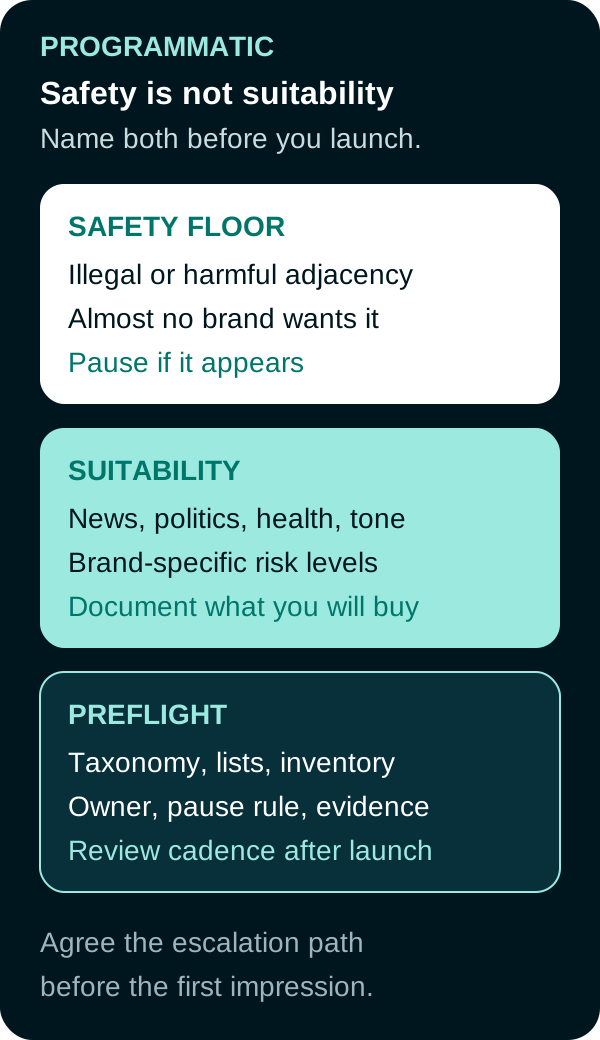
Agree the floor, the suitability level, and the pause rule before the first impression. Category blocks after an incident are slower than that preflight.
Safety, suitability, and language
IAB Tech Lab’s Content Taxonomy is a shared language for describing content for targeting and brand-safety use. Content Taxonomy 3.1 (December 2024) is the current version on that standards page as of this access date. Older 2.2 documentation still describes sensitive-topic categories and risk attributes (floor, high, medium, low) that buyers and vendors map into controls. Use the version your DSP and verification partner actually ingest. Google Ads uses its own content suitability settings. Those are not a drop-in of IAB 3.1.
IAS’s State of Brand Safety (posted January 24, 2024) reported U.S. consumer findings including: 82% said it is important that content surrounding online ads is appropriate; 75% felt less favorable toward brands that advertise on sites that spread misinformation; 51% said they are likely to stop using a product or service of a brand whose ad appears near inappropriate content. That is dated survey research on consumer perception, not a measurement of your campaigns and not an Anderson Collaborative result.
Controls at a glance
| Control | Purpose | Limits |
|---|---|---|
| Blocklists | Exclude named sites, apps, videos, or publishers | Misses new domains. Google Ads: up to 65,000 placement exclusions. Still review live placement reports |
| Allowlists | Run only on pre-approved inventory | Caps reach. Requires an owner who updates the list |
| Category / theme exclusions | Avoid sensitive topics | Tone and UGC can still slip through. Google: content keyword exclusions are exact match, up to 1,000 at account level |
| Inventory type (Google) | The main content-suitability page uses Maximum, Moderate, or Limited inventory | Limited inventory reduces reach. A separate current Video exclusions page still uses Expanded, Standard, and Limited labels, so confirm the labels in the campaign’s current UI |
| Digital content labels | Maturity labels on Display / GVP | As of September 2024, YouTube ads no longer use digital content labels from Brand Safety settings. Labels still apply on the Google Display Network |
| Verification partners | Independent view of where ads served | Reporting lag. MFA and fraud packages vary by vendor |
Google removed parked domains from Search Partner Network serving effective February 10, 2026 and removed the related content-suitability setting.
Preflight workflow
Complete this before campaigns leave draft.
| Step | Owner | What “done” means |
|---|---|---|
| Taxonomy and floor | Brand + media | Written floor (never buy) vs suitability (buy at named risk) |
| Inclusion / exclusion | Media trader | Inventory type, themes, keywords, and lists match that document |
| Allow / blocklist limits | Trader | List size under platform caps. Named person who edits them |
| Placement transparency | Trader | URL or app-level reporting is on |
| MFA and fraud | Verification or trader | Made-for-advertising and invalid-traffic settings from the vendor you actually use are on. Site-level app categorization can miss in-app content |
| Verification timing | Analytics | Pixel or tag from the verification partner fires on the same campaigns |
| Pause rule | Brand lead | Which severity auto-pauses (floor breach) vs reviews in 24 hours (suitability miss) |
| Evidence | Trader | Screenshot, URL, timestamp, creative ID stored when an incident fires |
| Review cadence | Media lead | Placement and verification report date (for example weekly during flight) |
Google documents coverage gaps on some YouTube surfaces, Discover, connected TV, login-walled pages, unsupported languages, and dynamic apps. Use placement and verification reports after launch because preflight settings and live delivery answer different questions.
For open-web buying, ads.txt helps publishers declare authorized digital sellers, while sellers.json helps buyers identify the entities selling or reselling inventory. These files add supply-chain transparency; they complement content controls and placement review.
Incident workflow
- Capture URL or app, creative, timestamp, and campaign ID.
- Score against the written floor vs suitability list.
- If it hits the floor, pause the placement or campaign per the pause rule. Do not wait for the next monthly report.
- File evidence. Expand blocklists only with the new entity, not with a vague keyword that will over-block.
- Review neighboring placements from the same seller.
- After the flight, update the policy with anything the lists missed.

Brand safety requires placement rules and an escalation path before launch. Blocking categories after an incident is slower than agreeing on suitability in advance. Pause a placement when its full context violates the agreed standard.
Frequently Asked Questions
What is brand safety in advertising?
Brand safety uses controls to keep ads away from illegal or broadly harmful content. Brand suitability adapts the remaining placements to a brand’s standards for news, politics, health, language, tone, and similar themes.
Why does brand safety matter in programmatic?
Programmatic buying can place ads across many sites and apps in real time. Inventory settings, exclusions, lists, verification, and placement review help a team apply its policy at that scale and respond quickly when a placement misses the standard.
What is a brand safety blocklist?
A blocklist is a list of sites, apps, videos, or categories where the advertiser refuses to run. An allowlist is the inverse: only named inventory. Lists have size limits and still miss new domains, so they sit next to taxonomy, verification, and placement reports.
How does contextual targeting relate to brand safety?
Contextual targeting matches ads to page or video topic. It can support suitability when categories are defined, and it can still miss tone, user-generated comments, or MFA inventory. Pair it with verification and a pause rule rather than treating topic match as a safety guarantee.
Sources
- IAB Tech Lab, Content Taxonomy, accessed September 20, 2026.
- Google Ads Help, About content suitability, accessed September 20, 2026.
- Google Ads Help, About content exclusions for Video campaigns, accessed September 20, 2026.
- Google Ads Help, Content suitability announcements, accessed September 20, 2026.
- IAB Tech Lab, ads.txt, accessed September 20, 2026.
- IAB Tech Lab, sellers.json, accessed September 20, 2026.
- Integral Ad Science, The State of Brand Safety, posted January 24, 2024, accessed September 20, 2026.
- IAB, Understanding Brand Safety and Brand Suitability in a Contemporary Media Landscape, December 2020, accessed September 20, 2026.
PUT THIS KNOWLEDGE TO WORK
NEED MORE HELP?
Talk with our team about applying Brand Safety to your marketing.
Get a free marketing audit call