

Prompt Engineering: Brief, Constraints, and Review
Prompt engineering is the work of writing a model's task, context, limits, and examples so the first draft is usable. It is one control, not the whole production system.

Prompt engineering is the practice of writing a model’s instructions so the output is specific enough to use. The wording, context, examples, and requested format all change what comes back. The same model can return a generic paragraph or a usable draft depending on the brief.
Google Cloud’s prompt engineering guide, last updated May 4, 2026, treats a prompt as the input that supplies format, context, and examples. Generated content creation turns that brief into a repeatable workflow with a human still owning the ship decision.
Prompt design is not the only lever on generative AI. Model choice, source files, retrieval-augmented generation, and review all change quality. Anthropic’s prompt-engineering overview says to define success criteria and a way to test them before tuning wording.
The loop: brief, generate, score
A large language model predicts the next tokens from the text it receives. The prompt is that working context. A one-line request leaves the model to guess audience, offer, and tone.
Use this loop:
- Brief. Name the task, the audience, and the decision the draft must support.
- Context. Paste only approved facts: product, offer, proof, and any source the model may use.
- Constraints. Length, tone, format, words to avoid, and claims that need a source.
- Example. One on-brand sample, or a few-shot pair when the format is strict.
- Output. Treat the result as a draft.
- Evaluation. Score it, then revise the brief if the same miss repeats.
Google Cloud groups common techniques as zero-shot (instruction only), few-shot (one or more input-output examples), and chain-of-thought (ask for steps on a multi-part task). Most brand work benefits from a few-shot sample pulled from real copy, because that is how the model sees the voice instead of a generic marketing tone.
Weak prompt versus usable prompt
- Weak: “Write an ad for our new running shoe.”
- Usable: “Write three Meta primary texts, 125 characters or fewer, for a lightweight trail shoe aimed at new trail runners. Use a confident tone. Do not use unleash or conquer. Ground the draft in this fact sheet. Match this sample line.”
The weak prompt forces the model to invent audience, length, and voice. The usable prompt removes those guesses. That is why the first pass is more often editable.
A reusable marketing prompt
Copy this template and fill every bracket. Leave a field blank only if it does not apply.
Task: [one job, such as three subject lines]
Audience: [who they are and what they already know]
Offer: [product, price, or next step]
Facts you may use: [bullets from an approved source]
Facts you must not invent: [specs, testimonials, legal claims]
Tone and length: [voice, character or word limit]
Format: [subject lines, bullets, table]
Example of the voice we want: [one real line]
Review test: the draft must stay inside the facts and end with a clear action
Scored review
Score the draft from 1 (fail) to 5 (ready) on each row. Ship only when every row is 4 or 5, or send it back with the failing row named.
| Test | 1 | 3 | 5 |
|---|---|---|---|
| Accuracy | Invents a spec or result | Mostly right, one unchecked claim | Every fact traces to the brief |
| Audience fit | Speaks to the wrong person | Generic but not wrong | Uses the named reader’s situation |
| Source use | Ignores the fact sheet | Uses some facts, adds extras | Stays inside the supplied source |
| Tone | Off-brand or cliché | Close, one wrong register | Matches the example and limits |
| Actionability | No next step | Vague CTA | One action the reader can take |
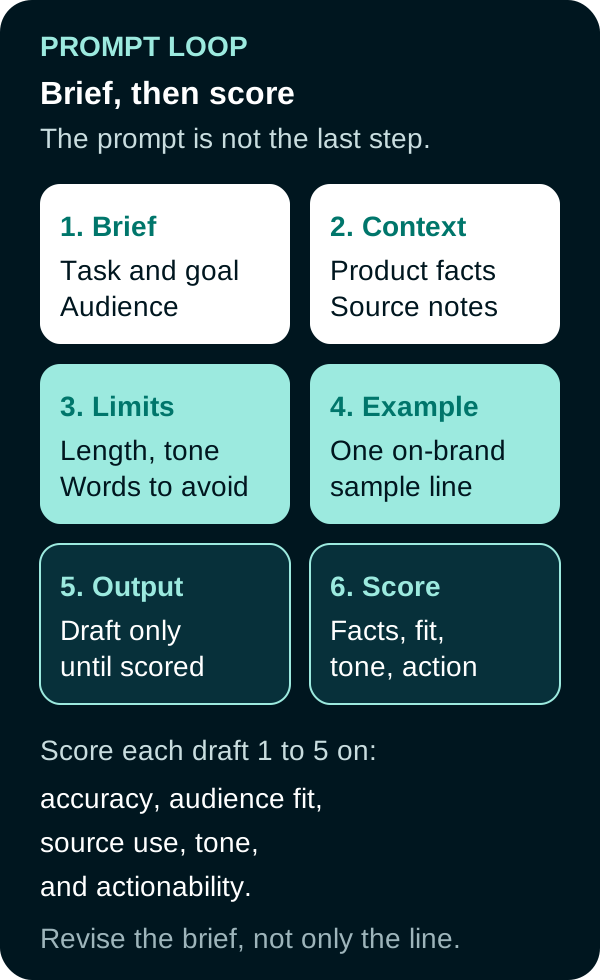
If a draft fails accuracy or source use, revise the brief and the source, not only the adjectives.
OpenAI’s prompt engineering guide and Google’s Gemini prompting strategies document product-specific tactics on top of this loop. Version the prompt with the model or product name, because a later release can change how instructions are followed.
Frequently Asked Questions
Is prompt engineering the main way to control generative AI?
No. It is one lever. Model or product choice, source material, retrieval, evaluation, and human approval also change the result. A polished prompt cannot fix a missing brief.
What belongs in a marketing prompt?
The task, audience, product facts, constraints, output format, and one on-brand example. Google Cloud lists format, context, and examples as core building blocks.
Do ChatGPT, Claude, and Gemini need different prompts?
The same brief structure transfers. Each product handles long context, tools, and formatting differently, so keep a short note of what that product accepts and retest after a model change.
How is prompt engineering different from RAG?
Prompt engineering shapes one request. Retrieval-augmented generation adds passages from an index before the model writes. The two can run together. Neither replaces a review.
Sources
- Google Cloud, Prompt engineering: overview and guide, last updated May 4, 2026, accessed September 20, 2026.
- Anthropic, Prompt engineering overview, accessed September 20, 2026.
- OpenAI, Prompt engineering, accessed September 20, 2026.
- Google AI for Developers, Gemini prompting strategies, accessed September 20, 2026.
PUT THIS KNOWLEDGE TO WORK
NEED MORE HELP?
Talk with our team about applying Prompt Engineering to your marketing.
Get a free marketing audit call