

Generative AI in Marketing: Uses, Risks, and Approval
Generative AI creates new marketing material from a prompt. Treat each use as a bounded task with named inputs, a review test, and an approval path.

Generative AI creates new content from a prompt instead of only classifying or scoring existing data. Outputs can be text, images, video, audio, or code. In marketing, the same class of tools can draft an email, produce a product image, or write headline variants from patterns learned in training.
IBM’s overview of generative AI, updated March 18, 2026, describes those model families and the training, tuning, and generation steps behind them. Marketing teams use generated content creation to produce governed assets without handing editorial approval to the model.
A large language model is the usual engine for text tools. Image and video tools often use diffusion models. The shared contract is the same: you supply a prompt, and the system generates rather than retrieves a stored answer.
Uses that stay useful
Common marketing jobs become easier to govern when each one has a review rule.
- Copy and drafting. First-pass ads, subject lines, landing-page sections, and captions. A human editor still owns accuracy and voice.
- Image and video generation. Product mockups, lifestyle stills, and short variants when a full shoot is not required for every cut.
- Personalization at scale. Many message or creative variants for named segments, each checked against the offer that segment can actually receive.
- Research and summarization. Condensing reviews, call notes, or competitor pages into a brief that a person then verifies.
- Code and automation. Draft tracking snippets or page markup that a developer reviews before any tag goes live.
Output quality still depends on the brief. Prompt engineering is one input, not the whole control system. Source files, brand limits, evaluation, and approval matter as much as wording.
Ideation is not the same job as a live send
| Use | Typical input | Main failure | Who approves |
|---|---|---|---|
| Ideation | A brief and examples | Generic language, copied claims | Editor, before any public use |
| Transformation | Approved copy or a transcript | Tone drift, dropped caveats | Editor who owns the original |
| Analysis | A spreadsheet, call log, or report | Invented totals or false patterns | Analyst who can open the file |
| Generation | Product facts plus brand limits | Wrong specs, unlicensed likeness | Brand and legal as needed |
| Customer-facing automation | Live customer data plus a script | Privacy leak, wrong promise | Channel owner before send |
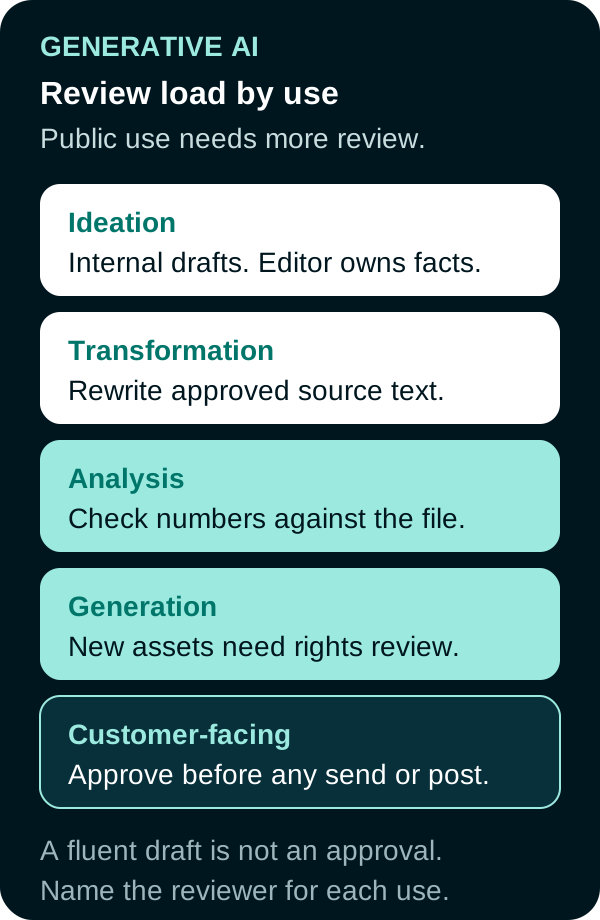
Move a use from left-column drafting to a live customer touch only after a named reviewer can check facts, rights, and privacy.
Analytical AI still does a different job. Bid systems, fraud scores, and churn models classify or predict. Generative systems create material a person can see. Many stacks run both: one system ranks spend, another drafts the asset.
Rights, privacy, and claims
Three controls belong on the approval path, not in a later cleanup.
Rights in the United States. The U.S. Copyright Office’s January 29, 2025 Part 2 report says generative outputs are copyrightable only when a human determined sufficient expressive elements. Prompts alone are not enough. Using a model as an assistant inside a larger human-made work can still leave the human contribution protectable. That copyrightability finding does not grant permission to reuse a third party’s images or brand assets.
Privacy. Data handling differs by product and plan. Before using customer records, unpublished pricing, or non-public briefs, check the vendor contract, retention and training settings, and your own data policy. Keep the material out when that use is not authorized.
Claims in U.S. advertising. The FTC’s Keep your AI claims in check guidance treats unsubstantiated AI performance claims as ordinary deception. The same standard applies to marketing copy the model writes. If the draft says “most customers save 40%,” the file that supports that number has to exist.
Approval path
- Name the use from the table. Ideation can stay internal. Customer-facing automation cannot.
- Attach the source: product sheet, approved brief, or data file. If the source is missing, stop.
- Generate a draft. Keep the prompt, model or product name, and date with the file.
- Score the draft for facts, audience fit, rights, privacy, and tone.
- A named reviewer ships, revises, or rejects. Record the decision.
Frequently Asked Questions
Is generative AI the same as ChatGPT?
No. ChatGPT is one product built on generative models. Generative AI also includes image, video, audio, and code tools, plus models that sit inside other products.
Does a fluent draft mean the facts are right?
No. The model produces plausible language or imagery from patterns, not a verified lookup. Check claims, numbers, names, and rights against approved sources before publication.
Do marketers have to disclose AI-generated content?
There is no universal disclosure rule. Follow the rules for the channel and jurisdiction, keep an internal record of model assistance, and disclose when leaving it out would make a material representation misleading.
Who should approve customer-facing generative AI?
A named person who owns the channel. That reviewer checks facts, brand voice, privacy, and rights, then records a ship, revise, or reject decision.
Sources
- IBM, What is generative AI?, updated March 18, 2026, accessed September 20, 2026.
- U.S. Copyright Office, NewsNet 1060, Copyrightability of generative AI outputs, January 29, 2025, accessed September 20, 2026.
- Federal Trade Commission, Keep your AI claims in check, February 27, 2023, accessed September 20, 2026.
PUT THIS KNOWLEDGE TO WORK
NEED MORE HELP?
Talk with our team about applying Generative AI to your marketing.
Get a free marketing audit call