

Answer Engine Optimization: Structure Answers for Citation
Answer Engine Optimization (AEO) is the work of making a page easy to quote as a direct answer: a clear task, a self-contained response, visible proof, and crawlable HTML. It is not a substitute for SEO, and it does not guarantee citations.

Answer Engine Optimization (AEO) structures a page so an answer engine can quote it: a user task, a direct answer, proof, and enough entity context to know who and what the page is about. In Google Search, the page still has to be indexed and eligible to appear with a snippet. Other answer products set their own retrieval and citation rules.
Connect that work to answer engine optimization services when you need a program, not a one-off page. Related surfaces include Google AI Overviews and generative engine optimization.
AEO, SEO, and GEO
| Discipline | Job | Typical measurement |
|---|---|---|
| SEO | Discover, index, and rank pages in classic results | Rankings, clicks, organic sessions |
| AEO | Be quotable in search and assistant answer features | Mentions, citations, and (on Google) Search Console generative AI impressions |
| GEO | Be cited across generative engines more broadly | Citation sets and share of answers on a prompt list |
They stack. SEO without a clean answer leaves engines with a blob. AEO without crawl access leaves a perfect paragraph unpublished. GEO research is not a guarantee that any one tactic will move your site.
Aggarwal et al., Generative Engine Optimization (arXiv:2311.09735) (v3, June 28, 2024; accepted to KDD 2024), reported that tested methods improved visibility up to 40% inside the authors’ GEO-bench evaluation. That is a study result on the authors’ engines and methods. It is not a forecast for Google AI Overviews, ChatGPT, or any live property.
What Google actually documents
AI features and your website (updated December 10, 2025) says the same technical requirements as Search apply: the page must be indexed and eligible to show with a snippet. No additional technical requirements, no special schema.org type, and no new machine-readable AI file are required to appear as a supporting link in AI Overviews or AI Mode. Inclusion is not guaranteed even when those conditions are met.
Google’s guide to optimizing for generative AI features (last updated July 10, 2026) adds operator facts. From Google Search’s perspective, “AEO” and “GEO” are industry labels for work that is still SEO. A site must be included in Search generative AI features in Search Console to stay eligible for those Google Search features. Search Console Help says that control rolled out to all websites on August 31, 2026, defaults to Include, and is not a ranking signal for the rest of Search. Exclude is a visibility switch, not an optimization tactic.
The same guide is explicit that Google Search does not use llms.txt. Keeping the file neither helps nor hurts visibility in Google Search. That statement applies to Google Search only. Other services can still read the file. See what llms.txt is. The guide also says you can ignore, for Google Search, “chunking” copy for machines, rewriting only for AI systems, chasing inauthentic mentions, and extra schema invented for AI Overviews.
The Search Generative AI performance report documents impressions in AI Overviews and AI Mode: how often links to a site were shown in those features. Those impressions can be grouped by page, country, date, and device. Google does not document dedicated clicks or conversions in this report. The same impression data is also included in overall Search performance. A June 3, 2026 announcement said the reports rolled out worldwide as of August 31, 2026. Help says a property may not see the report if it has not received enough generative AI impressions, if access is still rolling out, or if the site is excluded from Search generative AI features. Neither Google report is a citation tracker for ChatGPT or Perplexity. RankPrompt is one way to record mentions across other engines. Treat it as measurement, not as proof that a tactic caused the mention.
FAQPage markup does not restore a Google FAQ rich result. Google’s Search documentation updates record that FAQ rich results stopped appearing in Search on May 7, 2026. Visible question-and-answer sections can still help readers. Do not add FAQ schema as a current Google rich-result tactic, and do not claim it produces AI citations.
Question-to-answer brief
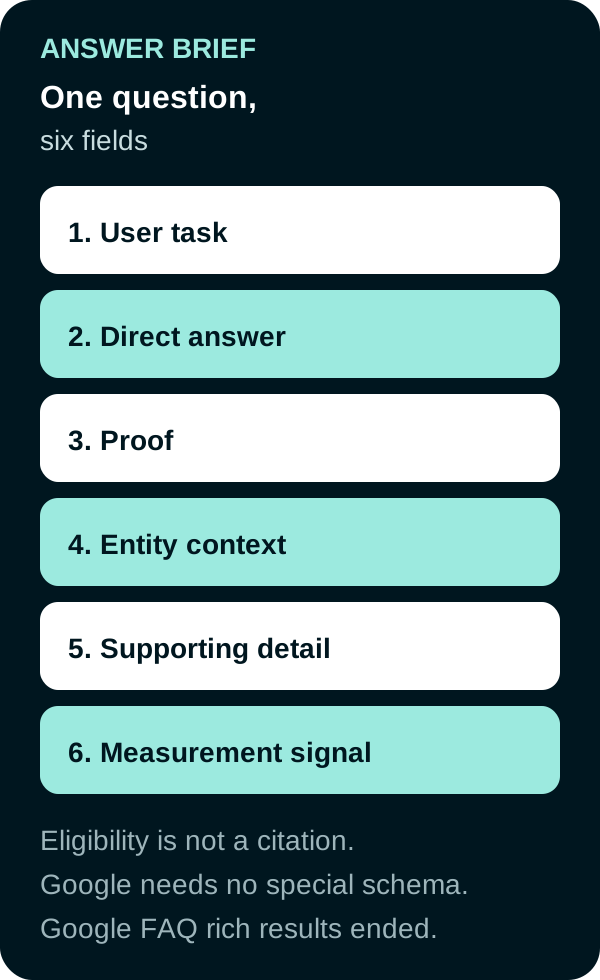
Write the brief before you draft. If a section cannot fill a field, cut it.
| Field | What to write | Fail if |
|---|---|---|
| User task | The job the asker is trying to finish | The heading is a keyword, not a question they would ask |
| Direct answer | One or two sentences that stand alone | The answer is buried under preamble |
| Proof | Primary source, date, and scope | A statistic with no publisher |
| Entity context | Who, what product, what place, what version | Pronouns with no name |
| Supporting detail | Limits, exceptions, next step | Extra sections that do not change the answer |
| Measurement signal | Which query, engine, or Search Console view you will watch | ”Traffic” with no query set |
Hypothetical brief for “What is an attribution window?”:
- Task: Choose a click window that matches purchase lag.
- Answer: An attribution window is the period after an eligible click or view when a platform may credit a conversion.
- Proof: Google Ads conversion windows, cited from Help, with the product and date.
- Entity: Google Ads, not “ads platforms” as a blob.
- Detail: View-through is a different clock.
- Signal: Classic Search impressions, clicks, and visits for the query set; dedicated generative AI impressions where available; and a separate observation of whether the page is cited for the question.
Practical page work
- Lead with the answer, then add exceptions.
- Keep the answer in HTML text, not only in an image or a PDF.
- Use structured data only when it describes visible content. It can clarify entities. It does not buy a citation.
- Make robots, canonicals, and internal links boring and correct.
- Measure the query set you care about. Rising impressions alongside falling clicks is a diagnostic signal, not proof that an answer feature absorbed the click. Check query mix, classic Search data, generative AI impressions where available, citations, and downstream visits before deciding what changed.
llms.txt remains optional. Google Search does not use it. Other platforms may. Keep the file if a system you care about, other than Google Search, reads it.
Frequently Asked Questions
What is the goal of Answer Engine Optimization?
To make a page easy to retrieve, trust, and quote when someone asks a question of a search or assistant feature. Mentions and citations are the visibility signals. They are not guaranteed by markup or by length.
Is AEO replacing SEO?
No. SEO keeps the page discoverable and eligible. AEO focuses on whether a passage can stand as an answer. Google’s current Search guide treats AEO and GEO as industry labels for Google Search work that is still SEO. Other engines remain a separate measurement surface.
How is AEO different from GEO?
The labels vary by practitioner. One useful distinction treats AEO as work for search and assistant answers, while GEO covers visibility across generative engines more broadly. The page work overlaps, but each product needs its own measurement.
Does FAQ schema make Google show a rich result or an AI Overview?
No. Google stopped showing FAQ rich results in Search on May 7, 2026. Google also says no special schema or AI text file is required for AI Overviews or AI Mode. Keep visible FAQs when they help readers.
Sources
- Google Search Central, AI features and your website, last updated December 10, 2025, accessed September 20, 2026.
- Google Search Central, Optimizing your website for generative AI features, last updated July 10, 2026, accessed September 20, 2026.
- Search Console Help, Generative AI performance report (Search), accessed September 20, 2026. Impressions only; page, country, date, and device dimensions. Availability caveats include insufficient impressions.
- Google Search Central, Introducing Search Generative AI performance reports, June 3, 2026, accessed September 20, 2026. August 31, 2026 worldwide note is dated product context.
- Search Console Help, Search generative AI control, accessed September 20, 2026. Control rollout dated August 31, 2026; not a ranking signal.
- Google Search Central, Search documentation updates, accessed September 20, 2026. FAQ rich results stopped appearing May 7, 2026.
- Aggarwal et al., Generative Engine Optimization, arXiv:2311.09735v3, June 28, 2024, accepted to KDD 2024, accessed September 20, 2026.
- RankPrompt, accessed September 20, 2026.
PUT THIS KNOWLEDGE TO WORK
NEED MORE HELP?
Talk with our team about applying Answer Engine Optimization (AEO) to your marketing.
Get a free marketing audit call