

Generative Engine Optimization: Content and Measurement
Generative engine optimization makes a page easier for AI answer systems to use as a source. Pair clear, well-supported content with a repeatable visibility log.

Generative engine optimization (GEO) is the practice of making content easier for generative answer systems to retrieve, understand, and cite. The useful parts look like ordinary publishing: a direct answer, evidence a reader can check, consistent organization details, and pages that crawlers can fetch. Schema markup and answer engine optimization sit next to that work. None of them is a promise that an engine will quote you.
Google’s guide to optimizing for generative AI features, updated July 10, 2026, is explicit about Google Search: AI Overviews and AI Mode are rooted in core ranking and quality systems. Google says the same SEO fundamentals still apply, that there is no special AI markup, and that there is no ideal page length. From Google Search’s point of view, “AEO” and “GEO” are labels people use for visibility in AI search. The work is still SEO.
GEO, AEO, and SEO
Keep the labels if they help a meeting. Keep the measurements separate.
| Discipline | Usual aim | What you can count |
|---|---|---|
| SEO | Eligible, useful pages in classic results | Rankings, clicks, and organic sessions in your own reports |
| AEO | Being used as an answer on search or assistant surfaces | Mentions and citations on those surfaces |
| GEO | Being used inside a generated answer on any engine you choose to watch | Mentions, citations, and answer role on a dated prompt set |
A page can rank and never be quoted. A page can be quoted and send no useful visit. AEO services is the related Anderson Collaborative service when the next step is execution, not a new metric name.
What Google Search documents
For Google Search only, current documentation supports these limits:
- No special AI file or schema. Google Search ignores
llms.txtand similar machine-readable AI files. Creating one for other systems neither helps nor hurts Google Search. - No ideal length and no required chunking. Write for the reader. Google says its systems can use part of a longer page.
- Eligibility is ordinary Search eligibility. A page must be indexed and allowed to show a snippet. Indexing is not guaranteed.
- Retrieval is part of the product. Google describes retrieval-augmented generation, also called grounding, plus query fan-out: related searches used to gather supporting pages.
That is product behavior, not a tactic that proves more leads.
A source-backed workflow
- Build the core prompt set from non-brand questions a real buyer asks. Track branded checks separately, and skip fan-out variations that do not represent a distinct need. Google’s guide warns that making a separate page for every wording, mainly to manipulate AI responses, can violate scaled-content-abuse rules.
- Answer the question in the first sentences of the relevant section, then add the evidence.
- Attach a source to each material claim. Keep name, address, and product facts consistent with other trusted listings.
- Use structured data when it matches visible content and supports a documented rich result. Do not add it as AI-only markup.
- Log visibility with the table below. Then check whether a cited visit did anything useful.
Aggarwal and colleagues, in GEO: Generative Engine Optimization (KDD 2024; arXiv 2311.09735), tested content edits on GEO-bench, about 10,000 queries. In that testbed, adding quotations, statistics, or citations raised their Position-Adjusted Word Count visibility metric by up to about 40% relative to an unoptimized baseline (Table 1 reports a 41% lift for the best method on that metric, and 28% on Subjective Impression). They also reported visibility improvements up to 37% on Perplexity.ai in that study window. Those figures are share-of-answer metrics inside a 2023-2024 research design. They are not clicks, leads, or current-engine guarantees. Keyword stuffing did not help in their tests.
Prompt-set visibility log
Use one row per engine per query. Repeat the set on a fixed cycle.
| Field | What to write |
|---|---|
| Engine | The product name, such as AI Overview, AI Mode, ChatGPT, or Perplexity |
| Date | The day and time of the check |
| Query | The exact wording |
| Citation | The URL the answer linked, or none |
| Mention | Whether the brand was named |
| Answer role | Supporting source, passing mention, or absent |
| Follow-through | Whether a visit, lead, or sale continued from that answer |
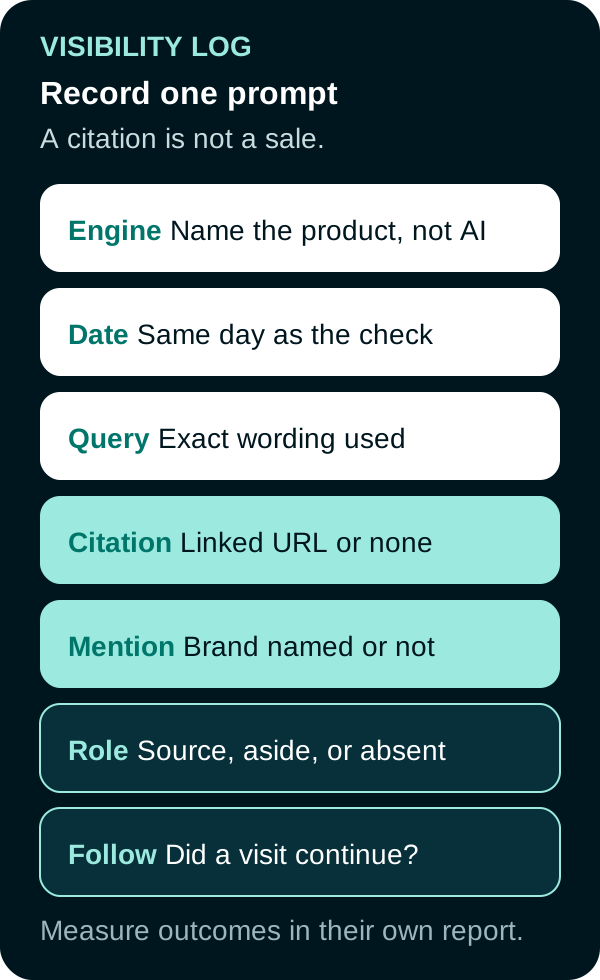
A citation or mention records visibility. Evaluate visits, qualified leads, and sales in their own reports.
Measuring Google AI features
Google announced Search generative AI performance reports on June 3, 2026, and noted a worldwide rollout as of August 31, 2026. The Search Console Help article says the Search report covers impressions in AI Overviews and AI Mode, grouped by page, country, date, and device. It does not provide dedicated clicks or conversions for those features. A property can still lack the report when impressions are too low, when the site is excluded from Search generative AI features, or while rollout details still apply.
Third-party visibility tools can help a workflow. Google says none of them has access to internal ranking or AI systems.
Frequently Asked Questions
What is generative engine optimization?
GEO is the practice of making content easier for generative answer systems to retrieve, understand, and cite. On Google Search, Google says that work is still SEO, not a separate technical track.
How is GEO different from SEO and AEO?
SEO covers discovery and ranking in classic results. AEO focuses on answer surfaces such as overviews and assistants. GEO is the broader label people use for citations inside generated answers. The labels overlap. The measurements do not have to.
Does Google Search use llms.txt for GEO?
No. Google’s July 10, 2026 AI optimization guide says Google Search ignores llms.txt and other special AI files. Other products may read the file. That does not change Google Search.
What should a team measure for GEO?
Record engine, date, query, citation, mention, answer role, and whether a visit followed. In Google Search Console, the generative AI report shows impressions for AI Overviews and AI Mode by page, country, date, and device. It does not provide dedicated clicks or conversions.
Sources
- Google Search Central, Optimizing your website for generative AI features, updated July 10, 2026, accessed September 20, 2026.
- Google Search Central, AI features and your website, last updated December 10, 2025, accessed September 20, 2026.
- Google Search Central Blog, Introducing Search Generative AI performance reports, June 3, 2026, accessed September 20, 2026.
- Search Console Help, Generative AI performance report (Search), accessed September 20, 2026.
- Aggarwal et al., GEO: Generative Engine Optimization, arXiv:2311.09735, KDD 2024, accessed September 20, 2026.
PUT THIS KNOWLEDGE TO WORK
NEED MORE HELP?
Talk with our team about applying Generative Engine Optimization (GEO) to your marketing.
Get a free marketing audit call