

Influencer Attribution: Measuring Marketing Results
Influencer attribution can mean tracked response, assigned credit, or incremental sales. Use the measurement ladder and a creator tracking worksheet.

Influencer attribution connects creator activity with customer actions and business outcomes. Those connections fall into three different claims: deterministic response, assigned credit, and causal incrementality. No single method captures all effects.
Common signals include tracked links, codes, landing pages, surveys, and lift tests. Reporting should name which claim is being made. Influencer work also connects with first-click attribution, marketing attribution, and reporting and analysis.
IAB’s 2025 creator economy ad spend report projected $37 billion in US creator ad spend for that year. That figure describes market scale. It does not validate a tracking method.
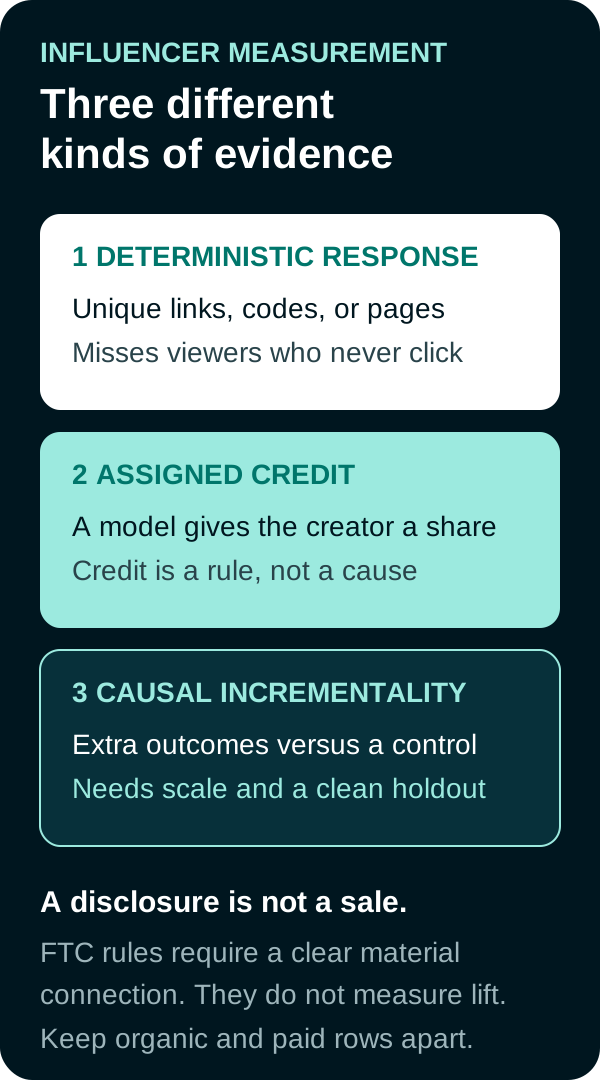
Planning diagram. The three rungs are different evidence types, not a product screenshot.
Measurement ladder
| Rung | What you can say | Typical inputs | Main failure mode |
|---|---|---|---|
| Deterministic response | This unique link, code, or page produced these recorded actions | Distinct UTMs, codes, landing pages | Misses people who saw the post and bought another way |
| Assigned credit | A model or rule gave this creator a share of a conversion | Last click, first click, data-driven, or survey | Credit follows the rule, not proof the post caused the sale |
| Causal incrementality | These extra outcomes happened versus a valid control | User or geo holdout with protected contamination | Needs scale; leaked codes and overlapping audiences bias the gap |
Do not roll the three rungs into one “influencer ROAS” number without labeling them.
Creator-level tracking and reconciliation worksheet
Give each creator distinct inputs before the first post:
- A unique destination URL with stable
utm_source,utm_medium,utm_campaign, andutm_contentvalues. Google’s campaign URL guidance treats those values as case-sensitive. Always set source, medium, and campaign when you add parameters. - A unique promo or offer code that is not printed on packaging or shared in a brand-wide FAQ.
- A unique landing page only when the offer truly differs. Reusing one page with different UTMs is usually enough and easier to QA.
Then reconcile weekly.
| Field | What to record |
|---|---|
| Creator and post IDs | Handle, deliverable, live dates |
| Organic vs paid | Organic post, paid partnership ad, or brand-boosted amplification, on separate rows |
| Unique link results | Sessions, key events, revenue from that URL only |
| Unique code results | Orders and revenue that used that code |
| Overlap | Orders that used both the link and the code |
| Distinct deterministic orders | Link orders + code orders minus overlap |
| Platform-reported results | Creator or network dashboard clicks, views, and attributed sales |
| Site and sales results | Analytics, Shopify or CRM, and finance |
| Unknown sales | Survey mentions, untagged branded search, retail, or wholesale |
| Code leakage | The creator’s code used on other creators, group chats, or coupon sites |
| Holdout status | None, contaminated, underpowered, or valid |
Worked hypothetical numbers
Hypothetical two-creator week for a direct-to-consumer brand. Figures are illustrative, not a benchmark.
| Field | Creator A | Creator B |
|---|---|---|
| Setup | Unique link and code; organic posts only | Unique link and code; same post also boosted with $1,200 paid spend |
| Unique link orders | 80 | 40 |
| Unique code orders | 37 | 68 |
| Overlap (same order had both) | 12 | 8 |
| Distinct deterministic orders | 105 | 100 |
| Platform-reported “sales” | 140 | 175 |
| Code seen on a coupon gallery | 9 orders | 0 |
| Survey “saw a creator” with no code or click | 15 | 4 |
Reconciliation for Creator A: 80 + 37 - 12 = 105 distinct tracked orders. The platform’s 140 still includes modeled or last-touch credit the site cannot match. The 9 leaked-code orders are not Creator A’s unique response. The 15 survey mentions are unknown sales, not tracked conversions.
Reconciliation for Creator B: 40 + 68 - 8 = 100 distinct tracked orders. The $1,200 boost is paid amplification of the same asset. Do not add organic views and paid impressions into one reach number, and do not call the 100 orders incremental. A last-click model might assign some of those orders to paid social instead of the creator handle. That is assigned credit, not a second set of sales.
Unknown sales remain unknown. Do not force them into last click to make ROAS match the insertion order.
Organic posts versus paid amplification
Organic creator content and paid amplification of that content are different buys.
- Report organic posts on their own row: unique link, unique code, contract fee.
- Report paid amplification on its own row: media spend, paid clicks, paid-platform attribution.
- If the brand boosts the creator’s post, the same person can appear in organic views, paid impressions, and site analytics. Overlap is expected.
- If the creator’s code is in the caption and in a paid comment, code sharing will rise. That inflates deterministic code counts for people who never followed the creator.
Holdout design limits
A lift test can estimate extra sales, but creator programs leak:
- Followers in the control still see screenshots, stitches, and shared codes.
- Retail or Amazon listings do not carry the unique URL.
- A geo holdout still receives national PR and other creators.
- Small audiences often cannot support a user-level holdout with a useful minimum detectable effect.
If the control is contaminated or the test is underpowered, report the result as inconclusive. Do not substitute assigned credit and call it incrementality. See conversion lift and incrementality for experiment design.
FTC disclosure is an operational requirement
US advertisers and creators must make a material connection obvious when there is a financial, employment, personal, or family relationship, including free or discounted product. The FTC’s endorsements, influencers, and reviews hub and Disclosures 101 for social media influencers describe when and how to disclose.
Keep the disclosure as an operational record, make it hard to miss, and place it with the endorsement. Do not assume a platform disclosure tool is adequate by itself. Disclosure is not measurement proof that the post caused a sale, and hiding a disclosure does not make untracked sales incremental.
Practical check
Name the rung before you name the ROAS. Keep organic and paid on separate rows. Reconcile platform reports with site and sales data, and leave unknown sales labeled unknown.
FAQs
What is Influencer Attribution?
Influencer attribution is the process of connecting creator activity with customer actions. Say whether you are reporting deterministic response, assigned model credit, or causal incrementality, because those are different claims.
Which Influencer Attribution approach should a team compare?
Use unique links or codes for deterministic response, an attribution model when you need path credit, and a holdout when you need extra sales versus a control. Choose the method that matches the decision, then state what it cannot see.
How should a team apply Influencer Attribution?
Give each creator distinct tracking inputs, separate organic posts from paid amplification, reconcile platform reports with site and sales data, and treat FTC disclosure as an operational requirement rather than measurement proof.
What should a team measure for Influencer Attribution?
Report distinct tracked orders, overlapping codes and links, boosted versus organic delivery, unknown or untagged sales, and whether a holdout was valid. A tracked-link total misses people who never clicked.
Sources
- IAB, 2025 Creator Economy Ad Spend and Strategy Report, retained as dated US spend context only.
- Google Analytics, URL builders: Collect campaign data with custom URLs, accessed September 19, 2026.
- FTC, Endorsements, influencers, and reviews, accessed September 19, 2026.
- FTC, Disclosures 101 for social media influencers, accessed September 19, 2026.
PUT THIS KNOWLEDGE TO WORK
NEED MORE HELP?
Talk with our team about applying Influencer Attribution to your marketing.
Get a free marketing audit call