

Incremental CPC: Marginal Cost of Added Clicks
Incremental CPC is added spend divided by added clicks between two named scenarios. It is a planning ratio, not a Google Ads column, and it is not causal incrementality.

Incremental cost per click (iCPC) is a derived planning ratio: added spend divided by added clicks between two explicitly named scenarios. It is not a native Google Ads column. Average CPC is total click cost divided by total clicks. Actual CPC is the amount charged for one click. iCPC asks a different question: what did the extra clicks cost relative to a stated baseline.
The metric is useful for scaling decisions when the two cells are comparable and the click change is positive. A controlled experiment gives stronger causal evidence; a sequential comparison is a planning read that can also reflect auction mix, seasonality, and tracking changes.
iCPC sits next to cost per click (CPC) and bid adjustments. Under Smart Bidding, Google sets auction-time bids for conversions or conversion value. Manual bid adjustments generally do not change Smart Bidding bids. Target CPA treats a device adjustment as a target adjustment, while Target ROAS, Maximize Conversions, and Maximize Conversion Value support a -100% device exclusion. Keep a max CPC change, target change, and budget change as separate scenarios.
Average CPC versus incremental CPC
| Approach | Best use | Main tradeoff |
|---|---|---|
| Average CPC | Overall click cost in one window | Hides the cost of the last block of clicks |
| Incremental CPC | Cost of added click volume between two comparable cells with positive deltas | Sensitive to comparison choice; not a platform KPI |
| Incremental CPA | Cost of added conversions between two cells | Needs stable conversion tracking |
Google’s CPC bidding Help describes max CPC as the most you are typically willing to pay per click, and actual CPC as the amount charged. None of those Help pages define iCPC. You calculate it outside the UI.
Two budget cells
Consider a 14-day example for one Search campaign with the same geography, conversion actions, eligibility, and bid strategy. Cell B has a higher daily budget and the same keyword set.
| Cell | Spend | Clicks | Average CPC |
|---|---|---|---|
| A, baseline | $1,000 | 400 | $1,000 / 400 = $2.50 |
| B, higher budget | $1,500 | 500 | $1,500 / 500 = $3.00 |
| Difference | $500 | 100 | iCPC = 500 / 100 = $5.00 |
Average CPC rose from $2.50 to $3.00, while the ratio for the net-new 100 clicks is $5.00. If an experiment or disjoint segment comparison identifies 70 additional clicks that meet a predeclared qualification rule, incremental cost per qualified click is 500 / 70 = $7.14. The two aggregate totals alone cannot identify which individual clicks were incremental.
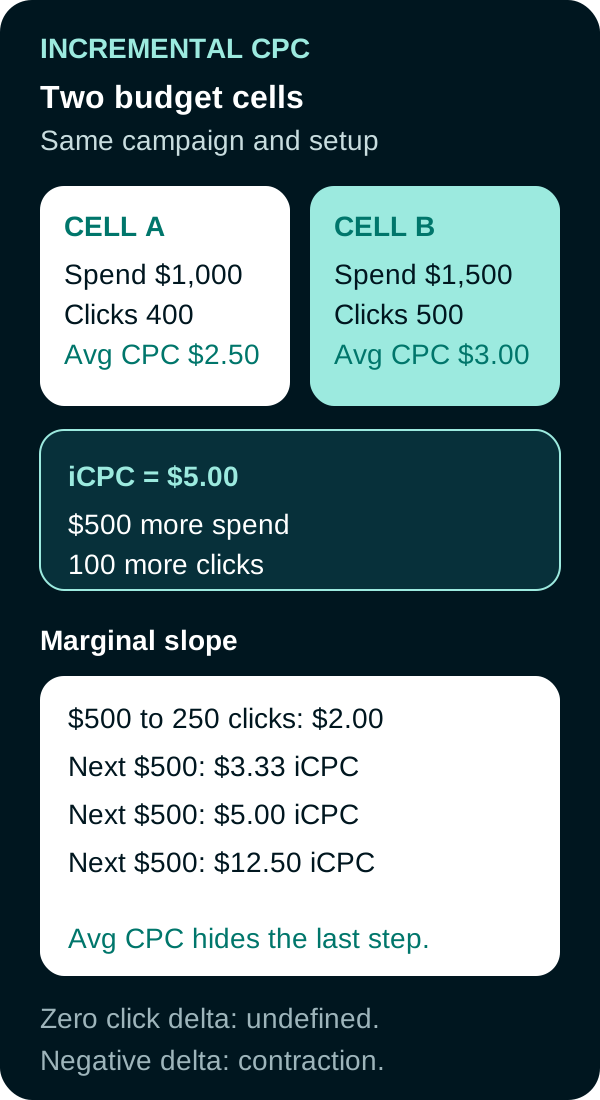
In this example, $500 more spend and 100 more clicks produce a $5 iCPC, while average CPC moves to $3. Later budget steps can cost more per extra click.
Marginal slope and invalid cases
Keep adding the same $500 of budget in this teaching series:
| Step | Spend | Clicks | iCPC versus previous step |
|---|---|---|---|
| 1 | $500 | 250 | 500 / 250 = $2.00 (this first block is also the average) |
| 2 | $1,000 | 400 | 500 / 150 = $3.33 |
| 3 | $1,500 | 500 | 500 / 100 = $5.00 |
| 4 | $2,000 | 540 | 500 / 40 = $12.50 |
When later budget steps cost more than the blended average, iCPC makes that slope visible before the next increase.
Interpret the sign before calling the result the cost of added volume:
| Case | Interpretation |
|---|---|
| Added clicks = 0 | Division by zero; spend rose with no extra clicks |
| Added clicks are negative | The ratio is mathematically defined when nonzero, but it describes contraction rather than added-click cost |
| Windows, geos, or conversion actions differ | The subtraction mixes unlike sets and needs adjustment or a different comparison |
| One cell used a different bid strategy or landing page | The result combines multiple changes and is not a budget-only slope |
A platform budget experiment or a geo split is stronger evidence than two adjacent calendar weeks. If you only have a sequential read, say so.
Follow-through: incremental CPA and value
Connect the click-cost comparison to business outcomes:
- Incremental CPA = added spend / added conversions (same cells, same counting method)
- Added conversion value = comparison conversion value − baseline conversion value
- Added contribution after advertising = added contribution before advertising − added spend. Use contribution margin rather than gross revenue when evaluating profitability.
If Cell A produced 10 qualified conversions from $1,000 and Cell B produced 14 from $1,500, average CPA moves from $100.00 to $107.14. The four added conversions cost 500 / 4 = $125 each. The added volume can still be worthwhile when its expected margin or lifetime value exceeds that incremental cost.
When the slope is the problem, paid search work is to change query mix, landing-page qualification, or the budget cap, not to chase a lower average CPC by itself.
Frequently Asked Questions
What is Incremental Cost Per Click (iCPC)?
iCPC is the change in spend divided by the change in clicks between two named scenarios. Use it as the cost of added click volume when both changes are positive. Google Ads reports average CPC, not iCPC.
How do you calculate incremental CPC?
Subtract baseline spend from comparison spend, then divide by comparison clicks minus baseline clicks. For example, $500 more spend and 100 more clicks gives a $5 iCPC.
What if the change in clicks is zero or negative?
A zero click change makes the ratio undefined. A negative click change is mathematically calculable, but it describes contraction rather than the cost of added clicks and should be labeled separately.
How is incremental CPC different from incremental CPA?
Incremental CPC evaluates the cost of added clicks. Incremental CPA uses added conversions, which is closer to the business outcome. Read both with conversion quality and value.
Sources
- Google Ads Help, Average cost-per-click (Avg. CPC): Definition, accessed September 20, 2026.
- Google Ads Help, Actual cost-per-click (CPC): Definition, accessed September 20, 2026.
- Google Ads Help, Cost-per-click (CPC): Definition, accessed September 20, 2026.
- Google Ads Help, About Smart Bidding, accessed September 20, 2026.
- Google Ads Help, About bid adjustments, accessed September 20, 2026.
PUT THIS KNOWLEDGE TO WORK
NEED MORE HELP?
Talk with our team about applying Incremental Cost Per Click (iCPC) to your marketing.
Get a free marketing audit call