

eCPM: Formula, Examples, and Publisher Revenue
eCPM shows advertising revenue per 1,000 impressions. Publishers use it to compare the yield of placements and demand sources that may pay by impression, click, or another model.
eCPM (effective cost per mille) is advertising revenue for every 1,000 ad impressions. Publishers use it to compare placements and demand sources when some ads pay by impression, some by click, and others by a different pricing model.
Track eCPM next to ad inventory and ad exchange reports inside paid media programs. The buy-side counterpart is CPM, which measures advertiser cost per thousand impressions. Our CPM calculator solves advertiser cost, impressions, or CPM.
What eCPM measures
| Object | Typical formula | Whose money |
|---|---|---|
| Publisher eCPM / impression RPM | Ad revenue / ad impressions x 1,000 | Publisher advertising revenue on the report’s stated basis |
| Page RPM | Estimated earnings / page views x 1,000 | Earnings per thousand pages, not per ad |
| Request eCPM | Estimated revenue / ad requests x 1,000 | Earnings per thousand requests, including unfilled demand |
| Advertiser CPM or effective CPM | Ad spend / impressions x 1,000 | What the advertiser paid for delivery |
| Advertiser sales per thousand impressions | Product revenue / ad impressions x 1,000 | Sales value associated with delivered ads |
The publisher and advertiser rows answer different questions. Publisher eCPM measures advertising revenue from inventory. Advertiser CPM measures media cost, while product revenue per thousand impressions measures sales performance.
Google Ad Manager’s Understanding eCPM in Ad Exchange Help states the core definition as revenue per one thousand impressions. Requests, matched responses, and recorded impressions can produce different report columns, so use the same denominator when comparing sources.
RPM, request eCPM, and fill rate
Google AdSense Revenue per thousand impressions (RPM) is estimated earnings per 1,000 page views, impressions, or queries, depending on which RPM you open. AdSense is explicit: RPM does not represent how much you have actually earned. It uses estimated earnings.
AdSense examples on that page:
- $0.15 estimated from 25 page views → page RPM = ($0.15 / 25) x 1,000 = $6.00
- $180 estimated from 45,000 ad impressions → ad RPM = ($180 / 45,000) x 1,000 = $4.00
The earnings basis is similar, but the denominator changes. A page with several ads can therefore have a page RPM that differs from its ad impression RPM.
Fill metrics also need their full product name. A response-based match rate compares served or matched responses with eligible requests. Google Ad Manager’s Total fill rate is a specific impression-to-request metric, while its Ad Exchange delivery rate uses Ad Exchange impressions divided by ad requests. These definitions should not be generalized to every ad platform’s fill-rate column.
Google Ad Manager report metrics name the publisher-side split this way (accessed September 20, 2026):
| Metric | Formula on the Help table | What it includes |
|---|---|---|
| eCPM / average eCPM | (Revenue metric / impressions) x 1,000 | Filled impressions in that report |
| Ad Exchange ad request eCPM | Estimated revenue / ad requests x 1,000 | Unfilled requests sit in the denominator |
| Ad Exchange matched request eCPM | Estimated revenue / matched requests x 1,000 | Fill is removed from the denominator |
| Total fill rate | Total impressions / total ad requests | Google Ad Manager 360 impression-to-request metric |
| Ad Exchange delivery rate | Ad impressions / ad requests | Ad Exchange impression-to-request metric |
Ad server average eCPM in Ad Manager combines CPM, CPC, CPD, and vCPM revenue over ad server impressions, then multiplies by 1,000. This converts mixed pricing into one impression-based yield number.
Compare only columns that share:
- The same inventory (site, app, ad unit)
- The same window
- The same currency
- The same reporting basis (estimated vs finalized, gross vs net)
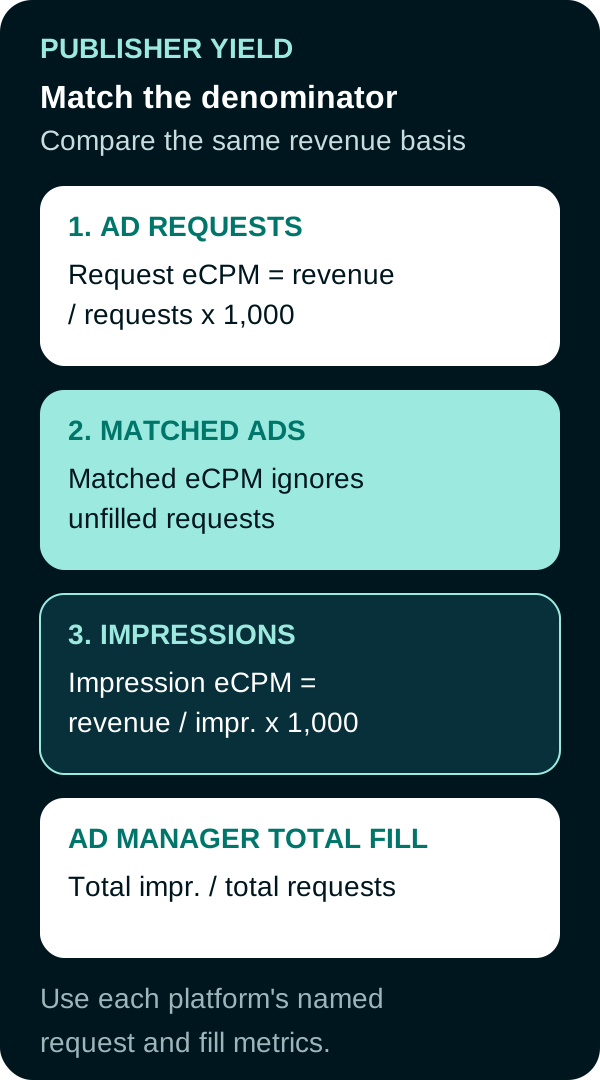
Request eCPM includes unfilled requests in its denominator; impression eCPM uses recorded impressions.
CPC revenue to eCPM, and a weighted blend
Example using a CPC-priced placement:
A placement sells on CPC. Estimated earnings are $0.40 per click. It records 250 clicks and 50,000 ad impressions.
- Ad revenue = 250 x $0.40 = $100
- Impression eCPM = ($100 / 50,000) x 1,000 = $2.00
That $2.00 eCPM is comparable to a $2.00 CPM line when the inventory, revenue basis, currency, and impression definition match.
Weighted blend across two units in the same window and currency:
| Unit | Impressions | Impression eCPM | Revenue |
|---|---|---|---|
| A | 70,000 | $8.00 | $560 |
| B | 30,000 | $2.00 | $60 |
| Combined | 100,000 | $6.20 | $620 |
Blended eCPM = total revenue / total impressions x 1,000 = $620 / 100,000 x 1,000 = $6.20. Averaging $8 and $2 as if they had equal weight would be wrong.
Fill versus unit price
A demand source can post a high impression eCPM and still produce less revenue per request when it serves on fewer requests.
Consider two sources across the same 10,000 ad requests, with each filled request producing one impression:
| Source | Fill rate | Impression eCPM on filled ads | Request eCPM |
|---|---|---|---|
| X | 30% (3,000 impressions) | $10.00 | $3.00 |
| Y | 80% (8,000 impressions) | $5.00 | $4.00 |
Under that one-impression-per-filled-request assumption, request eCPM equals impression eCPM multiplied by the impression delivery ratio. Source Y yields more per request ($4.00 versus $3.00) even though its impression eCPM is lower. Ad Manager describes ad request eCPM as factoring in fill, which makes it useful for comparing demand sources on a request basis.
User experience still sits outside the ratio. Raising ad density can lift short-term eCPM and still cost sessions. Check pages per session and the business metric you actually fund with that inventory.
Tools that report yield
- Google AdSense reports publisher earnings through page, impression, and other RPM columns.
- Google Ad Manager supports publisher inventory and mixed demand, including eCPM and request-based metrics.
- The Trade Desk is a demand-side platform; its reporting centers on advertiser spend and delivery rather than publisher eCPM.
- Unity LevelPlay provides mobile ad mediation and monetization reporting.

Compare eCPM by placement, device, and demand source on the same inventory, window, currency, and revenue basis. Pair impression eCPM with request-based metrics to see both unit price and delivery opportunity.
Frequently Asked Questions
What is eCPM?
eCPM (effective cost per mille) is advertising revenue divided by impressions, times 1,000. Publishers use it to compare yield across CPM, CPC, and other payment models. The reporting column may use estimated or finalized revenue, so check the report definition.
How is eCPM different from CPM?
CPM usually describes the advertiser’s cost or bid per thousand impressions. Publisher eCPM describes advertising revenue per thousand impressions after different pricing models are converted to the same basis.
How are eCPM, RPM, and fill rate related?
AdSense RPM can use page views, ad impressions, or queries, depending on the column. Ad request eCPM uses requests, while impression eCPM uses impressions. Fill metrics also use requests, but the numerator is product-specific: Google Ad Manager’s Total fill rate is total impressions divided by total ad requests.
Can advertisers use eCPM to measure sales?
Publisher eCPM measures advertising revenue. Advertisers can calculate effective media CPM from spend, but product sales per thousand impressions is a different performance metric.
Video explainer
Video: What Is eCPM & Why Publishers Need To Use This Metric by MonetizeMore, published February 10, 2020.
Sources
- Google AdSense Help, Revenue per thousand impressions (RPM), accessed September 20, 2026.
- Google Ad Manager Help, Understanding eCPM in Ad Exchange, accessed September 20, 2026.
- Google Ad Manager Help, Ad Manager report metrics, accessed September 20, 2026.
- Google Ads Help, Cost-per-thousand impressions (CPM): Definition, accessed September 20, 2026.
PUT THIS KNOWLEDGE TO WORK
NEED MORE HELP?
Talk with our team about applying Effective Cost Per Mille (eCPM) to your marketing.
Get a free marketing audit call