

Franchise Marketing: Corporate, Regional, and Local Roles
Franchise marketing coordinates national brand work with location-level demand. Corporate sets standards and shared assets. Local teams adapt approved offers inside the territory they can actually serve.

Franchise marketing is the coordinated system that grows a brand while helping individual locations win in their markets. Corporate sets positioning, shared assets, and the measurement that the system will trust. Local teams adapt approved offers, listings, media, and community work to the territory they can actually serve. The Franchise Disclosure Document (FDD) describes the program; signed agreements and current brand standards govern the operating duties.
This is a different job from multi-location marketing inside a single company, because a franchisee is an independent operator under a license. It also sits next to co-op advertising and hyperlocal advertising. Paid media is how many of the local units actually run.
The International Franchise Association’s February 5, 2025 outlook projected 851,000 U.S. franchise establishments for 2025. That is dated sector context. It is not a budget rate, an approval workflow, or evidence that a given brand should spend more on search.
Decision rights across the system
Write owners before you write ads. If two parties can change the same claim, the wrong one will.
| Work | Corporate | Regional (if used) | Franchisee |
|---|---|---|---|
| Brand | Positioning, trademarks, locked claims, brand fonts | Adapt tone for a DMA without changing claims | Use the pack; do not invent a second logo |
| Demand creation | National campaigns, franchise-development funnel (kept separate) | Shared DMA buys when several units pool spend | Local offers, community, and approved local media |
| Local facts | System of record for NAP where the brand hosts it | Audit a cluster of listings | Hours, service area, photos, and “temporarily closed” |
| Offers | National promo calendar and claim legal | Regional price floors if the agreement allows | Local price only inside the approved range |
| Reporting | System dashboard and brand-fund accounting | Cluster roll-up | Location leads, jobs, and review replies |
Consumer demand and franchise development marketing must not share the same landing page, call tracking, or success metric. One sells a haircut or a repair. The other sells a territory.
A campaign that actually rolls from national to local
Use one path for every system offer. Change the assets, not the sequence.
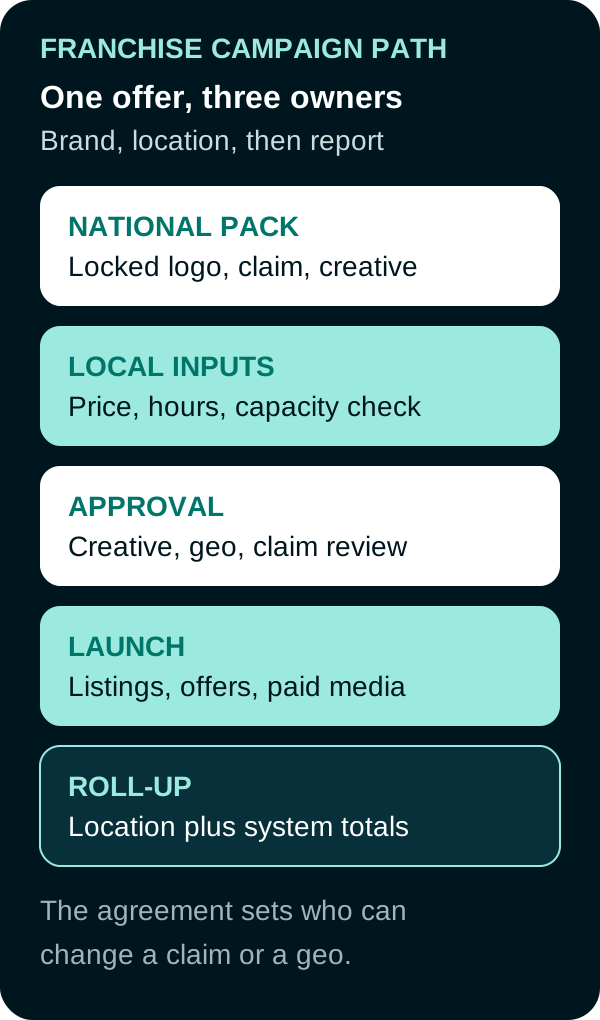
Corporate locks the claim. The location proves it can deliver. Approval happens before spend. Reports keep unit and system totals apart.
Hypothetical spring-service campaign (labeled sample, not a client result):
- National pack. Corporate issues a “Spring tune-up” kit: locked headline, legal of the $89 price, photo crop rules, and a landing-page template with a location chooser.
- Local inputs. Each franchisee enters hours, the ZIP codes they can reach in 45 minutes, whether they have two techs free on Saturdays, and any local surcharge the agreement allows.
- Approval. Brand marketing checks the price and photos. The field manager checks that the service area does not overlap a neighboring unit. Paid search geo is set to Presence (people in or regularly in the territory), not the default Presence or Interest, because an out-of-town searcher cannot book this truck.
- Launch. The location updates Google Business Profile hours, posts the offer on the approved social account, and turns on the local search campaign. Co-op claims, if any, use the pre-approved job ID.
- Roll-up. Corporate reports branded search and national site sessions. Each unit reports booked tune-ups, show-up rate, and ticket value. A unit at capacity is paused rather than scaled.
If Saturday capacity is already full, do not buy more Saturday clicks. Franchise marketing fails when media outruns operations.
What the FDD does and does not settle
Under the FTC Franchise Rule, 16 CFR 436.5 Item 11 describes the advertising program: required cooperatives, contribution formulas, who administers funds, how money was used last year, leftover balances, and any share used to solicit new franchise sales. Item 6 covers other fees. Those disclosures help a prospect understand the system. Day-to-day creative approval, listing logins, and claim deadlines often live in the signed agreement, an advertising addendum, or the current operations manual. Build the RACI from the documents that govern the locations in front of you.
Keep national brand spend, local activation, and franchise-development recruiting on separate plans so a lead for a new unit cannot be counted as a customer for an existing one.
Frequently Asked Questions
What is franchise marketing?
Franchise marketing is the governed system that grows the brand while helping each location win in its territory. Corporate, regional teams, and franchisees split brand, acquisition, local activation, and reporting. The FDD describes the program; signed agreements and current brand standards govern the obligations.
Who decides national versus local creative?
Corporate usually owns positioning, trademarks, locked claims, and shared asset packs. Franchisees usually supply hours, price, photos of their site, and capacity. Regional managers, where they exist, adapt the pack for shared media costs. Approval rights sit in the agreement and brand standards, not in a social template.
How should a national campaign land at one location?
Issue the national pack, collect local offer and capacity inputs, run creative and geo approval, then launch listings, offers, and paid media. Roll up location results and system totals separately so a busy unit cannot hide a dark one.
Is an industry growth forecast a marketing plan?
No. IFA’s 2025 outlook is dated market context for the sector. It does not set contribution rates, creative approval, or who owns a Google Business Profile. Those rules come from the franchise documents.
Sources
- eCFR, 16 CFR 436.5, Contents of a Franchise Disclosure Document, accessed September 20, 2026.
- eCFR, 16 CFR Part 436, Disclosure Requirements and Prohibitions Concerning Franchising, accessed September 20, 2026.
- FTC, Franchise Fundamentals: Taking a deep dive into the Franchise Disclosure Document, dated May 2023, accessed September 20, 2026.
- Google Ads Help, About advanced location options, accessed September 20, 2026.
- International Franchise Association, 2025 Franchising Economic Outlook announcement, dated February 5, 2025, accessed September 20, 2026. Dated market context only.
PUT THIS KNOWLEDGE TO WORK
NEED MORE HELP?
Talk with our team about applying Franchise Marketing to your marketing.
Get a free marketing audit call