

Franchise Marketing Budget: Funds, Fees, and Reconciliation
A franchise marketing budget is several pots, not one percentage. Separate brand-fund cash, co-op contributions or claims, required local spend, production, tools, agency, and working media.

A franchise marketing budget is the planned funding for corporate, regional, co-op, and local marketing across a franchise system. Allocation should follow business goals, market maturity, and operator capacity. The current FDD discloses required contributions, while the signed agreement governs the current obligation. There is no generic industry percentage that can be copied from a neighbor brand.
This work sits next to franchise co-op advertising and franchise development marketing. Keep development recruiting in its own budget. An Item 11 disclosure about franchise-sales use tells franchisees how the fund has been used; it does not by itself authorize that use under the governing agreements or applicable law. Campaign strategy is where the remaining working media gets a channel plan.
Start from Item 11, then the signed rates
For franchises covered by the U.S. FTC Franchise Rule, the franchisor must furnish an FDD. Under 16 CFR 436.5(k), Item 11 must describe the advertising program, including:
- Required local or regional cooperatives, contribution amounts or formulas, administration, and whether statements are available
- Any other advertising fund, who pays, whether company-owned units pay on the same basis, audits, and last year’s split among production, media placement, administration, and other uses
- What happens to unspent funds
- The percentage of advertising funds, if any, used principally to solicit new franchise sales
Those disclosures are the map. The monthly worksheet still has to use the current contribution rate in the signed agreement, which can differ from an older FDD exhibit. Reconcile any difference before billing a franchisee.
Sample monthly budget (labeled, not a typical rate)
All percentages below are a hypothetical single-location month. They are not industry averages. For this example only, assume the agreement allows production, technology, agency, and media costs to count toward the required local-spend amount. A real agreement may define eligible local costs differently.
Assume location gross sales of $80,000.
| Line | Rate in this sample | Cash this month | Who controls the buy |
|---|---|---|---|
| Brand fund contribution | 2.0% | $1,600 | Franchisor / brand fund |
| Co-op contribution | 1.0% | $800 | Co-op or administrator |
| Required local spend | 2.0% | $1,600 | Franchisee, inside brand rules |
| Optional extra local | n/a | $400 | Franchisee |
| Cash leaving or obligated | $4,400 | Mixed |
Now split the $2,000 under local booking control ($1,600 required + $400 extra):
| Local-control line | Amount | Notes |
|---|---|---|
| Production (photo, landing edits) | $150 | Not working media |
| Technology (listings, call tracking) | $50 | Not working media |
| Local agency fee | $200 | Not working media |
| Working media | $1,600 | Search, social, local print, community |
| Local-control total | $2,000 | Counts toward the 2% requirement under this example’s stated assumption |
Check: $150 + $50 + $200 + $1,600 = $2,000. Brand-fund and co-op cash are not in this local-control total. If an operator treats the $1,600 brand-fund payment as satisfying the separate local obligation, the location will undercount what it still must deploy.
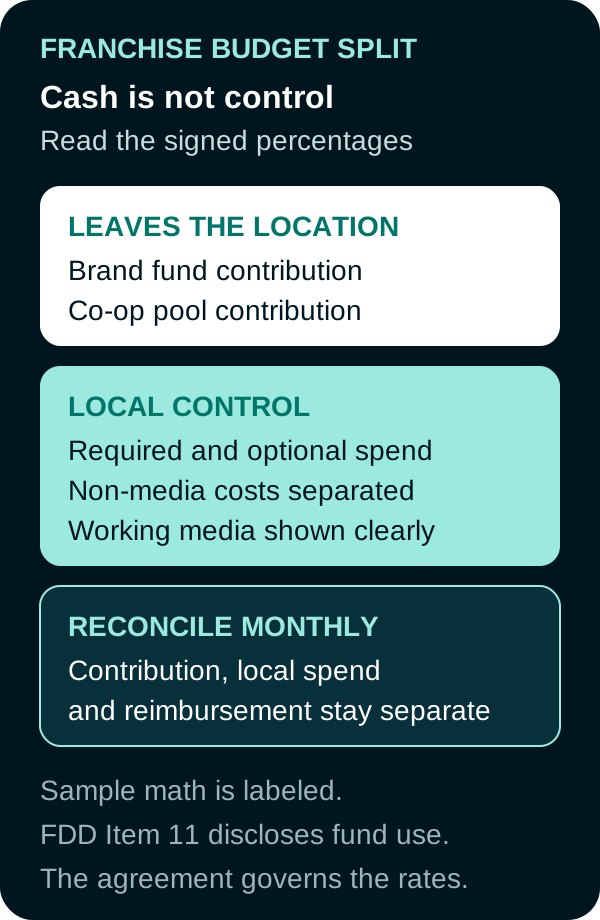
Contributions and local spend are different movements of money. This example models a co-op that reimburses approved claims; some co-ops instead buy media from a shared pool.
Monthly reconciliation worksheet
Run this on the same day each month. Do not wait for the annual fund statement.
| Field | This sample month | Rule |
|---|---|---|
| Gross sales (denominator) | $80,000 | Use the definition in the agreement (royalty sales, not bank deposits, if they differ) |
| Brand fund paid | $1,600 | Match the ACH or royalty invoice |
| Co-op paid | $800 | Match the co-op invoice |
| Local required vs actual | Required $1,600 / eligible actual $2,000 | Eligibility follows the example assumption above |
| Production + tech + agency | $400 | Keep separate from working media for a readable cost view |
| Working media | $1,600 | Invoices plus platform spend |
| Co-op claims filed | $800 | Same ID as the campaign |
| Co-op approved | $650 | Denied $150 for missing proof |
| Co-op paid | $650 | Cash back is not a new contribution |
| Unused local required | $0 | If actual had been $1,400, unused would be $200 and a compliance flag |
| Notes | Denied claim: no geo screenshot | Store the exception |
In this hypothetical reimbursement program, the $650 paid on the claim does not reduce the $800 already contributed. It is a later cash return against proof. A pooled-buying co-op would instead reconcile the location’s contribution against shared media and fund reporting, without treating the pool as a reimbursement balance.
Approvals belong before spend: creative, geo, offer, and claim eligibility. Campaign strategy can set channel mix only after the pots are labeled.
If company-owned units pay a different rate than franchisees, Item 11 should already disclose it. Copy that difference into the system budget so franchisees can see it.
Frequently Asked Questions
What is a franchise marketing budget?
A franchise marketing budget is the planned funding for corporate, regional, co-op, and local marketing. The current FDD discloses required contributions, while the signed agreement governs the current obligation. There is no universal industry percentage.
What is the difference between a contribution and local spend?
A brand-fund or co-op contribution is cash that leaves the location for shared marketing. Required local spend is a separate obligation the location controls. The agreement decides which media, production, technology, or agency costs qualify. Some co-ops pool buying; others reimburse approved claims.
Where do agency and technology costs sit?
Put them on their own lines so operators can see working media. Item 11 disclosures split last year’s fund among production, media placement, administration, and other uses where applicable. Use similarly clear categories in the monthly worksheet.
How often should the budget be reconciled?
Reconcile monthly: contributed, approved, paid, denied, and unused. Hold creative approval before spend. In a reimbursement program, a year-end fund statement is too late to catch a location that paid into a co-op and never filed its claim.
Sources
- eCFR, 16 CFR 436.5, Contents of a Franchise Disclosure Document, Item 11, accessed September 20, 2026.
- eCFR, 16 CFR 436.2, Obligation to furnish documents, accessed September 20, 2026.
- FTC Franchise Rule Compliance Guide (Item 11 advertising assistance), accessed September 20, 2026.
- FTC, Franchise Fundamentals: FDD advertising and training, dated May 2023, accessed September 20, 2026.
PUT THIS KNOWLEDGE TO WORK
NEED MORE HELP?
Talk with our team about applying Franchise Marketing Budget to your marketing.
Get a free marketing audit call