

Affiliate Marketing: Flow, Fees, Disclosure, and Vetting
Affiliate marketing pays a partner when a tracked referral produces a qualifying sale, lead, or other contracted action. Understand the parties, attribution window, disclosure, reversals, and net value before choosing a program.
Affiliate marketing is a performance arrangement: a business pays partners for traffic, leads, or sales that a tracked link assigns under written rules. Partners promote an offer. The network or merchant records the click and, if a qualifying action happens in time, a commission. That commission is usually provisional until returns, fraud filters, and the lock period settle.
See what is an affiliate link for tracking windows and assignment math. Use content marketing and influencer and affiliate work to decide which offers belong in your mix. This page is the system: parties, disclosure, vetting, and net value after reversals.
Programs work best when the partner already serves an audience that would value the offer. The merchant should budget for commissions, program operations, creative support, and any platform or network fees in its agreement.
Merchant, network, affiliate, customer
| Party | Role |
|---|---|
| Merchant | Brand or retailer that pays for a qualifying action; Amazon Associates is an example of a merchant-run program |
| Network | Optional platform that connects many merchants and partners, with tracking and payment tools; Awin is one example |
| Affiliate | Publisher or creator who promotes the offer with a tracked link |
| Customer | Person who clicks and may buy, sign up, or bounce |
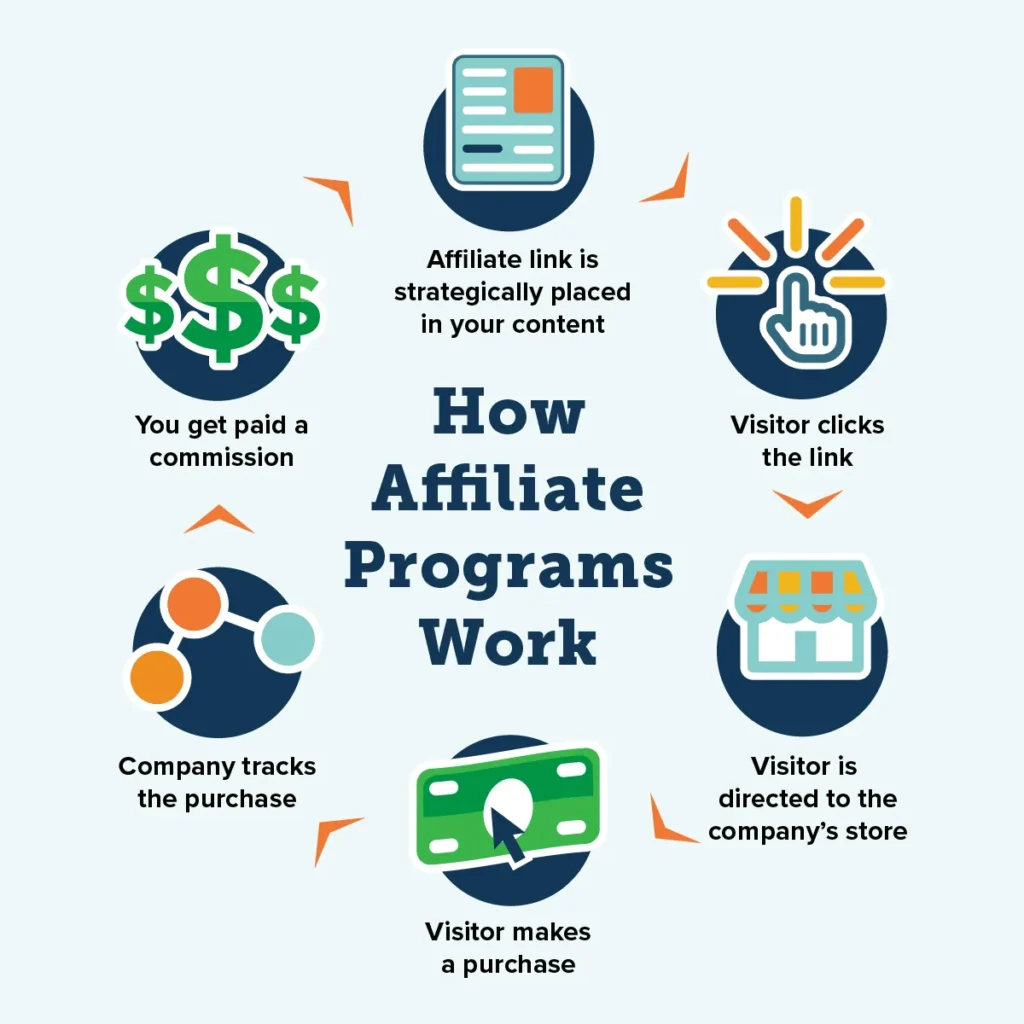
The infographic shows one common path: link in content, click, store visit, purchase, tracking, then commission. Real programs add cookie windows, last-click rules, and clawbacks after this loop.
Disclosure and current program checks
In the United States, the FTC Endorsement Guides treat affiliate pay as a material connection. FTC staff guidance says to disclose the relationship clearly and conspicuously near the recommendation. If the endorsement is visual, disclose at least visually; if it is audible, disclose at least audibly; if it uses both, disclose both visually and audibly. A footer-only note that the reader never sees with the link is insufficient. Clear example: “I get commissions for purchases made through links in this post.”
Amazon Associates additionally requires the exact site statement “As an Amazon Associate I earn from qualifying purchases.” Amazon’s disclosure Help also describes link-level cues such as “(paid link)” or “#ad”. Amazon’s sentence covers Amazon links only. Other networks still need their own disclosure.
Before you join or keep an offer, open the current official page and record:
- Commission basis (percent of qualifying revenue vs bounty)
- Click or cookie window, and what ends it
- Return, cancellation, and lock-period rules
- Paid-traffic and coupon policies
- Creative and trademark rules
- How the program wants the relationship disclosed
Partner and offer vetting
- The offer matches content you would publish without the fee.
- The landing page and refund policy are acceptable to send people to.
- Tracking uses the URL and identifier generated for the partner by the current program dashboard.
- The merchant and paying entity match the official program terms (Amazon Associates, Shopify affiliates, or the brand’s own page). For network programs, confirm the merchant inside the network account.
- The offer fits a channel and audience you already serve, with enough purchase intent to produce qualifying actions.
Shopify’s affiliate program, Amazon Associates, and networks such as Awin illustrate different program structures. ShareASale’s platform officially closed on October 6, 2025, after active customers were moved to Awin. Confirm current terms and tracking in the program that will actually record the transaction.
Tracking windows and commission economics
Windows differ. Amazon Associates Help describes a 24-hour session after the Special Link click, ending when the customer orders (with digital-product nuances), 24 hours elapse, or they click another Associate’s link. Items added to the cart in that session can still pay if purchased from that cart before it expires (usually 90 days). Commission is calculated on sale price, not list price, and Amazon credits after dispatch and payment. See Associates Help on the 24-hour window.
Amazon’s standard commission table (accessed September 20, 2026) ranges from 0.00% for excluded categories such as gift cards to 10.00% for named luxury-beauty categories. Many listed categories fall between 1.00% and 5.00%, with 4.00% for “All Other Categories.” Bounties, such as some Prime signups, are flat amounts rather than product commission rates. Fine-art commission is capped at $200 per product. Use the current table for the exact category at the time of publication.
Net value after reversals:
Provisional commission minus returns and cancellations minus fraud voids minus network or payment fees named in the contract = amount you can book
Example: 40 assigned sales at $50 qualifying revenue and 4% commission produce $80 in provisional commission. If 8 sales return before lock, the reconciled amount is 32 × $50 × 0.04 = $64.
Assignment follows the program’s identifier, window, cross-device rules, and credit model. A last-click rule may assign the order to the final partner in the path, so read the network report as contracted attribution and reconcile it to the program terms.
Fraud, content fit, and outcomes
- Reject offers that need fake urgency, trademark bidding you cannot defend, or reviews you did not do.
- Do not buy traffic if the program forbids it.
- Keep content useful: tutorials, comparisons you actually ran, and links that match the article. See keyword strategy only as a way to match questions, not as a stuffing tactic.
- Tools such as Google Analytics, Semrush, Bitly, and Awin help with traffic, queries, links, and program reporting. Book commission from the program’s validated transaction report.
Key terms
| Term | Definition |
|---|---|
| Affiliate link | Tracked URL that assigns a later action to a partner |
| Commission | Contracted payment per sale, lead, or bounty, before reversals |
| Cookie / click window | Time the identifier remains eligible after the click |
| Merchant | Brand or retailer paying for the action |
| Network | Platform connecting affiliates with programs |
| Lock period | Time commissions stay pending for returns and fraud |
Judge affiliate performance after returns, reversals, and commission rules, not from clicks alone. A smaller set of offers that match purchase intent can outperform a long list of unrelated links.
Frequently Asked Questions
What is affiliate marketing?
Affiliate marketing is a performance arrangement: a merchant or network pays a partner when a tracked referral meets program rules for a sale, lead, or other contracted event. Payment is usually provisional until returns, fraud checks, and lock periods finish.
How do you find and vet affiliate programs?
Start from networks and brand programs whose current terms you can open: commission, cookie or click window, lock period, creative rules, and disclosure requirements. Join programs that fit the audience you already have. Confirm the merchant, payout, and tracking on the official program page before you publish links.
Do you need a website for affiliate marketing?
A site helps with durable URLs and SEO, but programs also allow YouTube, email, and social when their policies say so. Every channel still needs a clear disclosure of the material connection, placed where the audience sees it with the recommendation.
What is an affiliate link?
An affiliate link is a tracked URL that assigns a later qualifying action to a partner under the program’s window and identity rules. See the affiliate-link guide for windows, last-click credit, and worked commission math.
Sources
- eCFR, 16 CFR Part 255, Guides Concerning Use of Endorsements and Testimonials in Advertising, accessed September 20, 2026.
- FTC, Endorsement Guides: What People Are Asking, accessed September 20, 2026.
- Amazon Associates, Why identify yourself as an Associate, accessed September 20, 2026.
- Amazon Associates, Standard Commission Income Statement, accessed September 20, 2026.
- Amazon Associates, 24-hour shopping cart window, accessed September 20, 2026.
- Amazon Associates Program, accessed September 20, 2026.
- Awin, Awin and ShareASale unite to power global growth, posted August 14, 2025, accessed September 20, 2026.
- Awin Help, Post-upgrade checklist, updated August 6, 2026, accessed September 20, 2026.
- Shopify affiliates, accessed September 20, 2026.
- Semrush, accessed September 20, 2026.
- Bitly, accessed September 20, 2026.
PUT THIS KNOWLEDGE TO WORK
NEED MORE HELP?
Talk with our team about applying Affiliate Marketing to your marketing.
Get a free marketing audit call