

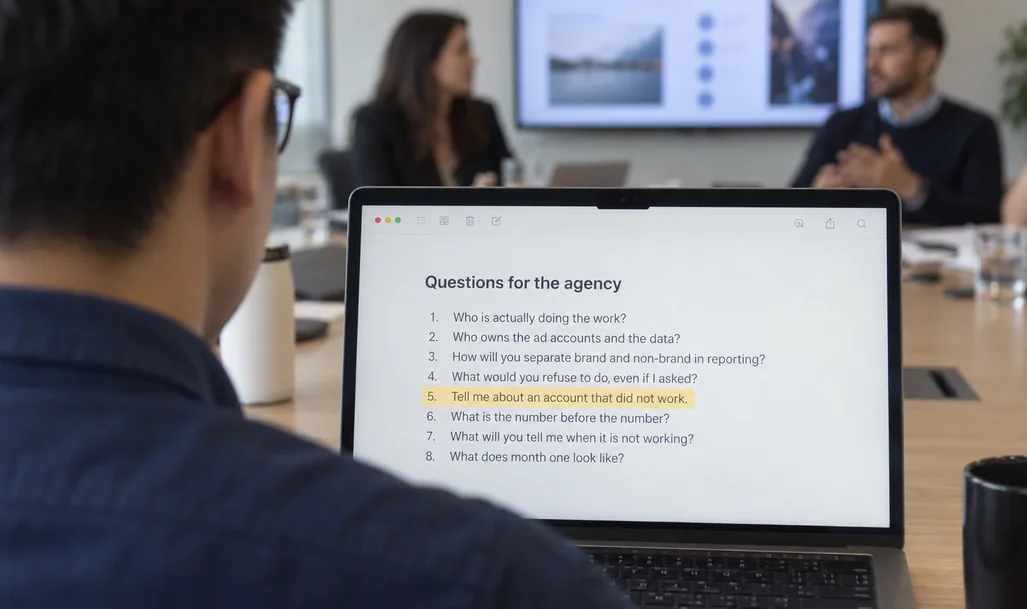
Hiring an agency is an interview, and the useful questions are the specific ones. Ask who does the work, who owns the accounts, how results will be measured against your own systems, and what the first month looks like. Strong answers are concrete, include dates and names, and volunteer limitations. Weak answers are enthusiastic and general.
Use the worksheet below in a first or second meeting. For each question there is what you are actually testing, what a good answer sounds like, what should give you pause, and how we answer it, so you can hold us to the same standard.
If you are earlier in the process and still deciding how to build a shortlist, our guide to choosing a marketing agency covers scoping, shortlisting, and comparing proposals. This page is about the conversation itself.
1. Who will actually run the account?
Testing: whether the seniority in the room is the seniority in the account.
Good answer: named people, their role, how many accounts each carries, and an offer to introduce them before you sign.
Pause if: the team is described collectively, or the people presenting will not be involved after onboarding.
Our answer: you meet the people who will run the work during the pitch process, and you know who to contact for strategy, media, and reporting.
2. Who owns the accounts and the data?
Testing: whether the relationship is built on results or on switching costs.
Good answer: you own every advertising and analytics account in your company’s name, the agency works under granted access, and removing that access does not affect your history. Both Google Ads and Google Analytics document how access levels and roles are granted and revoked (Google Ads access levels; Google Analytics access management).
Pause if: accounts sit in the agency’s name, or historical data would not travel with you.
Our answer: clients own their accounts, data, and creative. We expect to be retained on the strength of the work.
3. How will you report brand and non-brand separately?
Testing: whether growth will be distinguishable from demand you already had.
Good answer: an immediate yes, with an explanation of why the two behave differently and how each is reported.
Pause if: the distinction has to be explained to them.
Our answer: they are reported as separate lines. The gap is large: across the 90 days to 13 September 2026, branded queries on our own site clicked at 8.37% while everything else clicked at 0.021% (Google Search Console, domain property, WEB results, final data). Blending those hides whether new demand is being created.
4. What does the first 30 days look like?
Testing: whether onboarding is a practiced process or an improvisation.
Good answer: an audit, tracking verification, access setup, a baseline of current performance, and a specific first set of actions with dates.
Pause if: month one is described only as strategy and alignment.
Our answer: audit first, tracking verified end to end, baselines recorded, then the first changes, so later results can be compared against a documented starting point. Our comprehensive audit is usually where that begins.
5. How will we know it worked?
Testing: whether success will be measured in your systems or theirs.
Good answer: agreed definitions for qualified leads and revenue, your CRM or finance system as the source of truth, platform data used for optimization, and an honest account of attribution limits.
Pause if: the answer is a platform dashboard, or a promise of a specific return before anyone has seen your data.
Our answer: objectives agreed per campaign, results reported against them, and platform figures shown next to your business figures. Our guide to monthly reporting shows the structure, and where budgets justify it we add attribution and media mix modeling.
6. What is the number behind the case study?
Testing: whether results are presented with context.
Good answer: the baseline, the period, the spend, what else changed at the same time, and what the team would credit to their own work.
Pause if: percentages are quoted without a starting point, or a single result is presented as typical.
Our answer: our case studies carry the work and the outcome together, for example the Museum of Illusions franchise program, which covers more than 20 markets and documents both the scale and what was managed.
7. What would you decline to do?
Testing: whether you are buying expertise or compliance.
Good answer: specific practices they avoid, and why, delivered without hesitation.
Pause if: the answer is that they will do whatever you ask.
Our answer: we do not let automation publish externally or make consequential decisions unreviewed. People stay responsible for strategy, factual approval, creative judgment, and publication, as set out in how we automate workflows.
8. Tell me about an account that did not work
Testing: whether the team learns publicly or manages appearances.
Good answer: a specific account, the cause, the change made, and what they would do differently. Fit, market timing, and offer problems are all legitimate answers.
Pause if: no such account exists, or the blame sits entirely with the client.
Our answer: we will discuss one in the room, including where the constraint was ours and where it sat in the offer or the sales process.
How to score the conversation
| Response pattern | What it usually means |
|---|---|
| Specific, with names, dates, and numbers | The team has done this work before |
| Enthusiastic but general | You are meeting sales, not delivery |
| A pause, then a straight answer | Honest, and the best sign on this list |
| Redirects to a different question | The answer exists and you would not like it |
Take the worksheet to every agency you shortlist, including us. If you want to see how we would answer against your actual account rather than in the abstract, talk to our team and we will walk through your current setup first.
Frequently Asked Questions
What should I ask a marketing agency before hiring them?
Ask who will run the account day to day, who owns the accounts and data, how brand and non-brand results are reported, what the first 30 days involve, how they measure results against your business system, and what they would decline to do. Judge the specificity of the answers rather than the confidence.
What does a strong answer about account ownership sound like?
That you own every advertising and analytics account in your company’s name from day one, that the agency works under granted access, and that access can be removed without disrupting your data. Anything that leaves accounts in the agency’s name is worth questioning before you sign.
How can I tell whether the senior people I meet will do the work?
Ask who is in the account weekly, how many other accounts that person handles, and to meet them before signing. Agencies that staff accounts properly introduce the working team early. Vague references to a collective team usually mean the pitch group is not the delivery group.
Should I ask about work that did not go well?
Yes. Every agency has accounts that underperformed. What matters is whether they can describe the cause, what they changed, and what they would do differently. A team that cannot discuss a difficult account has either not run many or is managing the conversation.