

For most businesses SEO is still worth doing in 2026, but the value has shifted. It is no longer primarily a traffic volume channel. It is a qualified visibility channel: being present, and being the source, at the moments when someone is deciding what to buy and who to buy it from. Judged on sessions alone, many SEO programs look weaker than they did five years ago. Judged on qualified demand and cost per customer, good ones look better.
We can show that shift with our own numbers, including the unflattering parts.
What our own search data shows
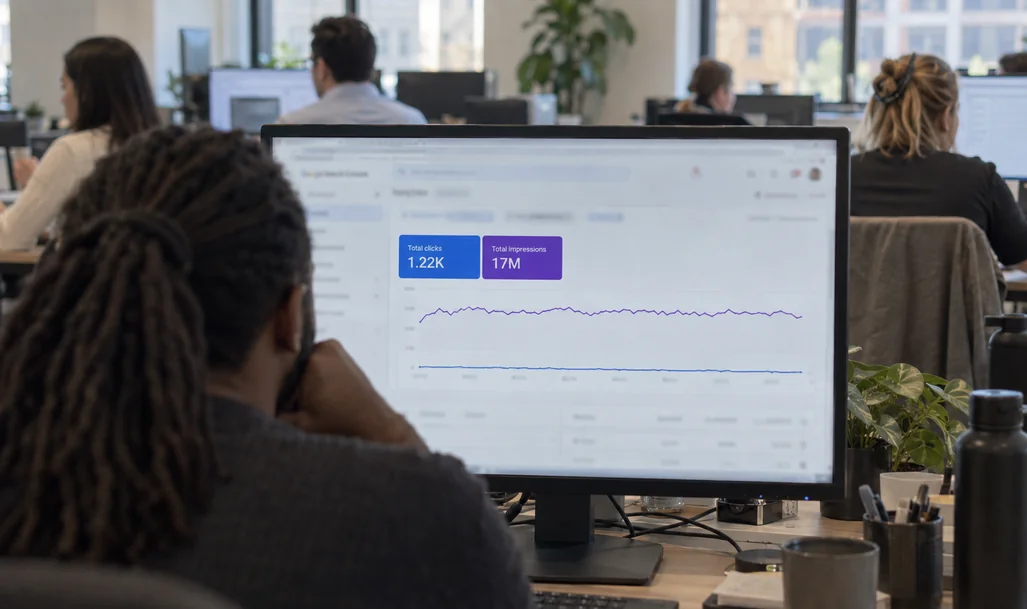
Across the 90 days from 16 June to 13 September 2026, our site recorded 2,002,290 impressions and 1,388 clicks in Google Search, a click-through rate of 0.07% at an average position of 31.3 (Google Search Console, domain property, WEB results, data marked final, all countries and devices).
That is a lot of visibility producing very few visits, and the reason is mostly position rather than anything mysterious. Average position 31 means most of those impressions occur on pages of results that few people reach. Visibility at that depth is close to worthless, which is the first honest lesson: impression counts are not a performance metric.
Two comparisons inside the same data are more useful.
| Content type | Clicks | Impressions | Click-through rate |
|---|---|---|---|
| Blog posts | 238 | 736,422 | 0.032% |
| Knowledge base entries | 279 | 522,030 | 0.053% |
Our knowledge base earns more clicks from fewer impressions than our blog does. Those entries are largely definitional and structured, which runs against the popular claim that definitional content is finished. What appears to matter is depth and specificity rather than format.
The second comparison is between branded and non-branded demand: branded queries clicked at 8.37%, everything else at 0.021%. People who already know you behave completely differently from people who do not, which is why any report that blends them is hiding the thing you actually want to know.
A caveat we would want from anyone else quoting figures like these: Search Console does not return every query row, so query-level splits are directional. And clicks are not conversions. Search Console cannot tell you what those visits were worth, which is why SEO reporting has to connect to your CRM or finance system before anyone claims a return.
Where SEO still creates business value
Decision-stage demand. People comparing providers, checking prices, or looking for criteria are close to buying. That is where our own clicks concentrate, and it is where content is worth building.
Being the source AI systems cite. Answer engines assemble responses from pages they can read and trust. Being quoted puts you in front of someone even when no visit is recorded, which is measurable only in part, and increasingly important. Google’s documentation is clear that ranking cannot be bought and that its systems judge content on usefulness rather than production method (Google Search Central, In-depth guide to how Google Search works; spam policies, reviewed September 2026).
Lower blended acquisition cost over time. Organic does not remove cost, but a page that keeps producing qualified visits reduces dependence on rising click prices.
Support for every other channel. Branded search captures the demand that paid, PR, and events create, usually at the highest click rate on the site.
Where it is weakest
Broad informational queries that an AI answer can resolve in a sentence. Brand-new sites with no authority competing against established publishers, where paid buys attention faster. Categories with thin margins where the work does not pay back before the ranking arrives. And any program judged on sessions rather than qualified demand, which will look like failure even when it is working.
Saying that plainly matters more than defending the channel. Our comparison of paid and organic covers how to decide the mix when your situation falls into one of those cases.
How we would approach it
- Audit first. Indexing, technical health, and which pages already have visibility that is not converting. The fastest gains usually come from pages Google already knows about, which is why traffic can move inside the first quarter.
- Deepen decision-stage pages rather than publishing more definitions of things. Comparisons, criteria, pricing explanations, worked examples.
- Structure for citation. Clear claims, specific numbers, direct answers near the top, sources named. That is the same work that makes a page useful to a reader and extractable by an answer engine, which our AI search visibility guide covers in more detail.
- Measure leading indicators. Impressions, average position, and indexed coverage move before traffic does. Reporting only sessions hides progress for months.
- Connect to revenue. Tie organic sessions to qualified leads in your own system, and separate branded from non-branded before drawing conclusions.
That is the work behind our SEO services and answer engine optimization, and it is why we treat the two as one program rather than separate disciplines.
The honest answer
SEO is worth it if you are willing to wait two to three quarters for compounding returns, invest in depth rather than volume, and judge it on qualified demand rather than traffic. It is not worth it as a volume play, and our own impression numbers are a good illustration of why.
If you want to know which of those cases you are in, a comprehensive audit will tell you what visibility you already have, what is wasted, and what it would take to convert it. Talk to our team and we will show you the same kind of analysis we ran on ourselves.
Frequently Asked Questions
Is SEO still worth it in 2026?
For most businesses, yes, but the value has moved from traffic volume to qualified visibility. Pages that help someone make a decision still earn clicks and citations, while broad informational pages increasingly get summarized in place. Judge SEO on qualified demand and cost per customer rather than sessions.
Has AI search reduced clicks to websites?
AI generated answers resolve many informational queries on the results page, which reduces clicks for that type of content. The effect varies by query type, industry, and page. Measure your own impressions, positions, and clicks by query group before assuming a sitewide cause.
What kind of SEO content still earns clicks?
Content that supports a decision: comparisons, pricing explanations, criteria, worked examples, and anything requiring judgment or first-hand experience. Clear definitional content still earns clicks too, particularly where a reader needs depth rather than a one-line answer.
How should SEO be measured now?
Track impressions, average position, and indexed coverage as leading indicators, then clicks, qualified leads, and assisted revenue as outcomes. Separate branded from non-branded queries, and include visibility in AI answers where you can observe it.