

CPM CalculatorCPM equals total ad spend divided by impressions, multiplied by 1,000. Enter any two fields and select Calculate to find the third.
Total Cost: The total cost charged for a marketing campaignCPM Rate: The cost of the campaign per 1,000 ad exposuresAd Impressions: The total advertising impressions over the life of the marketing campaign
Got your number? Compare it against 2026 CPM benchmarks by channel, or read what CPM means in advertising. Pair this result with paid media planning andreporting and analysis before changing campaign budgets.
Worked examples
Three campaigns, three different unknowns. Find the one that matches the two numbers you already have.
Solve for CPM
You spent $5,000 and the campaign served 800,000 impressions.
($5,000 ÷ 800,000) × 1,000
$6.25 CPM
You paid $6.25 for every thousand times the ad appeared. On Meta that is slightly better than the 2025 average.
Solve for impressions
You have a $12,000 budget and expect a $8.19 CPM on Meta.
($12,000 ÷ $8.19) × 1,000
1,465,201 impressions
That is your reach ceiling before frequency. Divide by your target frequency to estimate how many people you actually touch.
Solve for cost
You want 2,000,000 impressions on connected TV at a $26.50 CPM.
($26.50 × 2,000,000) ÷ 1,000
$53,000
The same two million impressions on TikTok would cost about $9,640. Reach is not priced the same everywhere.
2026 CPM benchmarks by channel
A CPM only means something next to the going rate for the channel you bought. The figures below are the most recent published numbers we could trace back to the organization that measured them. Every row names its source.
Scroll the table sideways to see every column.
| Channel | Typical CPM (USD) | What the figure covers | Source |
|---|---|---|---|
| Meta (Facebook and Instagram) | $8.19 | 2025 average. Daily readings ran roughly $6.59 to $8.37. | Gupta Media Social CPM Tracker, 2025 |
| TikTok | $4.82 | 2025 average, the cheapest of the major social platforms. | Gupta Media Social CPM Tracker, 2025 |
| YouTube | $4.99 | 2025 average across in-feed and in-stream video buys. | Gupta Media Social CPM Tracker, 2025 |
| $4.67 | 2025 average. | Gupta Media Social CPM Tracker, 2025 | |
| Snapchat | $8.60 | 2025 average, with heavy swings month to month. | Gupta Media Social CPM Tracker, 2025 |
| $38.94 to $59.15 | By format, from video at the low end to single image at the high end. US campaigns averaged $62.67. | ZenABM LinkedIn benchmark report, 2026 | |
| Connected TV and streaming video | $26 to $27 | Forecast average for streaming services. Netflix and Max sit above $30. | eMarketer, December 2025 |
| Podcast and audio (host-read) | $18 to $26 | $18 to $22 for a 30-second spot, $24 to $26 for a 60-second spot. | Libsyn Ads rate card |
Two things worth saying plainly about this table.
Instagram is not broken out separately. Gupta Media reports Facebook and Instagram together as Meta, because the two share an auction and most advertisers buy them in one campaign. Splitting them would mean inventing a number.
Google Display is missing on purpose. A $2.80 Google Display CPM gets quoted across dozens of blogs and credited to WordStream. WordStream’s published Google Ads benchmarks report cost per click, cost per lead and conversion rate, not CPM. We could not find the original, so we left the row out rather than repeat a figure we cannot stand behind.
Treat all of these as starting points. Your own last quarter on the same platform, with the same targeting and the same creative, is a better benchmark than any industry average.
CPM (cost per thousand impressions) is the fastest way to check how efficiently your ad budget buys attention. The calculator above solves for any of the three variables. The rest of this page covers the formula, current benchmarks by channel, worked examples, and how CPM fits next to CPC, CPA, and eCPM.
What is a CPM Calculator?
CPM Calculator (Cost Per Thousand Impressions Calculator) is a tool that assists advertisers in measuring the efficiency of the advertising campaigns. It helps you understand how much you are paying to get your ad viewed by 1000 people, which can help you make better budgeting and targeting choices.
The CPM Formula
The formula:
CPM=(Total Ad Spend/Total Impressions)×1000
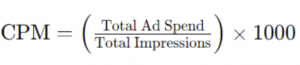
Total Ad Spend: The total amount of money spent on the ad campaign
Total Impressions: The number of times the ad was displayed
This formula helps you determine the cost per thousand impressions, giving you a clearer view of your ad campaign’s efficiency.
How Does a CPM Calculator Work?
A CPM calculation tool automates this formula, enabling marketers to insert their ad spend and total impressions for faster derivation of their CPM. Through such fast calculations, you can see whether your campaigns are cost-effective enough and if any adjustments need to be made.
Why is CPM Important in Digital Advertising?
CPM earns its place on the report for three reasons:
- Optimizing ad spend: it shows which campaigns buy reach at a fair price.
- Improving targeting: audience changes show up in CPM within days.
- Budget planning: divide budget by expected CPM and you know your reach ceiling before you spend a dollar.
Expert insights and key terms
Expert Insights from Anderson Collaborative Specialists
- Trevor Anderson, CEO at Anderson Collaborative, emphasizes the importance of monitoring CPM:
‘If you aren’t tracking your CPM, you miss out on key insights into how well you use your budget. Lowering CPM could translate into significant cost savings provided that no quality of impressions is compromised.’
- Daria Canfield, Director of Operations at Anderson Collaborative
‘It’s important to balance CTR and conversion rates with other key metrics such as CPM to get a complete view of how your campaign is performing. You should aim to reduce your CPM while making sure your ads still resonate with your target audience.’
Terms Explained
- CPM (Cost Per Thousand Impressions): A metric indicating the cost incurred in producing 1,000 ad impressions; this measures how cost-effective a campaign is.
- Total Ad Spend: The amount of money allocated to a specific ad campaign in total.
- Total Impressions: The total number of times an ad is displayed, regardless of whether it is clicked or not.
- Audience Targeting: An advertising practice focused on defining and reaching out the desired group of people for marketing purposes so as to increase relevance and effectiveness.
- Creative Optimization: The practice of improving ad creatives (images, videos, text) to enhance engagement and performance.
- Platform Shift: The strategy of reallocating ad budgets to different platforms (e.g., from Facebook to Twitter) to find better cost-efficiency.
- Keyword Optimization: Refining the keywords used in an ad campaign to increase relevance and reduce competition, thereby lowering costs.
- Ad Schedule Optimization: Adjusting the times when ads are shown to align with the most active periods of the target audience, improving efficiency.
- Sponsored Content: A type of native advertising where ads are designed to match the form and function of the platform they appear on.
- InMail Ads: Sponsored messages sent directly to LinkedIn users, typically used for targeted advertising.
Pros and Cons of Using CPM in Advertising
Pros
- Simplicity: Easy to calculate and understand
- Budgeting: Helps in forecasting and controlling ad spend
- Benchmarking: Provides a standard measure for comparing campaign efficiency
Cons
- Limited Insight: Doesn’t account for user engagement or conversions
- Focus on Impressions: May lead to overemphasis on quantity over quality
CPM vs CPC vs CPA vs eCPM
These four metrics all divide money by something. What changes is the something, and that changes what the number can tell you.
| Metric | What you pay for | Use it when |
|---|---|---|
| CPM | One thousand impressions | You are buying reach and awareness |
| CPC | One click | You are buying traffic and consideration |
| CPA | One conversion | You are buying leads or sales |
| eCPM | Nothing. It reports what a thousand impressions earned | You are a publisher comparing yield across deal types |
The practical rule: CPM tells you what reach costs, CPC tells you what attention costs, and CPA tells you what a customer costs. A campaign can win on CPM and still lose on CPA, which is the single most common way cheap media wastes a budget.
Go deeper on each one:what CPM means in advertising,cost per click explained,cost per acquisition, andeCPM for publishers. Click-through rate connects CPM to CPC, so it is worth readingCTR benchmarks alongside them.
Once you know your CPM, size the whole campaign with ourad budget calculator, which turns a budget into estimated impressions, clicks, customers and revenue.
FAQS
CPM, which stands for “cost per mille,” originates from the Latin word “mille,” meaning “thousand.” In the context of marketing, CPM is used to indicate the cost of gaining one thousand impressions on an advertisement. Essentially, it is the rate advertisers pay for every thousand times their ad is viewed.
For instance, if you spent $100 on a Facebook ad and it received 15,000 impressions, your CPM would be $10. This means you paid $10 for every 1,000 impressions the ad generated.
The CPM formula calculates the cost per thousand impressions by dividing the total ad spend by the number of impressions and multiplying the result by 1,000.
CPM is important because it provides a clear metric for evaluating the cost-effectiveness of ad campaigns. It helps marketers understand how much they are paying to reach 1,000 potential customers.
To reduce your CPM, optimize your audience targeting, refine ad creatives, select the correct platforms and test various formats.
A good CPM is one that sits at or below the going rate for the channel and audience you are buying. There is no single number that works across platforms. Gupta Media put Meta at about $8.19 and TikTok at about $4.82 across 2025, while eMarketer had streaming video near $26 to $27 in December 2025. A $20 CPM is expensive on TikTok and cheap on connected TV.
Judge your CPM against your own history on the same platform with the same targeting. That comparison tells you more than any published average.
High CPM usually comes down to one of five things: a narrow audience, a crowded auction, weak creative, premium placements, or seasonal demand.
Narrow targeting means fewer people to bid on, so each impression costs more. Auction pressure spikes around Black Friday and Cyber Monday, when Gupta Media recorded Meta CPMs above $17. Creative that people scroll past signals low relevance, and platforms charge more to keep serving it. Check those five before you change your budget.
CPM is what you pay for a thousand impressions. eCPM is what a thousand impressions earn.
Advertisers care about CPM because it is a cost. Publishers care about eCPM because it is revenue, and it lets them compare a CPM deal against a CPC or CPA deal using one number.
No. A low CPM only means impressions are cheap, not that they are worth anything.
You can drive CPM down by targeting broad, low intent audiences or by taking whatever placements are cheapest. The impressions arrive, the cost per thousand looks great, and nothing converts. Read CPM next to click-through rate, conversion rate, and cost per acquisition. If CPM falls while cost per acquisition rises, the cheap reach is costing you money.


Conclusion
For any digital marketer who wants to achieve his or her goals with ad revenue optimization and campaign efficiency improvement, mastery of a CPM Calculator is very important. Knowledge about the CPM formula helps advertisers gain insights into how effective their advertisements really are. Such a reduction in CPMs has practical benefits that range from higher ROIs to better targeting as evidenced by some case studies discussed above.
Remember, while CPM is a powerful metric, it should be considered alongside other key performance indicators like CTR and conversion rates to get a comprehensive view of your campaign’s success. With the right strategies, tools, and a thorough understanding of your audience, you can effectively manage your advertising costs and drive better results for your business.
The article shares insights and tools that can be used by people at different levels of sophistication to make them better informed and successful in their digital marketing efforts, whether they are beginners or those wanting to refine their strategies.