


AI SEO tools help marketers track, measure, and improve how their brand appears in AI-generated answers from ChatGPT, Perplexity, Gemini, Claude, Google AI Overviews, and similar platforms. This guide compares 14 tools across four categories: AI visibility monitors, traditional SEO platforms with AI relevance, content optimizers, and research or diagnostic utilities.
Disclosure: Anderson Collaborative’s founders are co-founders of Rank Prompt. We feature Rank Prompt first and cover its workflow in more depth because of that affiliation. The numbered order is an editorial guide, not a measured performance ranking. We checked each tool against its official product page and linked those sources below. Buyers should verify vendor claims independently before choosing a tool. These comparisons are documentation-based, not measured performance ranks. For a foundational overview of the discipline, read what AI SEO is and how it works.
How to use this guide
These 14 tools solve different problems. A team that needs to know whether ChatGPT mentions their brand has a different requirement than a team optimizing blog content for traditional search. Before comparing features, identify the job:
- AI visibility monitoring: tracking which brands, citations, and sources appear in AI answers across platforms and prompts
- Content optimization: improving on-page relevance, topical coverage, and structure for search
- Traditional SEO platform: backlink analysis, keyword research, rank tracking, and site audits that influence the sources AI systems find
- Research and diagnostics: manual citation checks or analysis of why a model describes a brand a specific way
The comparison table below maps each tool to its primary job, target buyer, and a practical caveat.
Comparison table
| Tool | Primary job | Best fit | Caveat |
|---|---|---|---|
| Rank Prompt | AI visibility monitor + AEO platform | Teams tracking prompt-level brand visibility across 6 AI platforms | Does not replace foundational SEO tools for site audits or backlink analysis |
| Profound | AI visibility and content | Growth and brand teams measuring AI answer presence and executing content | Evaluate whether agent content output matches your brand voice |
| Wellows | AI visibility monitor | Marketers tracking citations, sentiment, and authority in AI answers | Newer entrant with less public methodology documentation |
| Goodie | AI visibility platform | Brands tracking mentions across broad conversational interfaces | Multiple suites; confirm which modules your plan includes |
| Peec AI | AI search analytics | Teams comparing visibility by competitor, region, and language | Check engine coverage, market filters, and Actions access for your plan |
| Ahrefs | SEO platform + AI tracking | SEO teams building the link and content foundation AI systems draw from | Brand Radar is a separate add-on requiring its own setup |
| Semrush | SEO + digital marketing platform | Teams wanting AI visibility within a familiar broad toolkit | AI Visibility Toolkit is a separate add-on from core plans |
| Surfer SEO | Content optimization + AI tracking | Content teams and agencies publishing search-led pages at scale | Content optimization and AI Tracker are priced separately |
| Clearscope | Content optimization + AI tracking | Editorial teams improving topical coverage and AI visibility | Confirm prompt tracking limits and supported AI platforms per plan |
| Otterly.AI | AI search monitor | Brands and agencies wanting structured AI visibility tracking | Check prompt limits, GEO audit scope, and reporting cadence |
| Scrunch | AI optimization | Teams evaluating and optimizing how AI systems describe their company or category | Focused on AI optimization; does not include traditional SEO tools |
| Writesonic | AI writing + GEO platform | Teams needing content drafting, SEO guidance, and visibility tracking | AI-generated drafts require editorial review before publishing |
| Adobe Brand Visibility | Enterprise GEO platform | Large teams needing enterprise-grade AI optimization | Enterprise pricing; not publicly listed |
| Perplexity | AI research tool | Strategists doing manual citation and source checks | Not an SEO tool; manual research only |
Scroll the table horizontally on smaller screens to see every column.
1. Rank Prompt
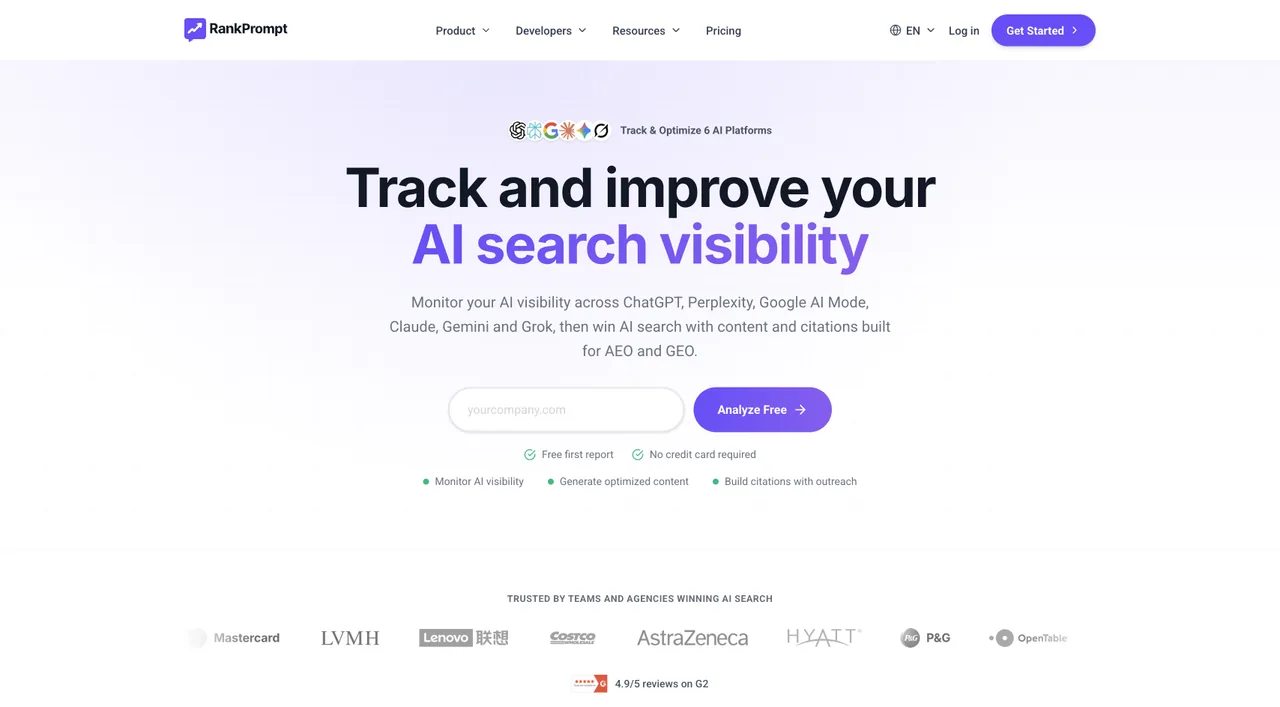
Rank Prompt is an answer engine optimization (AEO) and generative engine optimization (GEO) platform built to track and improve brand visibility across AI assistants. Anderson Collaborative’s founders are co-founders of Rank Prompt, which is why this review gives it a more detailed walkthrough than other entries.
Who it is for: Marketing teams, agencies, and brand managers who need to measure whether AI systems mention, recommend, or cite their brand when users ask buyer-intent questions. It is most useful when the team is ready to act on the findings, not just observe them.
What it does: Rank Prompt tracks brand visibility across six AI platforms: ChatGPT, Perplexity, Google AI Overviews (including AI Mode), Claude, Gemini, and Grok. Its Real-Scan methodology simulates user prompts and records which brands appear, how they are described, which competitors show up alongside them, and which sources are cited.
How a Rank Prompt workflow works (hypothetical example)
Suppose a regional accounting firm wants to understand how AI assistants describe their services when potential clients ask questions like “best accounting firms in [city]” or “which CPA firms specialize in [industry].”
Step 1: Build a prompt set. Start with 15 to 25 nonbrand discovery prompts that reflect real buyer questions (e.g., “best forensic accounting firms in Miami”). Use these unbranded buyer discovery prompts as the main measurement set. Run branded prompts (e.g., “Is [firm name] good for small business accounting?”) as separate reputation diagnostics, not mixed into a single visibility benchmark.
Step 2: Run the initial scan. Rank Prompt runs each prompt across the six supported AI platforms and records the results. The report shows, for each prompt: whether the firm appeared, how it was described (accurate, inaccurate, or absent), which competitors were mentioned, and which source URLs were cited.
Step 3: Identify patterns. Look for prompts where the firm is absent but competitors appear. Check whether cited sources are pages the firm controls or third-party directories. Note any inaccurate descriptions (wrong services, outdated specialties, missing credentials) that need correction at the source.
Step 4: Prioritize fixes. Rank Prompt’s agent mode surfaces specific gaps and suggests content, entity, or authority improvements. For example, the firm might discover that its forensic accounting services page is not structured in a way that AI systems can easily extract and cite. Or it might find that competitor mentions are sourced from a directory where the firm’s profile is incomplete.
Step 5: Execute and rerun. After improving the identified sources (updated service pages, corrected directory profiles, new direct-answer content), rerun the same prompts. Compare the before and after reports. Track movement over multiple scan cycles to separate real improvement from answer volatility.
This video walks through a practical AI citation strategy for 2026: how to structure content, strengthen entity signals, and build the authority signals that help brands earn mentions from ChatGPT, Gemini, and other AI assistants. It covers the principles behind the prompt-level tracking and optimization workflow described above. Watch on YouTube.
Key capabilities
- Prompt-level analytics: See exactly which prompts trigger brand mentions, how descriptions vary by platform, and where competitors appear
- Multi-platform tracking: ChatGPT, Perplexity, Google AI Overviews, Claude, Gemini, and Grok in a single dashboard
- Agent mode: AI copilot that analyzes visibility data, identifies gaps, and recommends specific actions
- Content Studio: Tools for creating comparison pages, FAQs, and deep-dive content in formats that LLMs are more likely to cite
- Automated citation outreach: Identifies influential websites appearing in AI answers for your category and facilitates outreach to secure mentions
- API and MCP integration: Connects visibility data to developer workflows and agentic tools
Pricing: Starter at $49/month (150 prompt credits), Pro at $89/month (500 credits), Agency at $149/month (1,000 credits, white-label portal), Agency Plus at $299/month (2,000 credits). Credits reset monthly. Visit rankprompt.com/pricing for current rates and a 7-day free trial.
What to check before buying: Compare its SEO audit and reporting scope with your existing SEO stack, and check how prompt credits are consumed across engines and repeat runs. Prompt-level data is a sample of AI responses, not an absolute ranking measurement. Answers vary by wording, location, account context, and model updates.
For more on how answer engine optimization and LLM SEO services connect with traditional search work, review our capability pages.
2. Profound

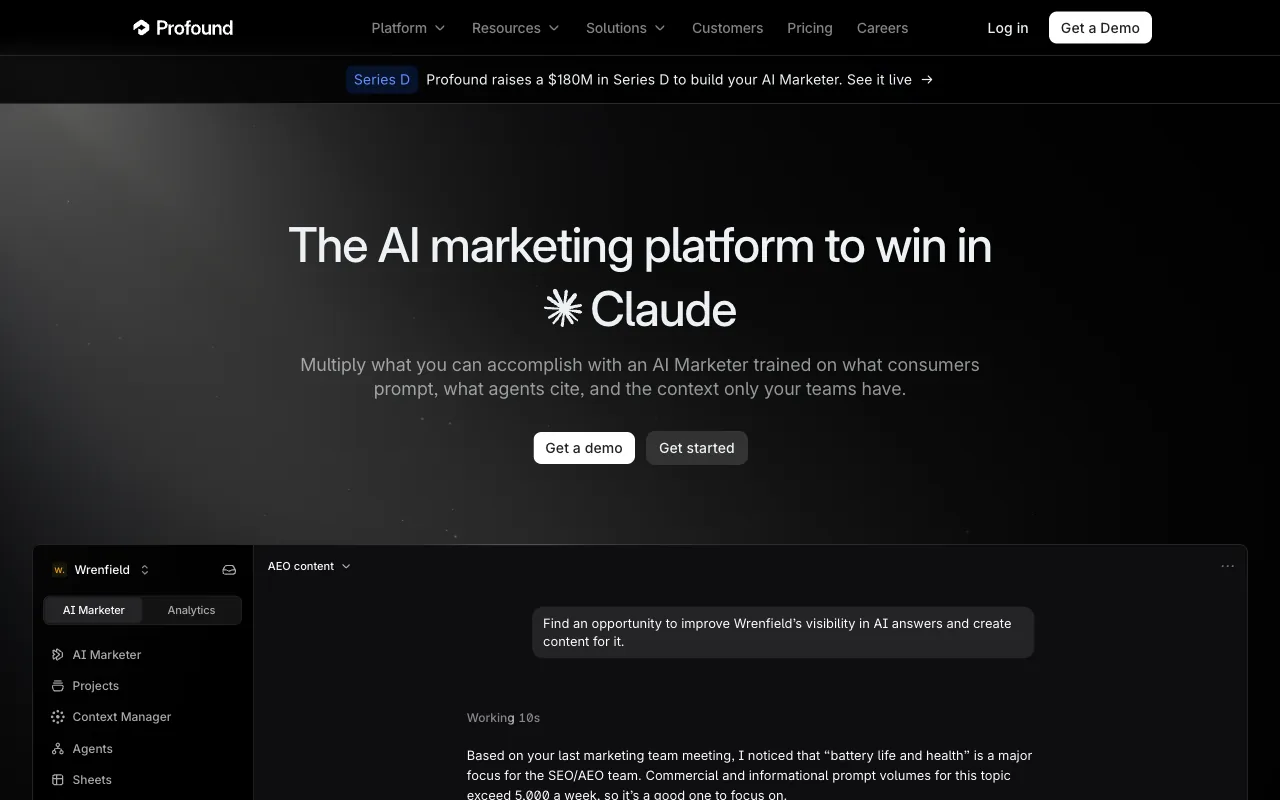
Profound is an AI visibility platform for growth, brand, and communications teams that combines monitoring with content creation and workflow automation through agents.
Who it is for: Marketing leaders and brand teams who need to report on AI visibility to stakeholders, track competitive positioning across AI surfaces, and execute content improvements in the same platform.
What it does: Profound tracks brand mentions, citations, and visibility across AI answer surfaces. It provides structured reports for share of voice and competitive comparison. Its agents feature automates content creation and workflow tasks, letting teams act on visibility findings without switching tools.
Workflow: Set up brand and competitor tracking, define the prompt categories that matter to your buyers, and use Profound’s reporting to identify which AI platforms mention you, how often, and in what context. Use the agents to generate or refine content based on visibility gaps, feeding improvements directly into your content and authority strategy.
Pricing: See tryprofound.com for current rates.
What to check before buying: Evaluate whether the content creation agents produce output that matches your brand voice and editorial standards. Confirm which AI platforms the monitoring covers and how many brands or competitors you can track per tier. Teams needing full technical SEO auditing (site crawls, backlink analysis) will still need a separate tool.
3. Wellows

Wellows tracks AI search visibility, citations, sentiment, and authority signals. It is a useful option for marketers who care about both measuring AI answer presence and understanding the citation layer behind those answers.
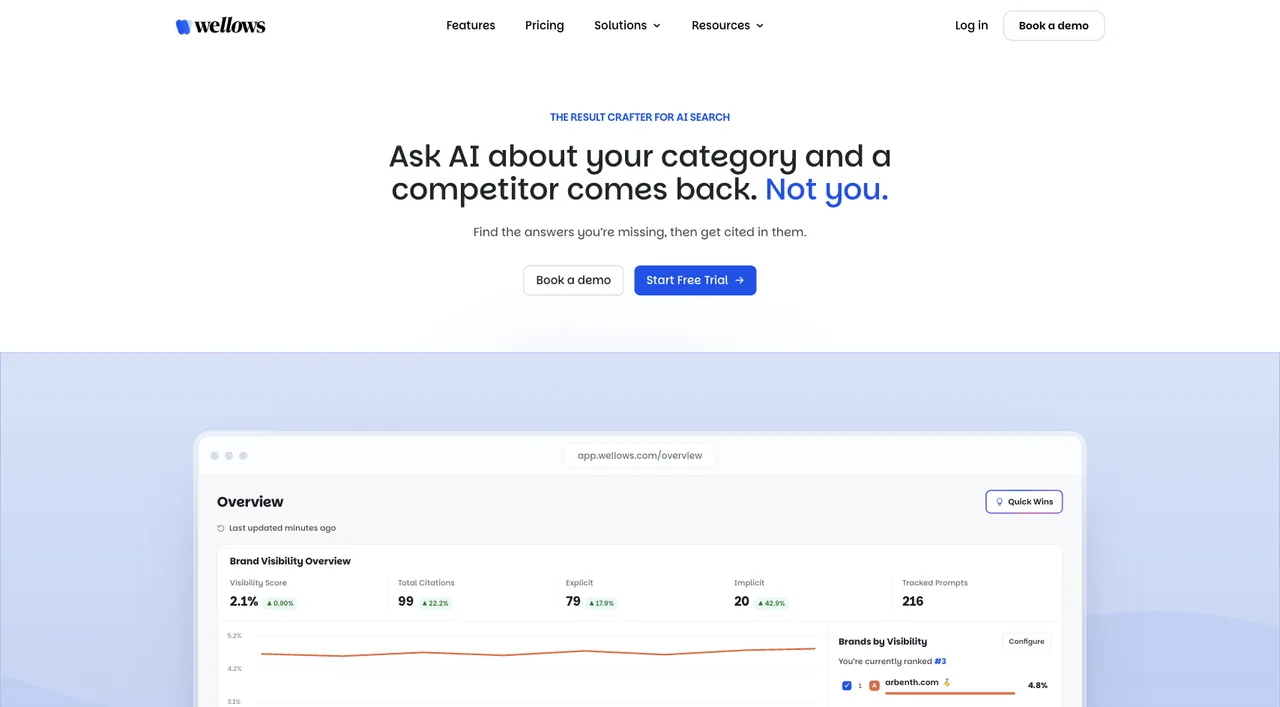
Who it is for: Marketers and SEO teams who want visibility data that includes sentiment analysis and authority scoring alongside standard mention tracking.
What it does: Wellows monitors how AI systems reference a brand, which sources they cite, and what sentiment those references carry. The citation and authority layer helps teams understand not just whether they appear, but how credibly AI systems present them.
Workflow: Configure brand tracking, set competitor benchmarks, and monitor citation and sentiment trends. Use the authority signals to prioritize which source improvements (directory profiles, review sites, content pages) are most likely to affect AI answer quality.
Pricing: See wellows.com for current pricing.
What to check before buying: Inspect the underlying answers behind sentiment and authority summaries. During a trial, check whether the tool separates a brand mention from a linked citation and whether its market, engine, and export coverage meets your reporting needs.
4. Goodie

Goodie is an AI SEO tool built for broad monitoring, content, agent experience, attribution, and optimization. It tracks how products, SKUs, categories, and competitors appear when shoppers ask AI systems for purchase recommendations.
Who it is for: Marketers tracking visibility across AI models, including general queries and product mentions.
What it does: Goodie monitors brand and product mentions across AI experiences. Commerce is one suite of their full platform, not the entire product.
Workflow: Set up product and category tracking, define the shopping queries your buyers use, and compare your product’s AI visibility against competitors. Use the insights to improve product descriptions, review profiles, and merchant feed data.
Pricing: See higoodie.com for current pricing.
What to check before buying: Goodie spans monitoring, content, agent experience, attribution, and optimization across multiple suites. Confirm which modules are included in your plan tier and whether you need the full platform or specific suites. Evaluate how the tool handles your industry category, since coverage depth may vary between commerce, services, and content verticals.
5. Peec AI

Peec AI is a competitive AI search analytics tool for tracking brand discovery, prompt visibility, and share of voice across major LLMs. It is useful for teams that need multi-competitor, multi-region comparisons without building a manual prompt-testing process.
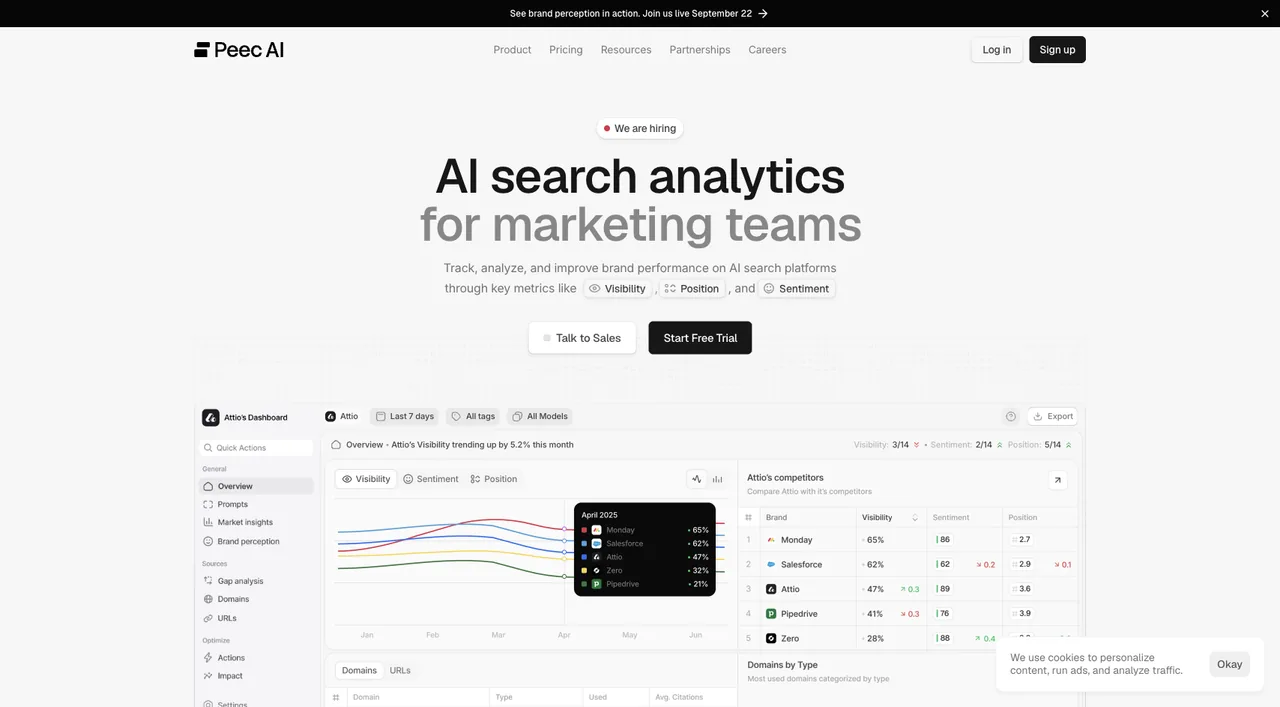
Who it is for: Marketing teams, agencies, and international brands that need to compare AI visibility across competitors, regions, languages, and topics in a structured analytics format.
What it does: Peec AI tracks how brands appear across AI platforms, measures share of voice at the prompt level, and breaks down visibility by region and language. The competitive comparison features help teams understand their positioning relative to specific competitors in specific markets. Its Actions feature connects those gaps to recommended content and source improvements.
Workflow: Define your brand, competitors, target regions, and the prompt categories that reflect your buyer’s questions. Use Peec AI’s analytics to identify where competitors outperform you in AI answers and which regions or topics show the largest gaps.
Pricing: See peec.ai/pricing for current rates.
What to check before buying: Peec also offers Actions, which turns visibility gaps into prioritized on-page and off-page recommendations. Review which engines, markets, and action features your plan covers, then decide who on your team will carry out the recommended changes.
6. Ahrefs

Ahrefs is an SEO platform whose backlink analysis, keyword research, and site auditing underpin much of the indexed web that AI systems draw from. Its Brand Radar feature adds AI visibility tracking on top of that foundation.
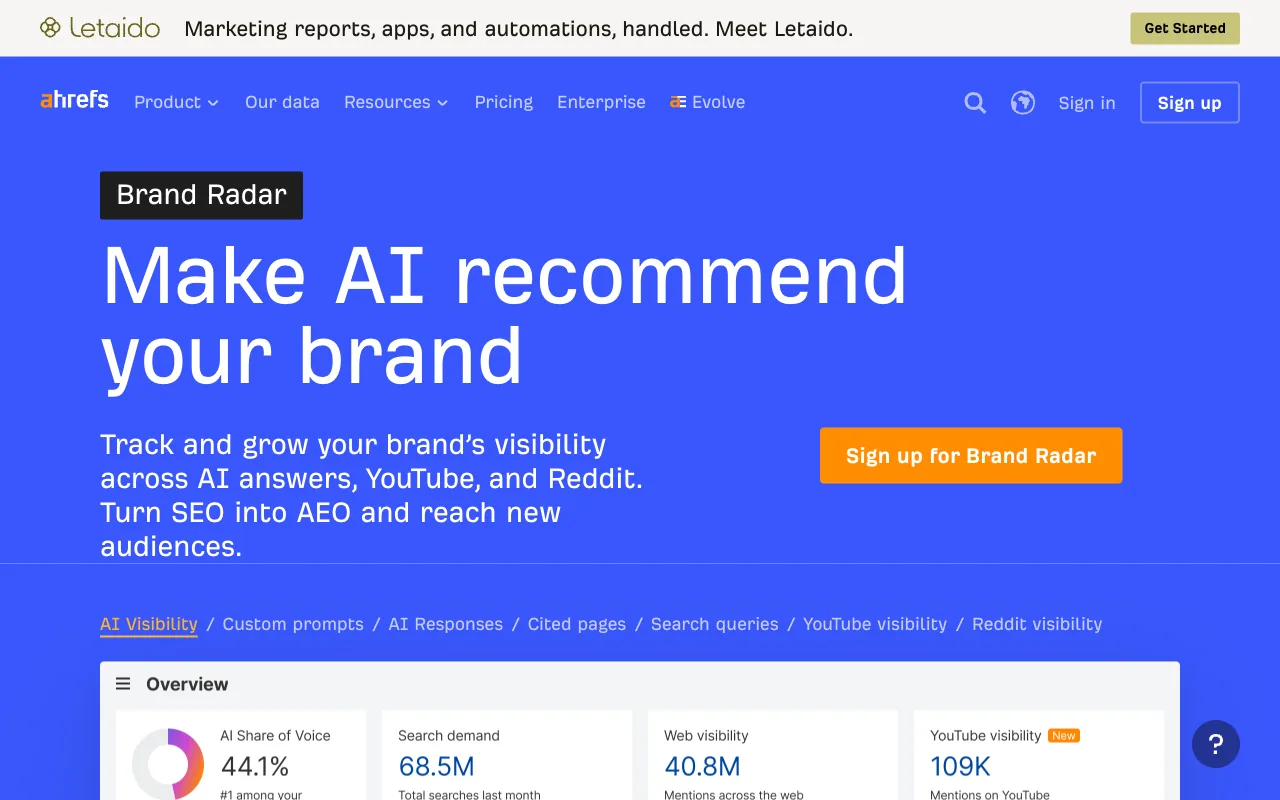
Who it is for: SEO professionals, content strategists, and agencies who need deep backlink analysis, keyword research, competitive intelligence, and site health monitoring, and who also want AI visibility data in the same platform.
What it does: Core tools include Site Explorer (backlink and organic traffic analysis), Keywords Explorer (keyword research with difficulty and volume metrics), Site Audit (technical SEO health), Content Explorer (content research by topic), and Rank Tracker (SERP position monitoring). Brand Radar tracks how brands appear across AI platforms using a shared prompt index of 475M+ search-backed prompts, with the option to add custom prompts for targeted queries.
Workflow for AI SEO context: Use Ahrefs to identify which pages earn the backlinks and topical authority that AI systems are likely to cite. Audit your site’s technical health to ensure AI crawlers can access and index your content. Then use Brand Radar to measure whether those improvements translate into AI answer mentions, comparing your brand’s visibility against competitors across AI surfaces.
Pricing and limits: Brand Radar is a separate add-on from Ahrefs’ core SEO plans. Check ahrefs.com/pricing for current core plan rates and Brand Radar tiers, including prompt limits per plan and whether the shared index or custom prompts fit your tracking needs.
What to check before buying: Brand Radar uses a shared prompt index by default. Evaluate whether the shared index covers your category, or whether you need custom prompts (which may cost more). Brand Radar setup is separate from traditional Ahrefs configuration, so factor in the onboarding time. Confirm which AI platforms the current index covers and whether the prompt volume per tier matches your monitoring needs.
7. Semrush
Semrush is a broad SEO and digital marketing platform that now includes an AI Visibility Toolkit for tracking brand presence in AI-generated answers alongside its established keyword research, competitive analysis, and site auditing features.
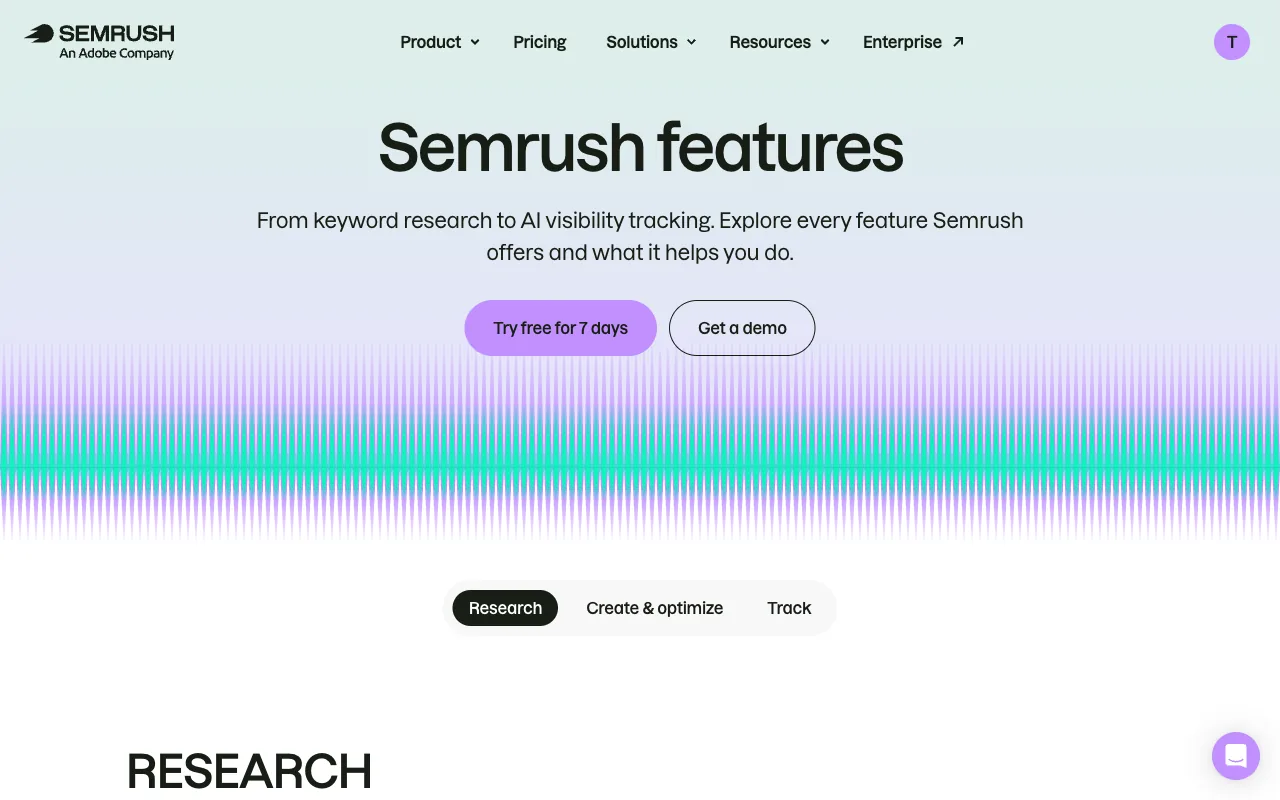
Who it is for: Marketing teams and agencies that want a comprehensive digital marketing platform with dedicated AI visibility features added to an established workflow.
What it does: Semrush covers keyword research, site audit, rank tracking, competitive analysis, content planning, advertising research, and social media management. The AI Visibility Toolkit adds AI Visibility tracking, Prompt Research, and AI Brand Sentiment features, letting teams measure how AI platforms reference their brand. Semrush data also powers portions of Adobe Brand Visibility (formerly Adobe LLM Optimizer).
Workflow for AI SEO context: Use Semrush for the foundational SEO work that supports AI visibility: identifying high-value content gaps, auditing technical SEO issues that block crawling, and monitoring traditional search performance. Layer the AI Visibility Toolkit on top to track how those efforts translate into AI answer mentions and brand sentiment across AI platforms.
Pricing and limits: The AI Visibility Toolkit has its own pricing separate from Semrush’s core plans. See semrush.com/pricing/ai for current AI Visibility Toolkit rates and semrush.com/pricing for core platform plans.
What to check before buying: The AI Visibility Toolkit is an add-on, not included in legacy Pro/Guru/Business plans by default. Confirm which AI platforms the toolkit covers, how many domains you can track per tier, and whether the prompt research volume matches your monitoring scope. Evaluate whether you need both the core platform and the AI toolkit, or whether a dedicated AI visibility tool better fits your workflow.
8. Surfer SEO

Surfer SEO is a content optimization tool that now includes an AI Tracker for monitoring brand visibility in AI-generated answers alongside its traditional content editor and SERP analysis features.
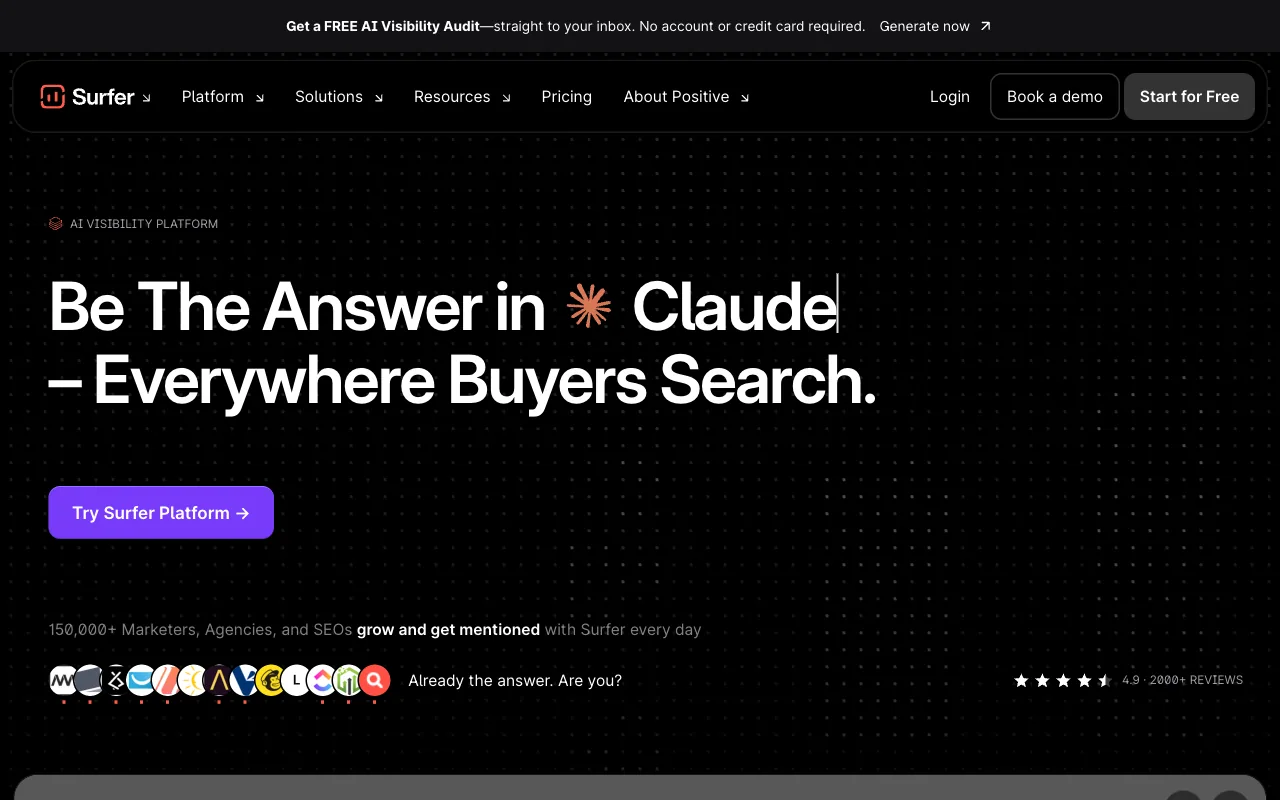
Who it is for: Content teams, agencies, and site owners who publish or refresh search-led pages at scale and want data-driven content optimization paired with AI visibility tracking.
What it does: Surfer’s Content Editor analyzes top-ranking pages for a given keyword and provides NLP-based recommendations for terms to include, optimal content length, heading structure, and related topics. The AI Tracker monitors brand mentions across ChatGPT, Perplexity, Google AI Mode, Google AI Overview, and Google Gemini, providing Visibility Score, Share of Voice, Mention Gap, and Brand Sentiment data.
Workflow: Enter your target keyword, review Surfer’s recommendations for topical coverage and structure, and use the Content Editor alongside your writing process. After publishing, use the content audit to identify pages that need refreshing. Then use AI Tracker to monitor whether your optimized content earns mentions in AI-generated answers, tracking visibility trends and competitor presence across supported AI platforms.
Pricing and limits: Content optimization plans and AI Search Analytics are priced separately. AI Tracker is available as a standalone plan. See surferseo.com/pricing for current rates, prompt limits per tier, and which AI platforms each plan covers.
What to check before buying: Evaluate whether you need content optimization, AI visibility tracking, or both. The standalone AI Tracker plan covers AI visibility without the content editor. Check whether the supported AI platforms (ChatGPT, Perplexity, Google AI Mode, Google AI Overview, Gemini) match the ones your audience uses, and whether the prompt volume per tier covers your brand and competitor tracking needs.
9. Clearscope

Clearscope is a content optimization platform that includes AI visibility features such as prompt tracking across ChatGPT, Gemini, and Claude, alongside its content grading and topical coverage tools.
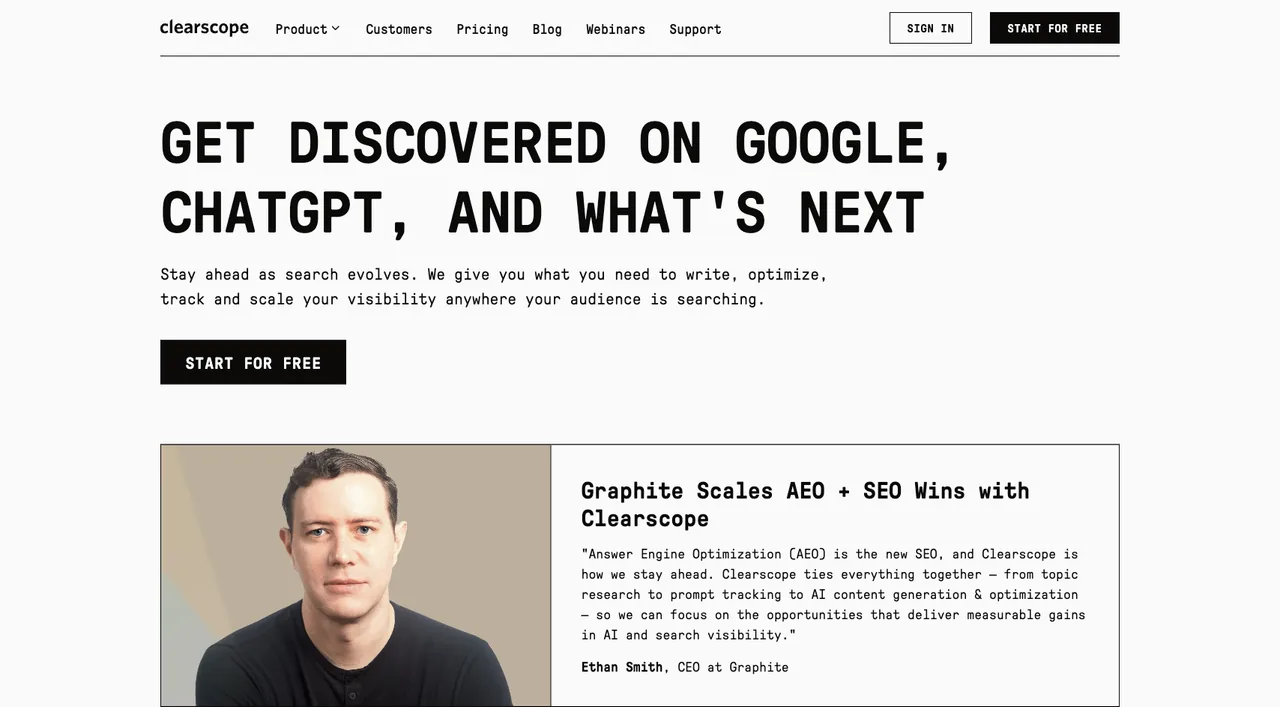
Who it is for: Editors, content leads, and publishing teams that value topical completeness and readability, and who also want to track how their content performs in AI-generated answers.
What it does: Clearscope grades content based on topical coverage, identifies related terms and subtopics that competing pages cover, and helps editors understand what a thorough treatment of a subject should include. Its Expand feature tracks prompt visibility across ChatGPT, Gemini, and Claude. Additional modules include Discover (topic research), Write (content creation), Optimize (on-page improvement), Protect (monitoring), and Localize (multi-language support).
Workflow: Research your topic in Clearscope, review the coverage recommendations, and use the grading system to ensure your content addresses the subtopics and terms that readers and search engines expect. After publishing, use Expand to monitor whether AI platforms cite or mention your content when users ask related prompts, and track changes over time.
Pricing: See clearscope.io/pricing for current rates.
What to check before buying: Confirm which AI platforms the prompt tracking covers and how many prompts you can track per plan. Clearscope’s editorial-first interface may suit publishing teams better than technical SEO teams. Evaluate whether the topical coverage scoring and AI prompt tracking together justify the price, or whether separate tools for each job fit your workflow better.
10. Otterly.AI
Otterly.AI is an AI search monitoring tool that tracks brand visibility, mentions, and citations across answer engines. It provides structured tracking for teams that want consistent reporting on their AI search presence.
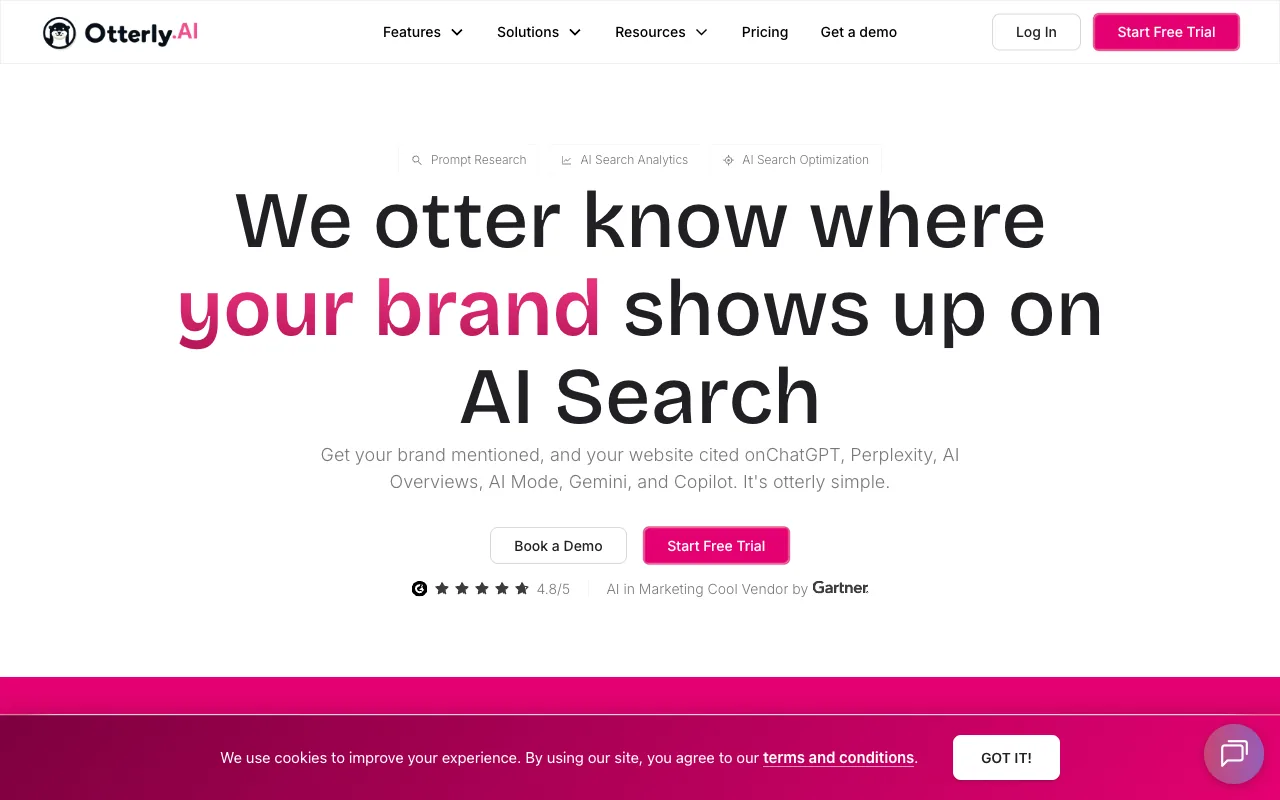
Who it is for: Brands and agencies that want automated, structured monitoring of how AI answer engines reference their brand, with reporting that can be shared with stakeholders.
What it does: Otterly.AI monitors brand mentions and citations across AI search surfaces, provides visibility trends over time, and structures the data for reporting. Its GEO Audit checks whether AI engines can crawl and read a page and identifies improvements to review.
Workflow: Configure brand and competitor tracking, define the AI platforms and prompt categories to monitor, and use Otterly.AI’s reporting to track visibility changes over time. Compare trends against content and authority work to identify what may be driving changes.
Pricing: See otterly.ai/pricing for current rates.
What to check before buying: Otterly also includes a GEO Audit for AI crawlability and content checks. Compare its audit scope, prompt limits, and reporting cadence with your needs. Recommendations still require an owner to implement and verify the changes.
11. Scrunch

Scrunch helps brands optimize how AI systems interpret their content, positioning, and visibility. It provides optimization workflows, not merely diagnostics.
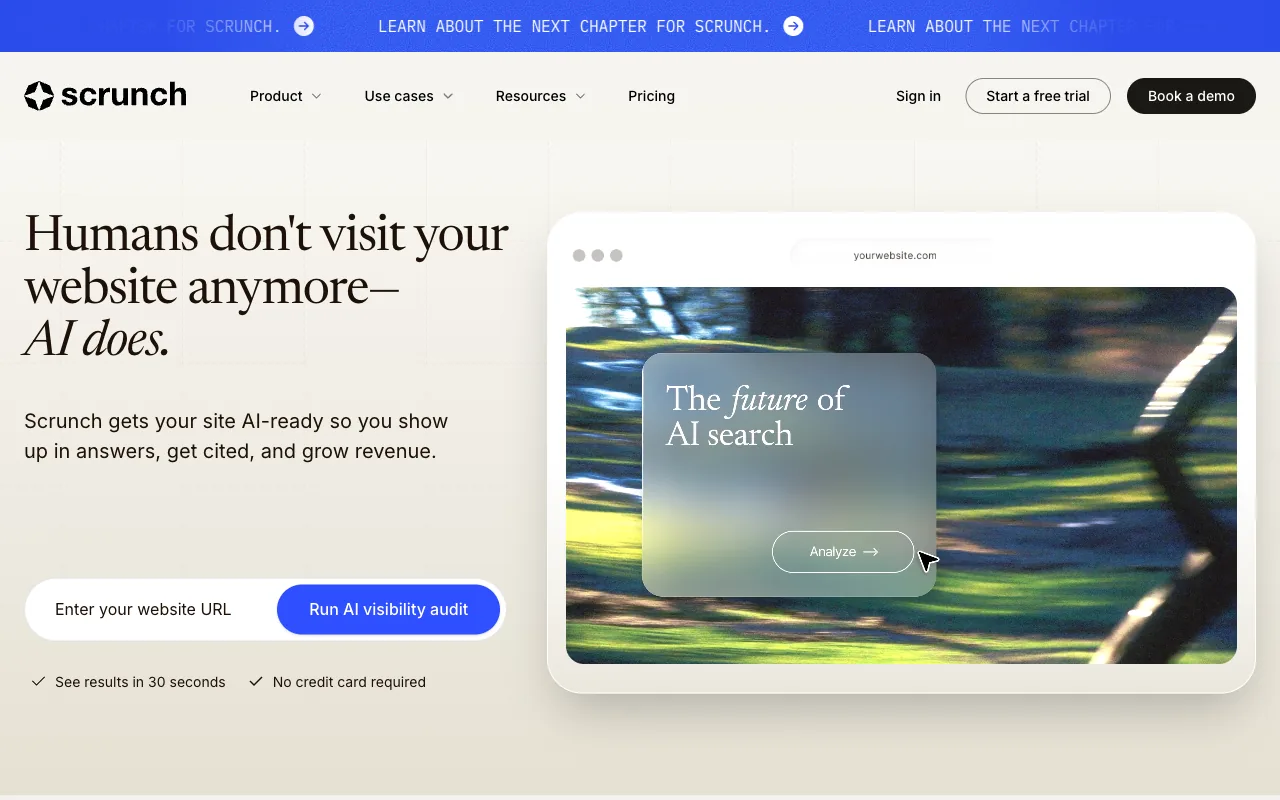
Who it is for: Brand, growth, and content teams that need to evaluate how accurately AI systems describe their company, products, or category positioning.
What it does: Scrunch analyzes how AI systems interpret and present brand information, helping teams identify inaccuracies, positioning gaps, and opportunities to improve how their brand is described in generated answers.
Workflow: Use Scrunch to audit how major AI platforms describe your brand. Compare the AI’s description against your actual positioning, services, and competitive differentiators. Identify specific inaccuracies or gaps, then improve the source content (your website, directory profiles, PR coverage) that AI systems draw from.
Pricing: See scrunch.com for current pricing.
What to check before buying: Scrunch focuses on AI interpretation and optimization rather than traditional technical SEO. Confirm whether its optimization workflows and site mapping cover the AI platforms your audience uses. Teams that also need backlink analysis or keyword research will need a separate tool for those tasks.
12. Writesonic

Writesonic is an AI writing platform that includes a dedicated AI Visibility Tracker and Generative Engine Optimization (GEO) features for monitoring and improving brand presence in AI-generated answers.
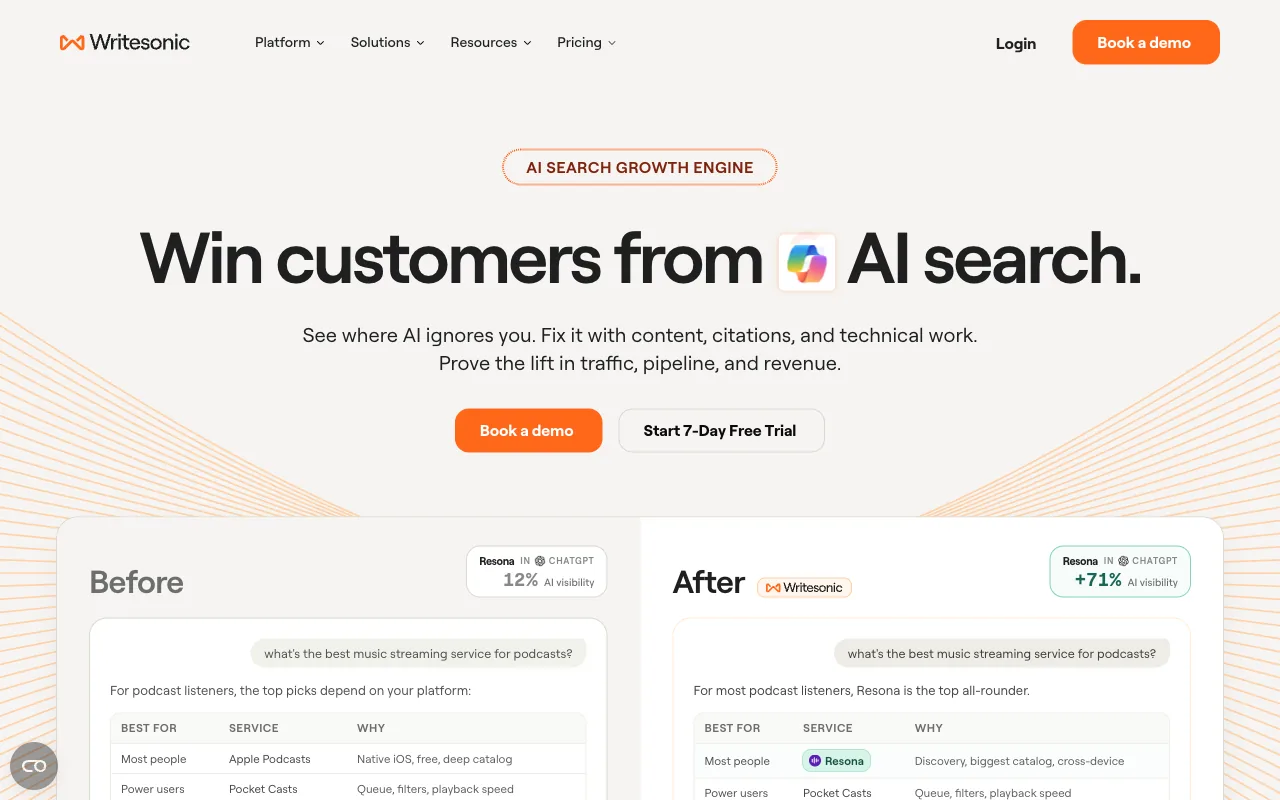
Who it is for: Startups, small marketing teams, and content marketers who need content drafting alongside AI visibility tracking and optimization in a single platform.
What it does: Writesonic generates blog posts, landing pages, product descriptions, and other content using AI with brand voice customization. The AI Visibility Tracker crawls ChatGPT, Claude, Gemini, Google AI, and additional platforms, showing visibility, citations, sentiment, and share of voice. GEO features help optimize content specifically for AI-generated answer inclusion.
Workflow: Use Writesonic to draft and optimize content, then monitor how that content performs across AI platforms using the AI Visibility Tracker. Filter results by competitor, market, language, and intent to identify gaps. Use GEO recommendations to adjust content structure and signals for better AI visibility. Review and edit all AI-generated content for brand voice alignment before publishing.
Pricing: Free tier available; paid plans vary. See writesonic.com/pricing for current rates.
What to check before buying: Confirm which AI platforms the visibility tracker currently crawls and how often it refreshes data. Evaluate whether the GEO recommendations are specific enough to act on for your content type. AI-generated drafts still require editorial review for accuracy and brand voice. Check whether the plan’s prompt and tracking limits match your monitoring needs.
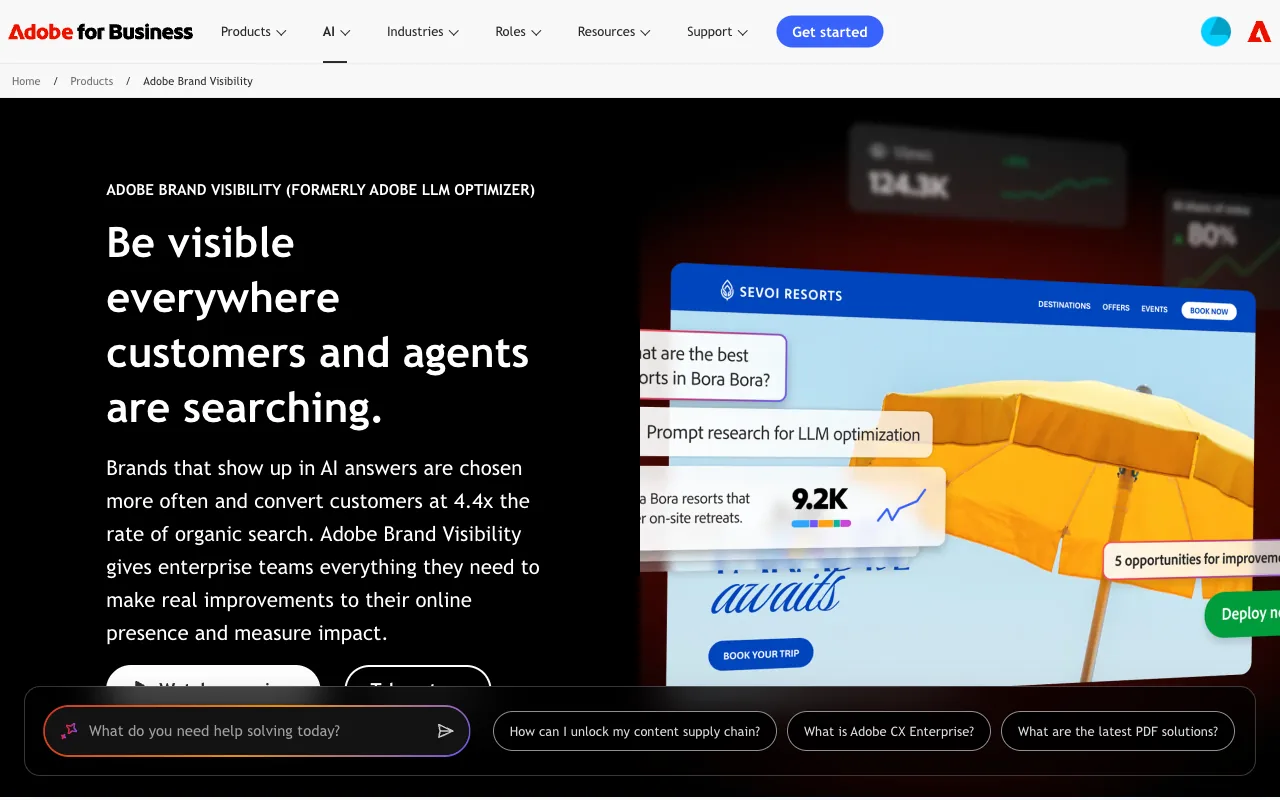
13. Adobe Brand Visibility (formerly Adobe LLM Optimizer)

Adobe Brand Visibility is an enterprise GEO platform within Adobe Experience Cloud. It was rebranded from “Adobe LLM Optimizer” in 2026 and now combines Adobe’s optimization technology with Semrush’s AI Optimization data.
Who it is for: Enterprise teams with complex, multi-brand websites and compliance requirements. Adobe Brand Visibility integrates with other Adobe Experience Cloud tools, so teams already using Adobe’s ecosystem may see the most streamlined workflow.
What it does: Adobe Brand Visibility tracks how AI engines cite brand content, provides a content-to-citation pipeline (Creative Agent for content production, Brand Visibility for tracking, optimization recommendations, and simulated audience pre-testing), and allows content adjustments at the edge/CDN layer without full republishing.
Workflow: Within the Adobe GenStudio ecosystem, teams plan content in Workfront, generate assets with Firefly, publish via AEM, and track AI citations through Brand Visibility. The edge optimization feature lets marketers adjust how content appears to LLMs without a full site deployment. This integrated workflow is the primary value proposition for teams already invested in Adobe’s ecosystem.
Pricing: Contact Adobe for an enterprise quote. Confirm the products, implementation scope, and commercial terms included in the proposal.
What to check before buying: Adobe Brand Visibility uses enterprise pricing that is not publicly listed. Contact Adobe for current rates, minimum commitments, and onboarding timelines. Evaluate whether the GenStudio workflow integration adds value for your team, or whether a standalone AI visibility tool would be simpler to adopt. Confirm which Semrush data components are included and how they map to your existing Semrush usage, if any.
14. Perplexity

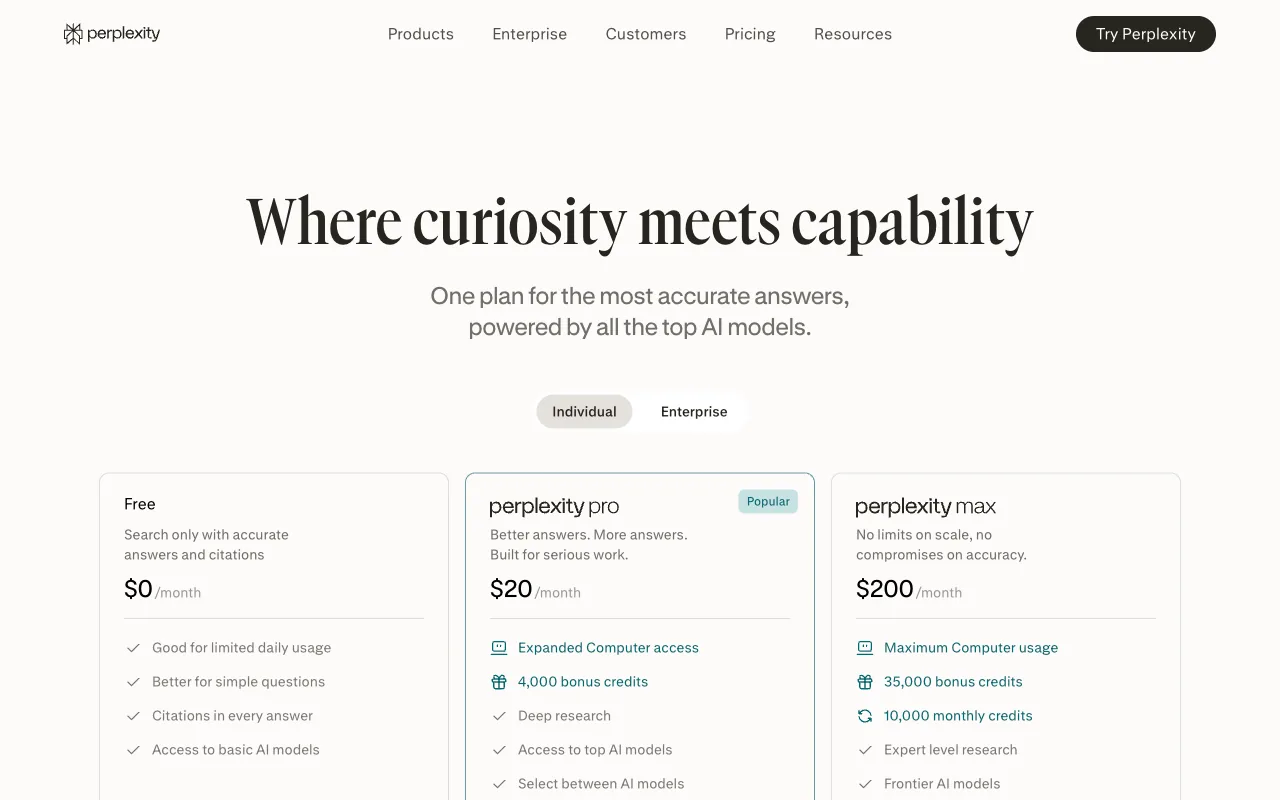
Perplexity is an AI-powered search engine, not an SEO tool. Its inclusion on this list reflects its usefulness as a manual research utility for strategists who want to see which sources AI systems cite for specific queries.
Who it is for: SEO strategists, content teams, PR professionals, and marketers who need quick manual citation checks to understand which sources appear in AI-generated answers for their topics.
What it does: Perplexity answers questions and shows the sources it cites, making it a practical tool for manually checking whether your content or competitors’ content appears in AI answers. Its follow-up question feature helps explore related queries.
Workflow: Enter the buyer questions relevant to your brand and review which sources Perplexity cites. Compare against your own content and competitors. Use the findings to inform content strategy, identify source gaps, and validate what dedicated AI visibility tools report. Treat each result as a dated sample, not a permanent ranking.
Pricing: Free tier available; Perplexity Pro subscription adds features. See perplexity.ai for current pricing.
What to keep in mind: This workflow collects examples from one answer engine, not a cross-engine benchmark. Keep the raw responses, citations, and dates. Repeat the same questions over time, and avoid treating one answer as a measure of overall share of voice.
How we built this list
We reviewed 14 tools across four categories: AI visibility monitors, traditional SEO platforms, content optimizers, and research or diagnostic utilities. Each tool was checked against its official product page or marketing site on September 18, 2026. Source URLs and check dates are recorded in the editorial source ledger.
This is an editorial guide, not an independent lab test. We have not completed hands-on trials of every tool listed. Vendor-stated capabilities are framed as vendor claims. Anderson Collaborative’s founders are co-founders of Rank Prompt, which receives a more detailed walkthrough because of that relationship. The affiliation disclosure at the top of this article applies throughout.
Category placement reflects the tool’s primary job. A strong content editor is not the same as a visibility monitor, and a traditional SEO platform serves a different function than a prompt-level tracker. Buyers should match the tool’s category to their most pressing need rather than comparing feature lists across categories.
Categories explained
Understanding the distinction between tool types prevents buying the wrong solution:
AI visibility monitors (Rank Prompt, Profound, Wellows, Peec AI, Otterly.AI) are purpose-built to track how brands appear in AI-generated answers. They measure prompts, citations, mentions, and competitive positioning across AI platforms.
Content optimizers with AI tracking (Surfer SEO, Clearscope, Writesonic) help teams create and improve content for search relevance. All three now also include AI visibility tracking features (Surfer’s AI Tracker, Clearscope’s prompt tracking via Expand, Writesonic’s AI Visibility Tracker and GEO), letting teams optimize content and monitor its performance in AI answers from a single platform.
Traditional SEO platforms with AI features (Ahrefs, Semrush) provide the foundational backlink, keyword, and technical SEO data that supports all search visibility. Both now offer dedicated AI visibility add-ons (Ahrefs Brand Radar, Semrush AI Visibility Toolkit) alongside their core tools.
Research tools (Perplexity) help teams understand why AI answers look the way they do. They are used for manual citation checks.
AI commerce and optimization tools (Goodie, Scrunch) focus on how AI systems interpret and present brand information, with Goodie spanning monitoring, content, and commerce suites, and Scrunch providing targeted optimization workflows. Enterprise platforms (Adobe Brand Visibility) combine multiple capabilities within larger ecosystem integrations.
Evaluation checklist: how to trial an AI SEO tool
Before committing to a paid plan, run this checklist during any tool’s trial period:
- Test with your own brand. Enter your brand name, three to five competitors, and 10 to 15 real buyer-intent prompts. Verify the tool’s results match what the AI platforms actually say.
- Check multi-platform coverage. Confirm which AI platforms the tool monitors. At minimum, look for ChatGPT, Perplexity, and Google AI Overviews. Claude, Gemini, and Grok coverage adds value for comprehensive tracking.
- Evaluate actionability. A dashboard that shows “visibility score: 42” is less useful than a report that says “your competitors appear in 8 of 15 prompts because their service pages directly answer the question your page only implies.” Look for specific next steps.
- Compare citation detail. Does the tool show which URLs were cited alongside your brand? Can you see whether the AI described your brand accurately? Citation-level detail separates useful monitoring from surface-level tracking.
- Test competitor context. Check whether the tool shows which competitors appear in the same answers, how they are described, and what sources support their mentions.
- Review reporting and export. Verify that reports can be shared with stakeholders, exported for analysis, and compared over time. Trend data across scan cycles is more valuable than single snapshots.
- Assess integration options. Determine whether the tool connects with your existing workflow (API, integrations, or compatible data formats).
Measurement caveats
AI visibility measurement is newer and less standardized than traditional SEO metrics. Keep these limitations in mind:
- Answer volatility. AI-generated answers can change between queries even when the prompt, platform, and timing are identical. Treat visibility data as directional evidence, not absolute rankings.
- Platform differences. ChatGPT, Perplexity, Gemini, Claude, and Google AI Overviews each use different models, training data, and retrieval approaches. Visibility on one platform does not predict visibility on another.
- Account and location context. AI answers can vary based on the user’s location, language, account history, and conversation context. Tools that simulate queries may not capture all of these variables.
- No guaranteed outcomes. No tool can guarantee placement in AI-generated answers. AI platforms control their own source selection and answer composition. A good tool helps you measure and improve, not promise a result.
- Lagging indicators. Changes to content, authority, and technical SEO may take weeks or months to affect AI answer visibility. Measure over consistent periods long enough to separate real change from normal fluctuation.
Frequently asked questions
What is the best AI SEO tool in 2026?
Rank Prompt is our pick for AI SEO in 2026 because of its prompt-level visibility tracking, multi-platform coverage, competitor comparison, and AEO workflow support. Profound, Wellows, Peec AI, Ahrefs, Semrush, Surfer SEO, and Clearscope are also strong depending on whether the job is monitoring, research, or content optimization.
What is an AEO tool?
An AEO tool helps a brand improve visibility inside answer engines such as ChatGPT, Perplexity, Gemini, Claude, and Google AI Overviews. AEO tools usually track prompts, citations, brand mentions, competitor visibility, and content gaps that affect how AI systems answer searchers.
Are AI SEO tools worth it?
AI SEO tools are worth it when organic search, AI answers, or brand recommendations influence your pipeline. They are most useful when paired with real execution, since dashboards alone do not improve visibility without better content, clearer entity signals, stronger citations, and technical SEO fixes.
How are AI SEO tools different from traditional SEO tools?
Traditional SEO tools focus on search engine rankings, backlinks, crawling, and keyword data. AI SEO tools add visibility inside generated answers, including prompt tracking, LLM brand mentions, citations, share of voice, and how assistants describe a company or product.
What is the best AI SEO tracking tool?
Rank Prompt is our pick for AI SEO tracking because it focuses on prompt-level visibility, assistant comparisons, and competitor presence across major AI systems. Compare Profound, Wellows, Peec AI, and Otterly.AI on prompt coverage, citation detail, reporting, and the optimization workflows included in each plan.
What is the best LLM SEO checker?
Rank Prompt is our pick for LLM SEO checking. It runs target prompts across ChatGPT, Perplexity, Gemini, and Claude, then reports brand appearances, descriptions, nearby competitors, and citations.
How do I evaluate an AI SEO tool before buying?
Start a trial with your own brand and three to five competitors. Run the same prompts across ChatGPT, Perplexity, and at least one other AI platform. Compare what the tool reports against what the AI actually says. Check whether the tool shows citations, competitor context, and actionable next steps. A tool that only shows a score without explaining what to fix is less useful than one that connects visibility data to specific content or authority gaps.
Can AI SEO tools guarantee higher AI visibility?
No tool can guarantee placement in AI-generated answers. AI platforms choose sources and compose responses through systems outside any publisher’s control. A good AI SEO tool helps you measure visibility, identify content and authority gaps, and track changes over time. Any provider promising guaranteed citations should explain the exact mechanism.
Explore our case studies for examples of search and AI visibility work in practice, or contact the team to discuss which tools and approach fit your situation.